
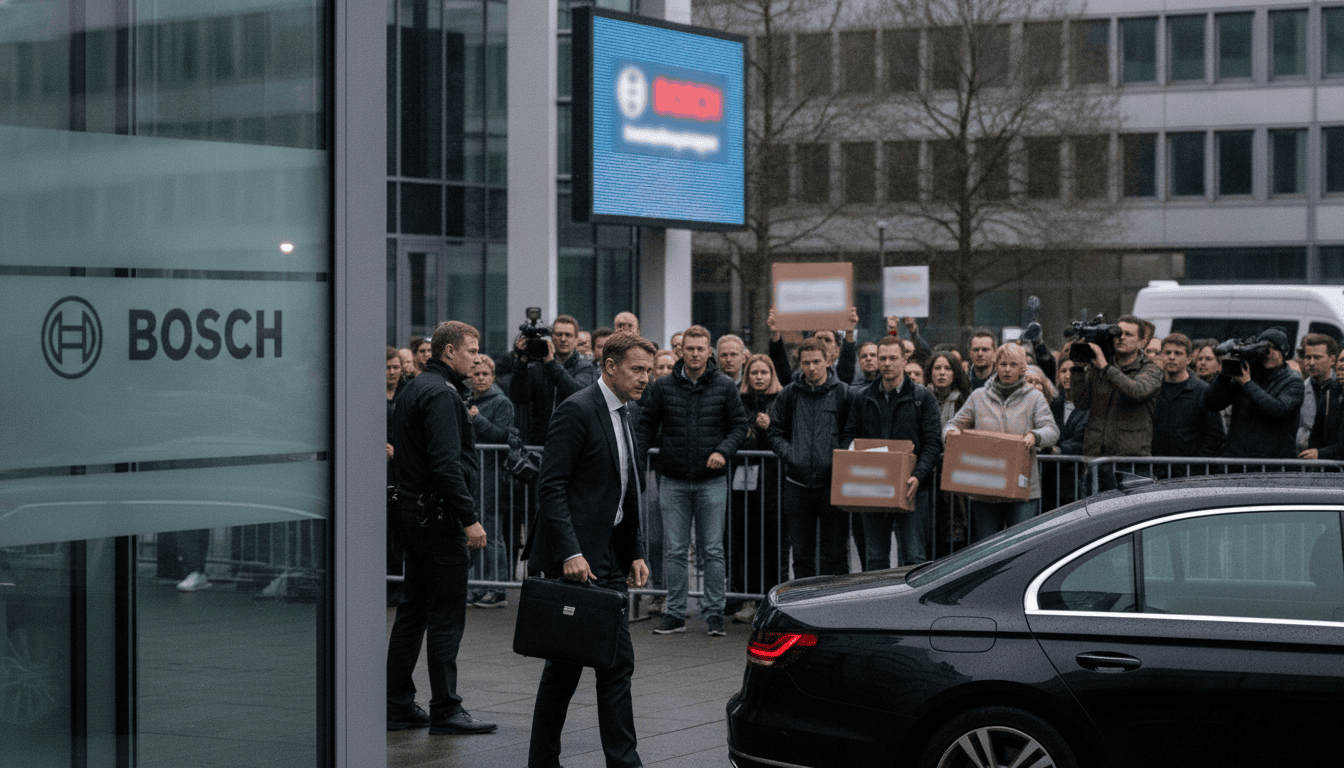
Bosch leadership shock as Stefan Hartung exits amid mass job cuts and partnership setbacks
Bosch faces renewed upheaval after CEO Stefan Hartung’s abrupt exit amid job cuts and strategic setbacks, leaving Christian Fischer a major turnaround task.
Immediate fallout from Hartung’s departure
Stefan Hartung stepped down as Bosch’s chairman of the management board in late June 2026, a move that surprised employees and industry partners. The announcement and the effective end of his tenure were separated by only a few days, underscoring the abrupt nature of the leadership change. Bosch has presented the departure as a change of responsibility, but internal and market observers view it as a forced exit tied to deeper strategic concerns.
The rapid timeline deprived Hartung of time to hand over ongoing negotiations and to brief key customers, intensifying uncertainty across divisions. His departure comes less than a year after a contract extension and amid a broader, unfinished corporate overhaul. The abruptness has amplified questions about governance and succession planning at the world’s largest auto supplier.
Scale of restructuring and financial pressures
Bosch’s leadership shake-up follows a program of sweeping restructuring that includes the elimination of nearly 28,000 jobs in Germany, part of a cost-cutting effort to turn around profitability. The company also endured its first annual loss in many years, a financial strain that has placed the board under pressure to demonstrate decisive results. Those twin pressures — heavy personnel reductions and disappointing financials — have framed the leadership debate at the highest levels.
Executives and analysts say the scale of the job cuts reflects the depth of the transformation Bosch believes is necessary to remain competitive amid electrification and software-driven mobility. Yet the reductions also have raised concerns about institutional knowledge loss and the company’s capacity to execute large-scale technology programs while streamlining its workforce.
Breakdown of a key automated-driving partnership
Weeks before Hartung’s resignation, Volkswagen ended a high-profile collaboration with Bosch to develop advanced automated-driving systems, citing divergent strategic priorities for the next stage of artificial intelligence development. The termination of the partnership highlighted a shortfall in Bosch’s ability to meet automotive OEMs’ expectations for rapid, scalable AI solutions. For many inside and outside Bosch, the split illustrated where recent leadership had struggled to deliver.
The loss of the VW engagement has concrete commercial implications and serves as a signal to other carmakers and potential partners about Bosch’s competitive position in software-defined vehicle systems. It also sharpens the mandate for the incoming leadership to reestablish trust with large automakers and to demonstrate a clearer path to faster, iterative development cycles.
Boardroom dynamics and the role of the Industrial Trust
The Robert Bosch Industrietreuhand and the supervisory board reportedly lost confidence that Hartung could reshape the nearly 140-year-old industrial group into a more agile technology company. Unlike prior departures, Hartung will not move into the influential Industrietreuhand circle, an indication of a decisive break with the corporate tradition of integrating outgoing chiefs into the shareholder structure. That departure from practice underscores a governance shift and a more activist approach by Bosch’s owners.
Board-level skepticism centered on whether the company’s hierarchical, engineering-focused culture could adapt quickly enough to the software-first demands of modern mobility. The governance bodies are now under pressure to pick a leader with a mandate to accelerate change without destabilizing core manufacturing operations.
Cultural barriers to speed and iterative delivery
Bosch’s engineering culture prizes technical perfection and comprehensive solutions, often favoring fully refined products over minimum-viable approaches. That mindset has historically produced high-quality, market-leading components but has also lengthened development cycles and driven up costs. In an era when automotive architectures evolve rapidly and clients expect continuous software updates, the insistence on near-complete solutions has become a liability.
Critics argue Bosch’s long development timelines require correspondingly high production volumes to amortize R&D, a business model less compatible with the fragmented, software-driven projects of today. To compete with nimbler players and OEMs that partner with startups, Bosch must adapt to iterative deployment methods and accept earlier market exposure for new systems.
Expectations for successor Christian Fischer
Christian Fischer, Hartung’s successor, inherits a company that must reconcile industrial scale with startup-like agility. Observers say his immediate tasks include repairing relationships with major manufacturers, streamlining decision-making, and accelerating software and AI development. Strategic partnerships with younger technology firms and a willingness to deploy 80-percent solutions — then refine them in real-world use — will likely be central elements of any credible turnaround plan.
Fischer also faces the delicate task of maintaining core manufacturing excellence while reshaping the company’s talent model and incentives to reward speed and cross-disciplinary collaboration. Already, Bosch has signaled interest in alliances with innovators, exemplified by a recent partnership in humanoid robotics, but those moves will need to be matched by internal reforms that enable faster product cycles.
Bosch now stands at a crossroads: the company must translate a painful restructuring into sustained strategic advantage without losing the engineering strengths that made it an industry cornerstone. The next months will test whether new leadership can stitch together agility and scale and restore confidence among customers, employees and the governing trust.
