
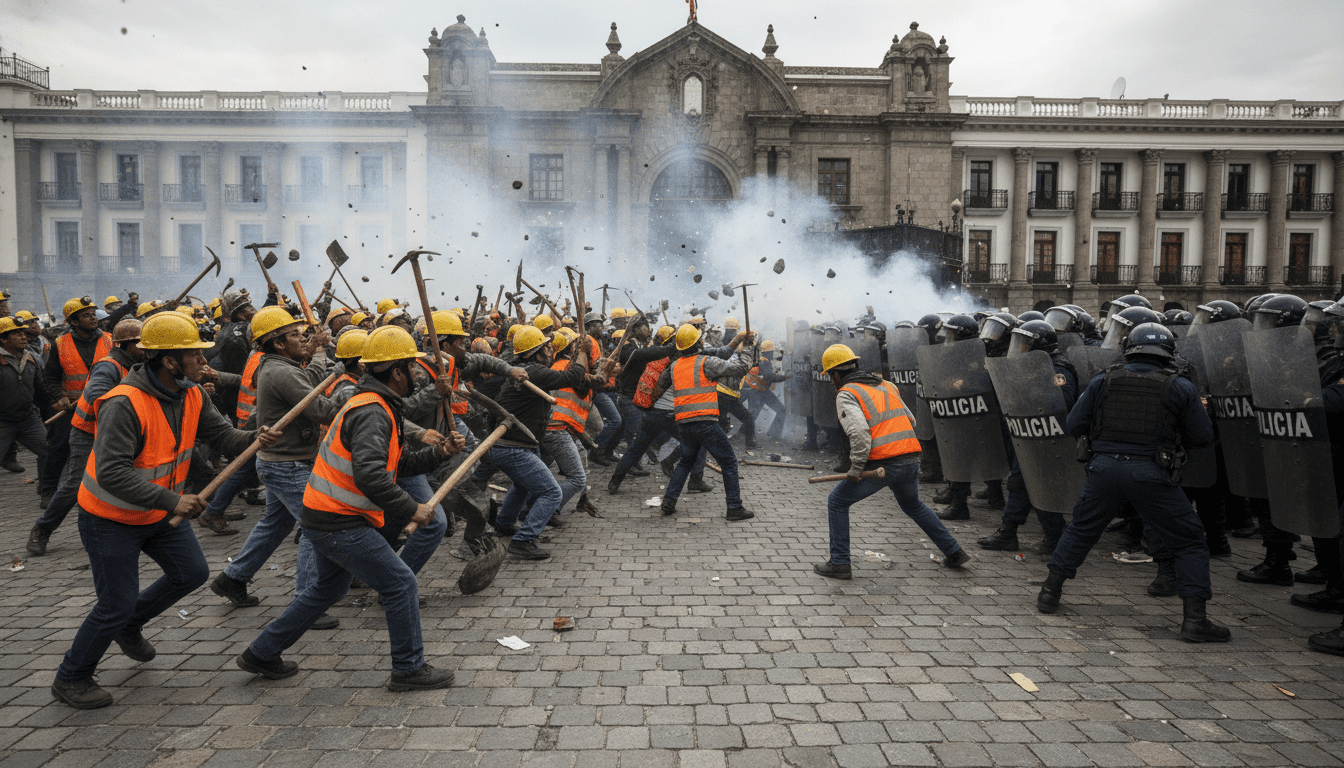
Bolivian miners protest in La Paz erupts into clashes as thousands attempt to storm government palace
Bolivian miners protest in La Paz turned violent as thousands clashed with police near the government palace, demanding labor reforms, fuel and the president’s resignation.
Clashes at the government palace in La Paz
A mass demonstration by Bolivian miners in La Paz escalated into violent confrontations with security forces as protesters attempted to advance on the government palace. Demonstrators sought to reach the central plaza outside the parliament and the presidential offices, prompting a heavy police response.
Authorities used tear gas to repel the crowd after reports that some demonstrators hurled explosives toward security lines, according to local media reporting. Officials sought to prevent the miners from breaching secure perimeters that protect seat-of-government buildings.
Scale and demands of the miners’ protest
Organizers and eyewitnesses said thousands of miners gathered in the city center on Thursday, initially mobilizing over demands for labor reforms and guaranteed fuel supplies. As the day progressed, the protest broadened and chants for President Rodrigo Paz’s resignation became more pronounced among participants.
Miners’ unions have framed the mobilization as a response to policy changes they say threaten employment and benefits that were secured under the previous administration. The mix of sector-specific grievances and wider political anger helped swell turnout and intensity.
Reported use of explosives and police tactics
Several local outlets reported that protesters threw dynamite sticks toward police positions during clashes, a claim cited by security sources and journalists on the scene. Police lines responded with tear gas and formations designed to prevent access to the central civic plaza.
Government spokespeople described the interventions as measures to protect public institutions and maintain order, while union leaders accused security forces of excessive force. Independent verification of the most serious allegations was limited amid chaotic scenes.
Political context: a shift from MAS to a new government
The protests come amid a broader political realignment in Bolivia following nearly two decades of rule by the Movement for Socialism (MAS). Rodrigo Paz, a Christian Democrat, assumed the presidency roughly six months ago and has pursued an agenda of economic opening and policy change.
Those policy shifts have provoked resistance from sectors that had benefited from MAS-era social programs, including many organized labor groups. The miners’ mobilization reflects deeper anxieties about the pace and direction of economic reform under the new administration.
Nationwide unrest and recent escalation
This confrontation is the latest episode in more than a week of unrest across the country, with multiple demonstrations targeting government policy in various regions. Protesters from diverse professions have staged roadblocks, strikes and public gatherings, increasing pressure on national institutions.
Observers say the pattern of protests suggests a coordination of grievances rather than a single-issue uprising, complicating efforts by authorities to negotiate localized settlements. The persistence of demonstrations has raised concerns about further disruption to public services and economic activity.
Response from unions and government officials
Union leaders called for renewed talks on wages, working conditions and fuel subsidies, while signaling their willingness to sustain pressure until demands are addressed. Some unions demanded immediate political concessions, including the resignation of President Paz, reflecting the radicalization of parts of the movement.
The government has offered to open channels of dialogue but framed certain actions—such as attempts to force entry into government buildings or use of explosives—as crossing legal lines. Negotiators on both sides face the challenge of restoring calm without conceding core positions.
The situation in La Paz remains fluid as authorities and union representatives assess next steps, with civic leaders warning of possible further mobilizations if talks do not progress. Observers say the crisis will test the new administration’s capacity to balance reform with social stability while debates over policy and political leadership continue to unfold.
