
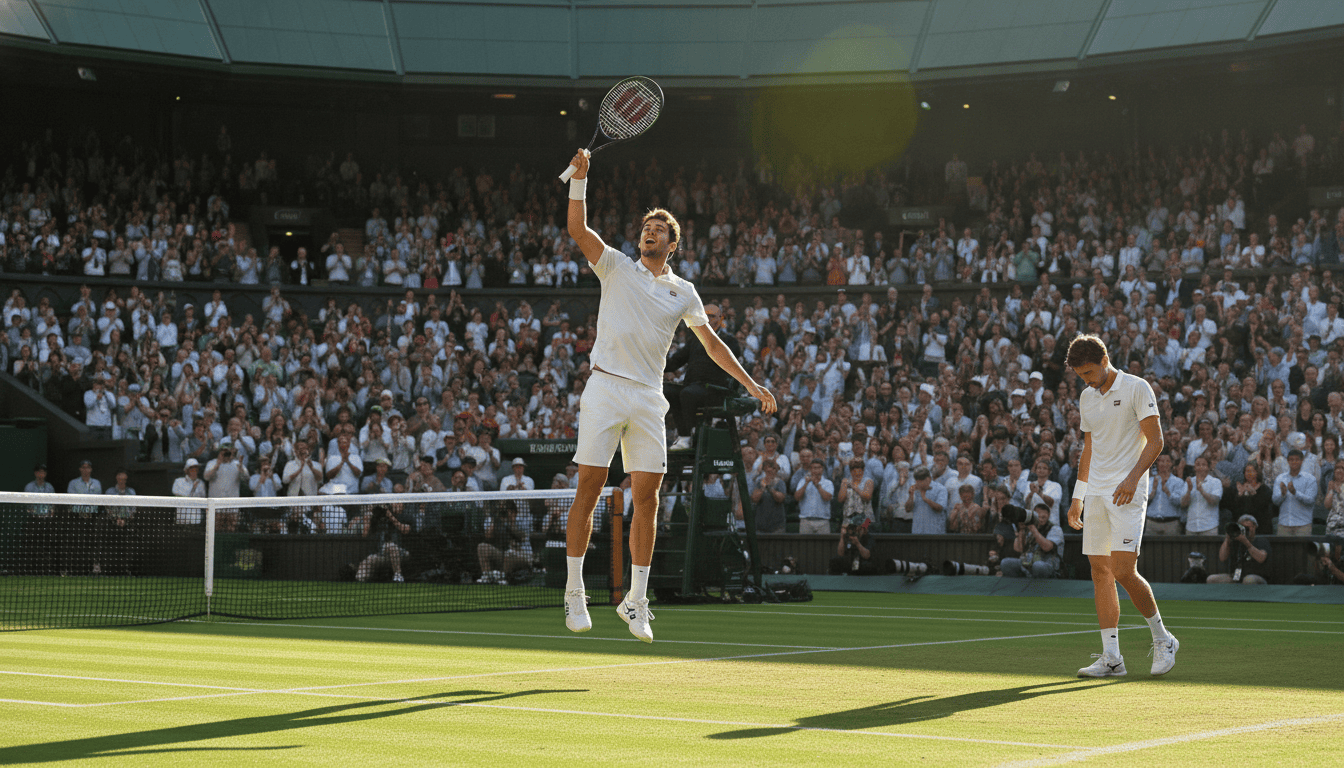
Zverev Ends Losing Streak, Reaches Wimbledon Semifinal After Straight-sets Win Over Fritz
Zverev beat Taylor Fritz 6-4, 6-4, 6-2 to reach the Wimbledon semifinal and will play wildcard Arthur Fery on Friday after a remarkable, surprise run.
Alexander Zverev reached the Wimbledon semifinal on Wednesday with a straight-sets victory over Taylor Fritz, ending a long run of head-to-head losses and cementing his status as one of the tournament’s form players. The freshly crowned French Open champion dominated on serve and return, closing out the match 6-4, 6-4, 6-2 and setting up a high-profile semifinal against British wildcard Arthur Fery. The result also marks the first time a German has advanced to the Wimbledon semi since Tommy Haas in 2009, a milestone that renewed local and national interest.
Match momentum swung early in Zverev’s favor
Zverev seized control by winning the early break that proved decisive in the opening set, reading Fritz’s serve and converting pressure into points. He chose to receive following the coin toss, a decision that paid off as he neutralised Fritz’s first deliveries and forced errors at crucial moments. The German’s offensive control and timely returns kept Fritz on the defensive, while Zverev maintained a high first-serve effectiveness across the contest.
Both players produced a steady stream of aces, but Zverev’s ability to win the longer exchanges prevailed when it mattered most. After an exchange of holds, Zverev manufactured a second-set break that left him two sets to the good, and he closed out the match with an efficient final set. Injury concerns briefly surfaced when Fritz sought treatment to his right knee, but Zverev sustained his level and closed the match with confident, well-timed aggression.
Arthur Fery completes one of Wimbledon’s biggest surprises
The other semifinalist, 21-year-old Arthur Fery, has become the story of the fortnight after defeating Flavio Cobolli 6-4, 7-6, 6-0 to advance. Ranked 114th in the world and largely unknown outside British tennis circles before the tournament, Fery reached the last four courtesy of a tournament wildcard and a string of composed performances. His progression makes him the second wildcard to reach a Wimbledon semifinal since Goran Ivanišević achieved the feat in 2001.
Fery’s run has captured public attention not only because of the unexpected results but also for the style and resilience he has shown under pressure. The former Stanford student has mixed aggressive serving with steady baseline play, and he has remained calm in tiebreaks and pivotal games. Organisers and spectators have welcomed the storyline of an emerging home player breaking through deep in a Grand Slam.
Historic markers for Zverev and Wimbledon
Zverev’s appearance in the semi represents a rare German presence in the tournament’s late stages and a personal vindication after recent challenges. He arrives at SW19 fresh from his first Grand Slam title at Roland Garros, the victory that redefined expectations for his season and seemingly altered the dynamic in matches against previous nemeses. His run to the last four at Wimbledon is the first by a German man at this stage in 14 years, underscoring the significance of his performance for national tennis.
Simultaneously, Fery’s achievement rewrites a portion of Wimbledon’s modern history by becoming the only wildcard since Ivanisević to reach the semis, reinforcing the tournament’s reputation for dramatic and unexpected breakthroughs. The pair of storylines—Zverev’s return to form and Fery’s breakout—has given this edition of Wimbledon a narrative of renewal and surprise.
Tactical adjustments and key statistics
Zverev attributed his turnaround to sharper serving and more aggressive forehand patterns, telling reporters he raised the pace and took initiative on key points. The match statistics bore that out: Zverev served a significant number of aces and kept a high first-serve win percentage, while also producing telling returns at pivotal moments. His decision to receive after winning the toss reflected confidence in his return game and set the tone for an assertive approach.
Fritz’s numbers suggested he was edged out in clutch situations despite a strong overall serving day, and his mid-match treatment for the knee may have disrupted his rhythm. Where rallies extended beyond the service exchange, Zverev’s ability to inject winners and shorten points proved decisive. The German’s controlled aggression and improved execution on break opportunities converted pressure into a straight-sets victory.
Other semifinal features defending champion Sinner and Djokovic
The tournament’s second semifinal paired Jannik Sinner, the defending champion and world No. 1, against Novak Djokovic, the record Grand Slam winner now aged 39. That matchup followed expectations and provided a counterpoint to the surprise presented by the Zverev–Fery pairing. Sinner’s consistency and Djokovic’s storied experience promise a contrasting style clash that rounds out a compelling final four.
Observers flagged the age and pedigree difference as a factor to watch, with Djokovic’s vast major experience set against Sinner’s current peak form and hunger to defend his title. The interplay between established legacy and emergent dominance has supplied Wimbledon with both marquee drama and unpredictable narratives this fortnight.
With the semifinal draw now set, attention turns to how Zverev will translate his recent form into another deep run on grass and whether Fery can sustain the momentum that has lifted him into the global spotlight. Fans and pundits alike expect a high-stakes Friday as two very different stories converge on Centre Court.
