
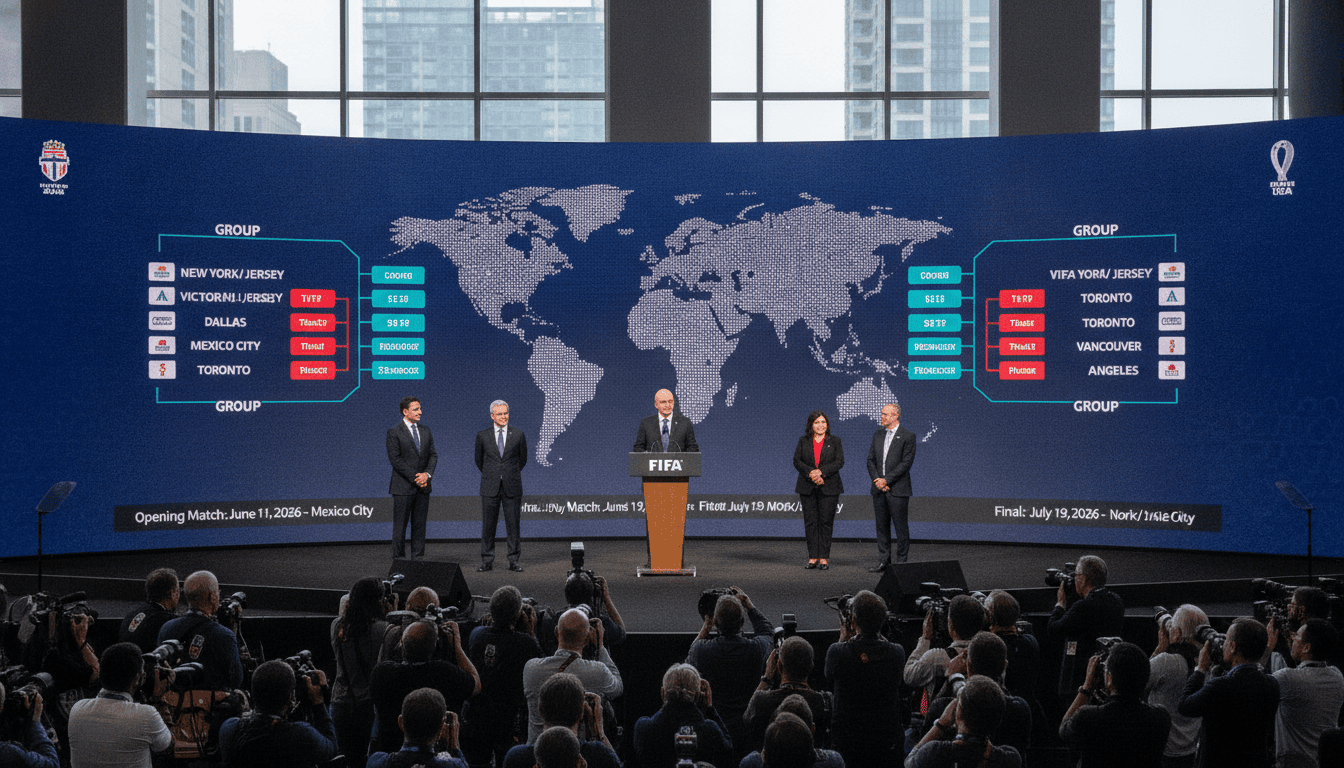
FIFA World Cup 2026: Full schedule, groups, stadiums and Germany’s early exit
Complete FIFA World Cup 2026 schedule, groups, stadiums and broadcast details. Tournament runs June 11–July 19, 2026; Germany eliminated on June 29, 2026.
The FIFA World Cup 2026 — staged across the United States, Mexico and Canada from June 11 to July 19, 2026 — is the largest tournament in the competition’s history, featuring 48 teams and 104 matches. The expanded format and triple-host arrangement produced a record number of venues and a complex schedule that spans multiple time zones. Among the tournament’s headline developments was Germany’s surprise elimination on June 29, 2026, when the national team bowed out in a penalty shootout in Boston.
Tournament format and group layout
The 2026 edition divides 48 teams into twelve groups of four, with the top two teams in each group advancing automatically. In addition, the eight best third-placed teams progress to a new round of 16, creating a hybrid knockout phase that increases the number of elimination matches. Group assignments include high-profile pools such as Group C (Brazil, Morocco, Haiti, Scotland) and Group E, which contained Germany alongside Curaçao, Ivory Coast and Ecuador.
The expanded draw meant more matches, more travel and new strategic priorities for coaches managing squad rotation. Tiebreakers follow a standard hierarchy: goal difference, goals scored and head-to-head results, with fair-play points applied if teams remain level.
Key knockout dates and notable fixtures
The tournament’s knockout calendar was spread across marquee U.S. stadiums, with the Round of 16 played from June 28 to July 4 and quarter-finals scheduled between July 9 and July 12. Quarter-final fixtures included France v Morocco in Foxborough on July 9 and Spain v Belgium in Los Angeles on July 10, both fixtures drawing significant international attention. The semi-finals were set for July 14 in Dallas and July 15 in Atlanta, with the third-place match in Miami on July 18 and the final at New York’s East Rutherford stadium on July 19.
Organizers staggered kick-off times to accommodate global television audiences and local logistics, which shaped how teams planned recovery and travel. The sequence and location of the knockout rounds meant several nations had to cover large distances between matches, testing squad management and contingency planning.
Germany’s campaign and elimination in Boston
Germany opened the tournament with a resounding 7-1 win over Curaçao on June 14 in Houston, a result that raised expectations for the DFB side. A narrow 2-1 victory against Ivory Coast in Toronto followed, but Germany then lost 2-1 to Ecuador in New York on June 25, leaving the group stage decision to the final match. On June 29 in Boston, Germany drew 1-1 with Paraguay and were eliminated after losing the ensuing penalty shootout.
The early exit marked an unexpected conclusion for a squad that began the competition with an emphatic win but struggled for consistency. Coach Julian Nagelsmann’s tactical approach and in-game adjustments became focal points for post-match analysis, and commentators questioned whether rotation and substitutions achieved their intended effect.
Host cities, stadium capacities and logistics
For the first time the World Cup took place across three countries and 16 stadiums, with 11 venues in the United States, three in Mexico and two in Canada. Stadium capacities ranged from approximately 45,000 in Toronto to over 90,000 in Arlington’s Dallas venue, and iconic grounds such as Mexico City’s Azteca hosted high-profile fixtures. The distribution of matches across North America required organizers to coordinate transport, security and accommodation at an unprecedented scale.
Time-zone differences between host cities and European viewers were substantial; most matches were scheduled to convert to Central European Summer Time with offsets of six to nine hours depending on the venue. That imbalance influenced kickoff times broadcast in Europe and shaped fan travel plans for supporters following their teams across multiple venues.
Broadcast rights, streaming and television coverage
In many European markets the public broadcasters carried a majority of the tournament: ARD and ZDF collectively screened sixty of the 104 matches, while a pay service held the rights to stream and air all fixtures. In Germany, MagentaTV offered comprehensive coverage of every match, supplementing the public broadcasters’ schedules. Live streams were simultaneously available through the broadcasters’ online platforms and dedicated apps, ensuring viewers could follow matches on multiple devices.
The split between free-to-air and subscription streaming produced debate over access and fan experience, but it also meant that domestic audiences could see major national-team matches on public television while subscribing viewers gained access to full tournament coverage.
Stadium operations and fan experience
Matchday operations emphasized fan safety and mobility, with host cities deploying layered security protocols and transportation plans to handle match crowds. Organizers highlighted the advantages of staging matches in established sporting markets, which benefited from existing transit infrastructure and hospitality capacity. Local fan zones and cultural programming around stadiums aimed to create a festival atmosphere that reflected the tournament’s continental footprint.
Spectator services varied by venue, but most host stadiums offered multilingual signage, ticketing support and enhanced public transport links to manage peak arrivals and departures. Event planners will review logistics and fan feedback as a blueprint for future multi-nation tournaments.
The FIFA World Cup 2026 set new benchmarks in size and logistics, testing teams, broadcasters and host cities alike across three countries. While the tournament delivered memorable fixtures and expanded participation, it also underscored the practical challenges of staging the world game on a continental scale and the fine margins that determine a team’s progress in a compressed, high-stakes competition.
