
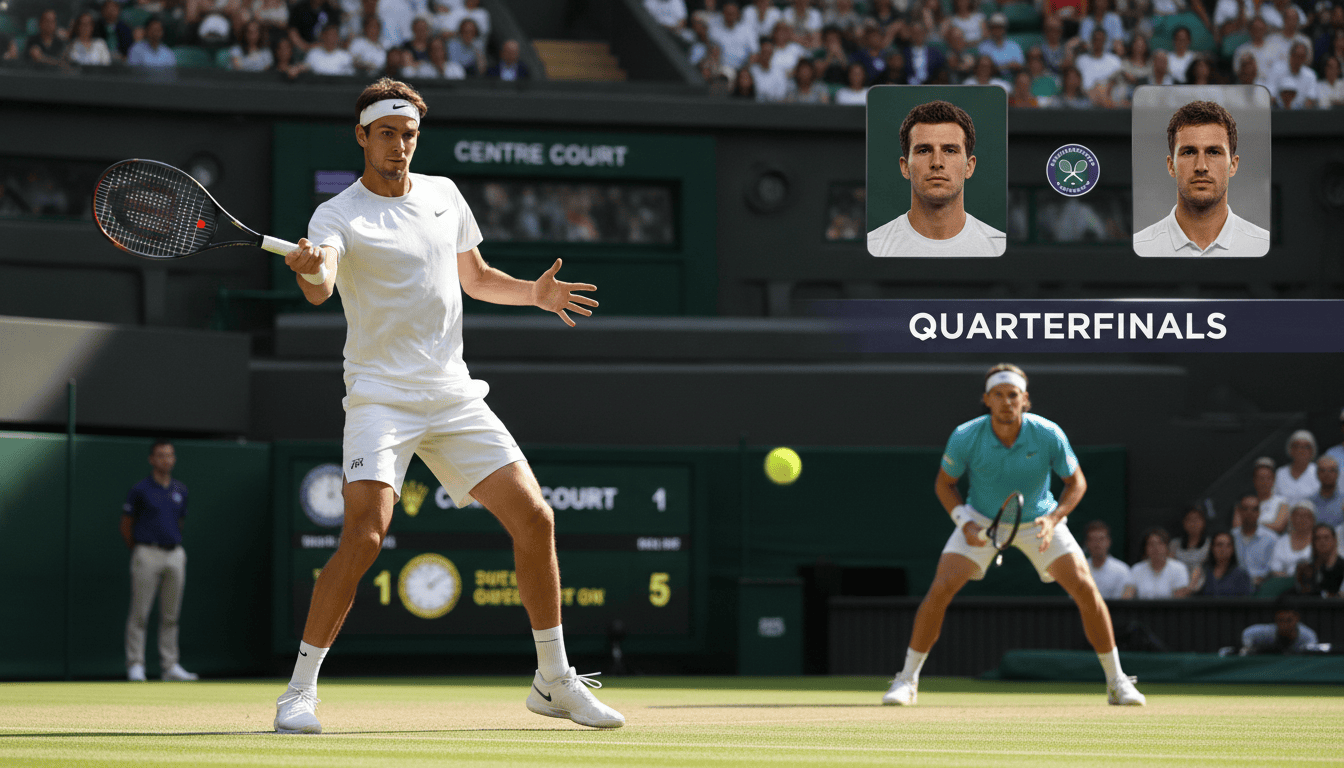
Taylor Fritz Wimbledon quarterfinal spotlight: serve strength, grass mastery and a mental showdown with Alexander Zverev
Taylor Fritz Wimbledon quarterfinal clash with Alexander Zverev highlights serve dominance, grass-court mastery and a psychological battle for a place in the semifinals.
Taylor Fritz Wimbledon headline encounters in London as the American’s blend of power and precision carries him into the last eight, setting up a high-stakes meeting with Alexander Zverev. Fritz has arrived on Centre Court in strong form after a straight-through run on grass, and his game—built around a heavy serve and aggressive returns—has proven well suited to the worn lawns of the second week. Zverev, fresh from completing an interrupted match, faces not only Fritz’s firepower but also the mental hurdle of recurring head-to-head struggles. The forthcoming quarterfinal is being framed as much as a psychological test as a tactical battle.
Fritz’s Wimbledon style and recent form
Taylor Fritz’s Wimbledon presence has drawn notice both for his on-court efficiency and his off-court style, the latter visible in his striking walk-ins. On the court, he appears to have moved past a knee tendon issue that disrupted his season last autumn, playing with steadier footwork and fewer limitations. Fritz’s confidence is evident in how he applies pressure with his first serve and mixes aggressive baseline play with occasional chip returns. That blend has delivered a string of convincing wins on grass this fortnight.
Head-to-head context and match stakes
The matchup with Alexander Zverev carries a clear narrative weight: historical results have tilted in Fritz’s favor, leaving Zverev with a psychological deficit to overcome. The recent sequence of meetings gives the American the upper hand in their rivalry, and Zverev has acknowledged the extra mental strain of facing an opponent who has had his measure. For Zverev, the challenge is to reset quickly after an interrupted contest and to prevent the match from becoming a replay of past, frustrating encounters.
Why the serve will decide key moments
Both players rely heavily on powerful first serves that shorten points and impose a tempo hard to disrupt on grass. Fritz’s serving pattern forces opponents back and creates time pressure, while his return game—often punctuated by low, skidding chip-balls—aims to take the sting out of the rival’s serve. Zverev, likewise, produces a high share of unreturnable first serves, meaning rallies are likely to be brief and decisive points frequent. The contest will hinge on which player manages those short, high-leverage exchanges most effectively.
Zverev’s injury history and mental reset
Zverev arrives with a recent history that includes injury setbacks and a major clay-court triumph that altered expectations around his game. He has described the task of meeting top rivals on consecutive days as taxing more for the mind than for the body, and he has emphasized the need to compartmentalize both success and failure. That approach was central to his clay-court breakthrough, and he will seek the same psychological resilience to face a player who has repeatedly troubled him.
Veteran perspective: Tommy Haas on fear opponents
Former top player Tommy Haas offered a succinct diagnosis of the dynamic at play: some opponents provoke a mental freeze that alters timing, coordination and risk-taking. Haas explained that when players over-focus on the result against a particular rival, their muscle tone tightens and creativity falls away, turning familiar strokes into awkward mechanics. The solution, he suggested, is often tactical adaptation coupled with a deliberate effort to restore looseness under pressure. That advice is likely to be cited in both tents as the quarterfinal approaches.
Implications for Fritz and American men’s tennis
A deep run for Fritz at Wimbledon would reinforce his reputation as one of the tour’s most effective grass-court players and amplify talk about American prospects in major tournaments. He has habitually performed well on grass, collecting a notable share of his tour titles on the surface, and a semifinal berth—or beyond—would sharpen conversations about his Grand Slam ceiling. For U.S. men’s tennis, continued progress from players like Fritz, Ben Shelton and Frances Tiafoe would narrow a long-standing gap at the very top of the major events.
The forthcoming contest between Taylor Fritz and Alexander Zverev promises to be compact, intense and decided in a handful of critical moments rather than long, attritional rallies. Both competitors bring weapons tailor-made for the surface, but the mental angle—who manages expectations, momentum swings and short-ball pressure—may be the ultimate arbiter. Whoever emerges will carry not just a place in the semifinals but a psychological boost that could shape the second week at Wimbledon.
