
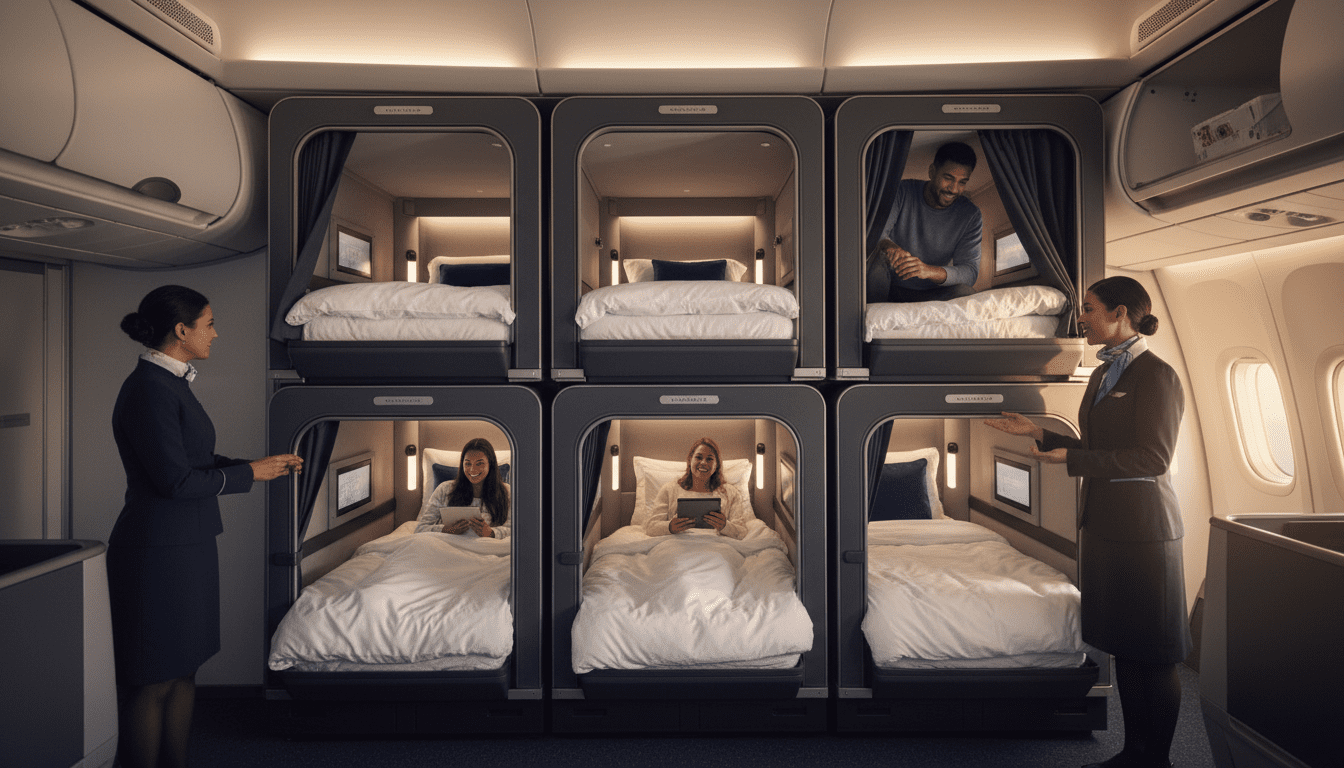
Air New Zealand launches Skynest sleep pods for economy passengers on Auckland–New York flights
Air New Zealand unveils Skynest sleep pods for economy passengers on ultra-long flights. Bookings open May 18, 2026; initial service: Auckland–New York.
Air New Zealand will offer its new Skynest sleep pods to economy passengers, a lie-flat sleeping compartment designed for ultra-long-haul comfort. The airline says bookings for the four-hour sleep sessions open on May 18, 2026, with the first installations entering service from November 2026 on select Boeing 787-9 Dreamliner flights. The Skynest concept is presented as a novel way to reduce fatigue on one of the world’s longest routes, Auckland–New York.
Skynest design and onboard amenities
The Skynest consists of six stacked lie-flat berths installed between the Economy and Premium Economy cabins in a 787-9 configuration. Each pod includes a full-length mattress, fresh bedding, privacy curtains, dimmable lighting, ventilation and charging ports, and passengers are provided a sleep kit with a mask and earplugs. The airline emphasizes an emphasis on comfort and hygiene, with specially laundered linens and restrictions to keep the sleeping area clean.
How booking and use will work
Passengers must retain a regular aircraft seat but may purchase an additional, separate four-hour sleep session in a Skynest pod. Air New Zealand says the four-hour window is timed to align with natural sleep cycles to allow passengers to rest without abrupt awakenings. Initially the product will be bookable for flights on the Auckland–New York route, a sector that takes roughly 17 hours end-to-end.
Operational rules and hygiene measures
The airline has imposed strict usage rules: no eating or creating crumbs inside the pods, and each berth is intended for single use only rather than shared occupancy. These rules are intended to preserve cleanliness and reduce disturbance to other passengers and crew during sleep periods. Ventilation and dedicated cleaning procedures are part of the overall hygiene protocol, according to Air New Zealand’s description of the product.
Testing, development and airline rationale
Air New Zealand says Skynest was developed over several years and trialed with more than 200 test participants prior to the public rollout. Company leadership has framed the product as a response to New Zealand’s geographic remoteness, arguing that improved onboard comfort helps make very long journeys more palatable for travelers. The carrier describes Skynest as the result of iterative design work aimed at creating a private, lie-flat rest option that works within existing narrow-body cabin constraints.
Placement on the fleet and schedule for rollout
The Skynest modules are being fitted specifically to Boeing 787-9 Dreamliners and will be located in the mid-cabin area between fare classes. Air New Zealand plans to begin bookings on May 18, 2026, and to introduce the sleeping berths into passenger service from November 2026. Initially deployed on the Auckland–New York route, the airline may evaluate wider use based on passenger uptake, operational performance and regulatory approvals.
Potential impact on ultra‑long‑haul travel
By offering a commercially bookable lie-flat option for economy ticket holders, Air New Zealand is testing whether sleep accommodations can become a mainstream amenity on ultra-long sectors. If the Skynest proves popular, other carriers that operate nonstop flights of similar duration may consider comparable concepts, though retrofitting and certification remain practical hurdles. For passengers, the availability of a dedicated sleep space could change how travelers plan for recovery and comfort on journeys that exceed typical overnight flight lengths.
Industry observers will watch metrics such as booking rates, customer satisfaction and turnaround time for cleaning to assess whether the model scales. Airlines must balance revenue potential with space lost for passenger seats and the additional crew or maintenance tasks associated with a separate rest module. Regulatory bodies and safety certification processes will also play a role in any broader adoption of pod-style sleeping compartments.
Skynest represents a deliberate experiment in cabin innovation that targets a specific pain point for long-distance travelers. Air New Zealand’s rollout schedule—bookable from May 18, 2026, with service starting in November 2026 on Auckland–New York flights—sets a clear timetable for passengers and industry watchers to evaluate its effectiveness.
