
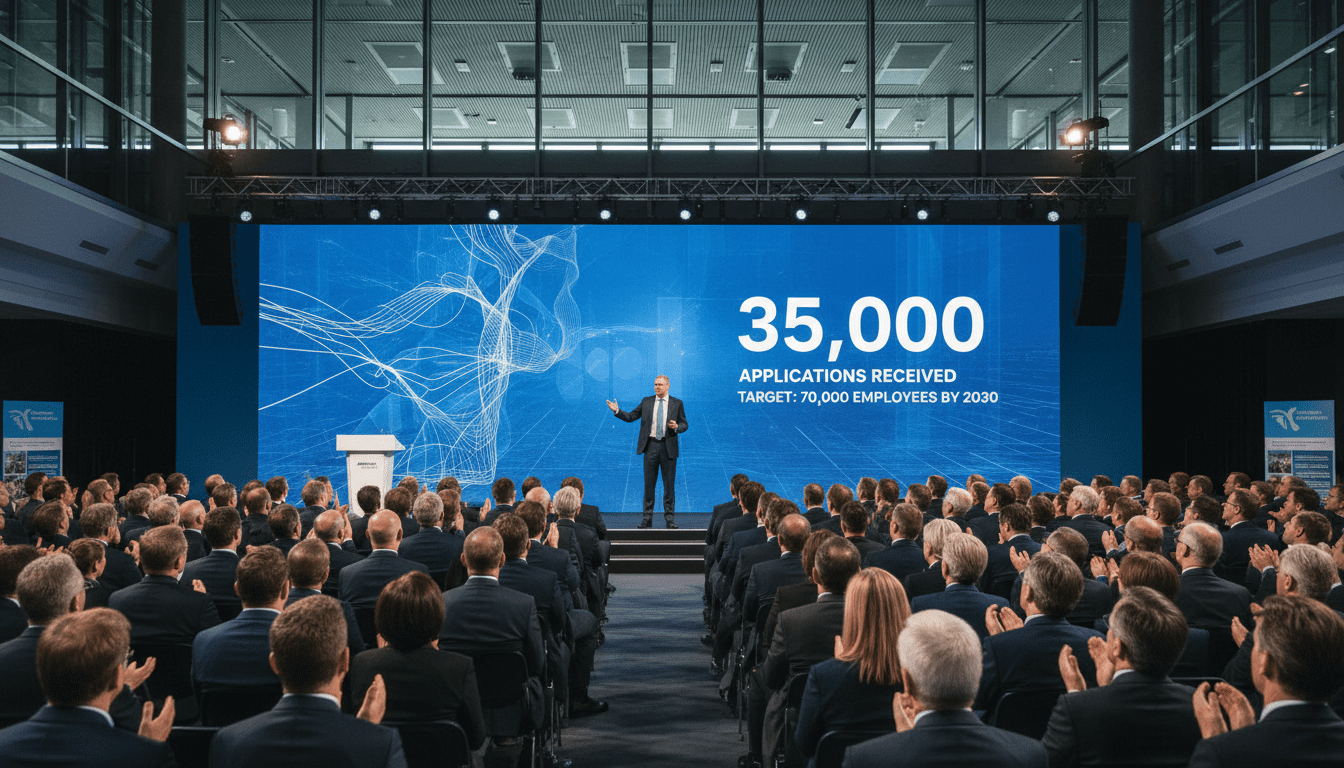
Rheinmetall hiring surge: 350,000 applications as production and workforce scale up for heightened defence demand
Rheinmetall receives 350,000 job applications as it expands production and supply chains, aiming for 70,000 employees by 2030 and major capacity increases.
Rheinmetall said it received roughly 350,000 job applications in the past year as the German defence group scales operations to meet surging demand, the company’s CEO told journalists. The hiring surge comes alongside aggressive increases in vehicle and munitions production and a recent acquisition that expands the group’s footprint in naval shipbuilding. Company officials described the trend as driven by elevated defence spending across Europe and the need to rebuild and expand domestic industrial capacity.
350,000 applications reported, 250,000 from Germany
Rheinmetall reported that about 350,000 applications arrived over the last year, with roughly 250,000 originating in Germany, reflecting strong domestic interest in defence-sector employment. The company currently employs about 44,000 people across its global operations, and management said recruitment activity has intensified at almost every site. Executives characterized the volume of applications as unprecedented for the group and as evidence of an expanding labour market for defence manufacturing skills.
The reported inflow poses new human-resources challenges, including screening, onboarding and targeted training for specialist roles. Rheinmetall faces pressure to convert large applicant pools into qualified hires while maintaining certifications and safety standards required by defence contracts.
Production capacity jumps for trucks, medium-calibre and artillery munitions
Rheinmetall described significant increases in production capacity across several product lines. Annual output of military logistics trucks has been raised from about 600 units to 4,500, according to the company. Production of medium-calibre ammunition was scaled from roughly 800,000 rounds a year to more than four million, while artillery ammunition capacity rose from about 70,000 to 1.1 million rounds annually.
Company leadership framed the expansions as part of a broader effort to reduce reliance on foreign suppliers and to ensure readiness for NATO and national defence requirements. Officials also said Germany now has greater conventional ammunition production capacity than the United States, reflecting a rapid investment cycle in ordnance manufacturing.
Supply chain reach and employment projection to 2030
Rheinmetall said its supplier network includes approximately 11,500 German subcontractors, with around 4,500 drawn from the automotive sector. Management projected that, if the group grows to as many as 70,000 employees by 2030, roughly 210,000 additional jobs could be linked to its supply chain, a scale that would make the group’s extended employment footprint comparable to a significant fraction of Germany’s automotive industry.
The company presented this forecast as a top-line scenario contingent on sustained defence orders and political commitments for procurement. Analysts note that such projections depend on contract longevity, export approvals and the ability of small and medium-sized suppliers to expand capacity in parallel.
NVL acquisition expands naval capabilities and workforce
In early March Rheinmetall completed the acquisition of NVL, the parent of the Blohm+Voss shipyard, purchasing the unit from the Lürssen group. Management said the deal transfers the entire existing workforce to Rheinmetall and anticipates hiring an additional roughly 500 employees to support integration and new naval projects. The transaction underscores the company’s push into naval shipbuilding and systems integration as part of a broader diversification strategy.
Executives emphasized continuity in operations and pledged to preserve local shipyard expertise while aligning naval activities with Rheinmetall’s logistics and systems divisions. Observers said the move could strengthen Germany’s domestic shipbuilding capacity for military vessels and associated industrial services.
CEO expects demand to level off between 2035 and 2040 absent armed conflict in Germany
Rheinmetall’s CEO signalled that the current growth phase may prove temporary and that demand could moderate by the mid-to-late 2030s if no major conflict occurs on German soil. He told reporters he expects the “zenith” of orders and sales to ease between about 2035 and 2040 in a scenario without direct military engagement in Germany. That forecast frames current hiring and capacity expansion as front-loading for readiness and potential export opportunities.
The company’s forward-looking timeline highlights the tension between near-term ramp-up to satisfy urgent orders and the long-term risks of overcapacity should demand decline. Policy decisions on procurement budgets and allied cooperation will be significant determinants of whether expanded capacity remains fully utilized.
Industry and policy implications for Germany and suppliers
Rheinmetall’s reported surge in recruitment and production has ripple effects for the wider industrial base, especially suppliers with links to the automotive sector. The integration of thousands of suppliers into defence supply chains may require firms to retool, obtain new certifications and adapt to defence procurement cycles. Policymakers face questions about workforce training, regional economic impacts and the balance between military readiness and civilian industrial policy.
Economic development agencies and trade associations will likely monitor the distributional effects of increased defence spending on employment and supplier resilience. The shift also raises strategic considerations about domestic industrial sovereignty and the capacity to sustain prolonged production efforts if geopolitical tensions persist.
The company’s figures and forecasts paint a picture of rapid expansion that is being operationalized through acquisitions, investments in factory throughput and a broad recruitment push, while acknowledging uncertainty over long-term demand trends.
