
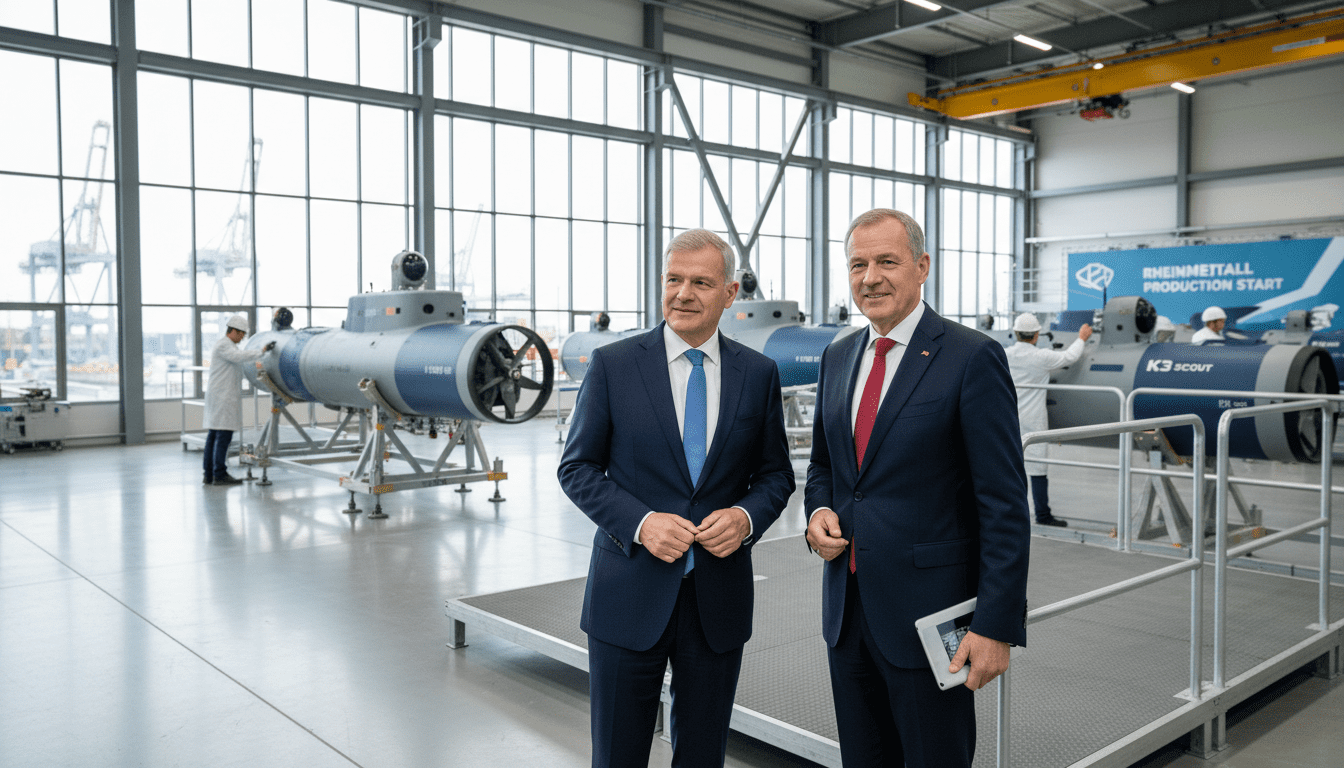
Rheinmetall naval drones enter serial production in Hamburg, aiming for 500–1,000 units and billions in sales
Rheinmetall naval drones enter serial production in Hamburg; K3 Scout boats aim for 500–1,000 units yearly, promising billions in sales and naval expansion.
Rheinmetall has begun serial production of naval drones in Hamburg, pursuing a fast-growing market for uncrewed maritime systems. Rheinmetall naval drones are being manufactured at Blohm+Voss under a joint venture, and the company says initial orders and production targets could translate into billion-euro revenues. The move marks a strategic push by the defence group into shipbuilding and remote maritime capabilities.
Hamburg yard starts K3 Scout series manufacturing
Production of the K3 Scout unmanned surface vessels has commenced this week at the Blohm+Voss yard in Hamburg, Rheinmetall announced as it formalised the new line. The programme is a joint venture with Britain’s Kraken Technology Group and builds on groundwork laid by the NVL Group before Rheinmetall completed its takeover in early March. Executives presented the launch as the start of a broader naval push that combines shipbuilding skills with Rheinmetall’s systems integration capabilities.
Design, performance and pricing of the K3 Scout
The K3 Scout is an 8.5‑metre craft capable of reaching up to 55 knots, roughly 100 kilometres per hour, depending on configuration. The vessels can operate uncrewed, be remotely controlled, or be fitted with autonomous systems and modular payloads for surveillance or weapon carriage. Rheinmetall has priced the boats at about €350,000 each, positioning them as relatively low-cost assets compared with larger missile systems.
Orders, production targets and market potential
Company leadership said there are already orders for several hundred units and an initial target of 500 boats per year, with expansion to 1,000 units possible. At those volumes Mr. Rheinmetall’s chief executive argues the programme could deliver revenues in the billions, driven by export demand from navies seeking persistent, low-cost maritime sensors and deterrent capability. The firm framed the K3 Scout as attractive to any state with a navy, offering flexibility for coastal surveillance, force protection and layered maritime defence.
F126 frigate debate and implications for naval procurement
The naval push comes against the backdrop of the contested F126 frigate programme, where the federal government removed the previous general contractor after significant cost and delivery problems. Rheinmetall executives said a Bundestag decision on how to proceed is expected in the third quarter, and they argued the F126 design meets capabilities Germany requires for operations in high-latitude and Arctic conditions. Alternatives under discussion include shorter-term procurements such as the Meko A‑200 class, which would provide a faster delivery option while longer-term decisions are resolved.
Workforce, yards and further consolidation moves
Rheinmetall plans to hire hundreds of workers for the emerging marine division and signalled possible expansion of the Hamburg site to increase production capacity. The group indicated it is studying further acquisitions, including discussions around German Naval Yards Kiel, while other shipbuilders such as TKMS have also expressed interest. Management told investors and industry audiences that merging naval construction experience with Rheinmetall’s defence systems could create the kind of end‑to‑end industrial capability sought by government customers.
Rheinmetall also drew a contrast with unrelated industrial options it considered and rejected, saying certain plants lacked the structural fit to support naval production, and underscoring the need for predictable procurement planning. Executives cautioned that framework agreements alone do not guarantee production take‑up and flagged supply‑chain and customer readiness issues—citing examples of vehicles produced but not yet accepted due to operational constraints at the buyer side.
The company reiterated an ambition to become a leading global defence supplier, projecting high growth in coming years while also acknowledging a potential long‑term market peak in the mid‑2030s absent new security drivers. Executives said they were in talks with governments on possible support arrangements, including cost‑sharing models that would help underwrite fixed industrial costs while expanding allied capability.
Looking ahead, Rheinmetall’s entry into naval unmanned systems signals a rapid broadening of its business footprint from land systems into maritime domains, with immediate commercial targets and longer‑term bets on major surface combatant programmes. The success of the K3 Scout line, and the company’s broader shipbuilding ambitions, will depend on delivery of government decisions, export approvals and the ability to scale production while integrating advanced sensors and weapons into compact, sea‑going platforms.
