
Left leader urges government to strengthen statutory pension with Austrian-style model
Ines Schwerdtner urges boosting Germany’s statutory pension with an Austrian-style contribution system to raise benefits and include self-employed now.
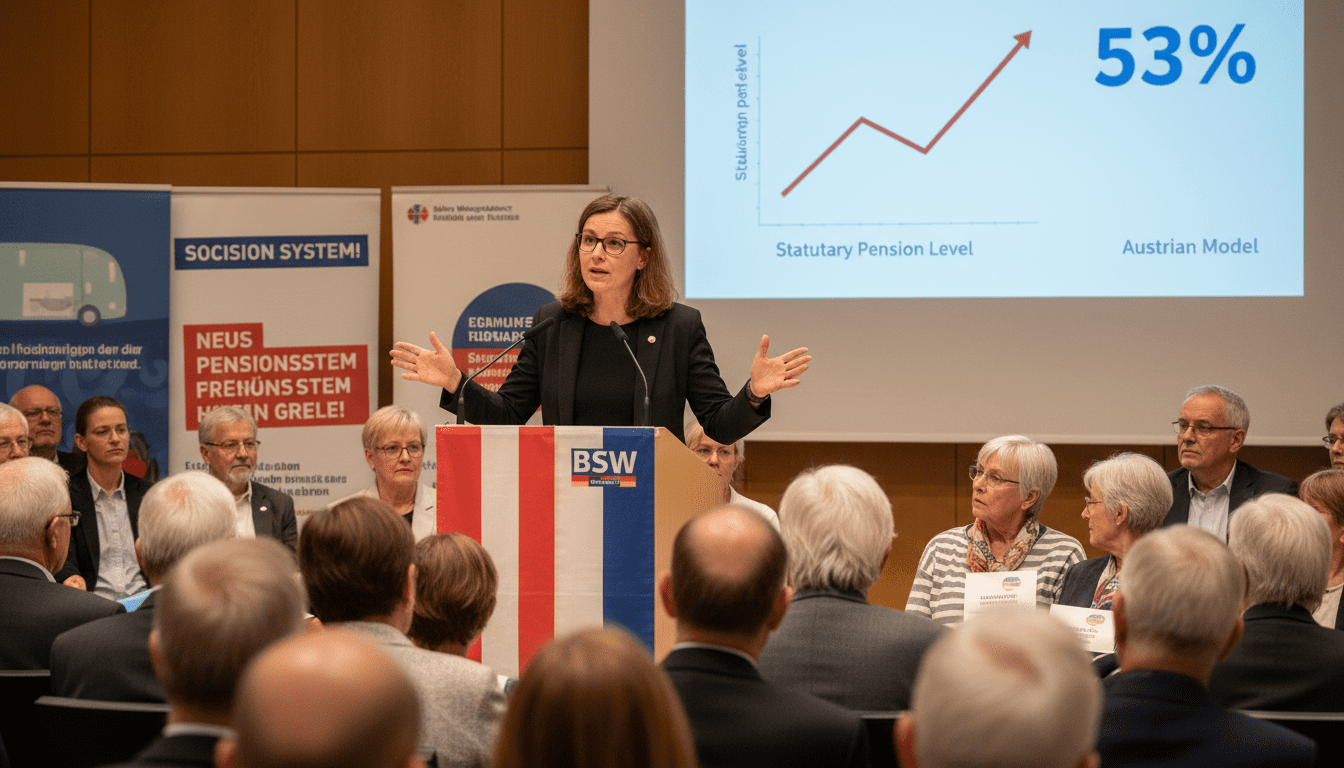
Germany’s Left Party leader Ines Schwerdtner has called for a substantial strengthening of the statutory pension, proposing an Austrian-style universal contribution scheme to lift replacement rates and expand the contributor base. Schwerdtner told the dpa news agency that Germany’s relatively low pensions within the EU are the product of years of policy mistakes and that a robust public pension must be the foundation of old-age security. The proposal would raise the official pension level target from roughly 48 percent to at least 53 percent and bring groups now outside the statutory system—such as civil servants and many self-employed people—into common contribution arrangements.
Left leader proposes Austrian model
Schwerdtner argued that Austria’s unified approach, where virtually all workers pay into the same public system, produces higher and more predictable pensions than Germany’s mixture of statutory, occupational and private provision. She warned that continued reliance on private retirement savings makes pension outcomes uncertain for a large share of the population. The Left leader framed her demand as a corrective to long-term reforms that, in her view, shifted risk onto individuals rather than maintaining a solid public safety net.
Details of the proposed Erwerbstätigenversicherung
Under the plan advocated by the Left, a new Erwerbstätigenversicherung would require contributions from employees, civil servants, self-employed professionals and elected officials into a single statutory fund. The change aims to raise the replacement rate—the level of a full pension after 45 years of average earnings—by widening the contribution base and stabilizing financing. Schwerdtner said the adjustment should be transparent and legally anchored so that pension entitlements reflect collective contributions rather than market-dependent products.
Government reaction and Merz controversy
The proposal comes amid intensified debate after Chancellor Friedrich Merz’s recent comment that the statutory pension might in future provide only a “basic safety net” for old age, a remark that provoked criticism across the political spectrum. Social Minister Bärbel Bas of the SPD responded by saying the forthcoming pension reform is intended to secure living standards through a mix of statutory, occupational and private pensions. Schwerdtner has rejected that three-pillar framing, arguing that it accepts a diminished role for the statutory pension and risks leaving many retirees worse off.
Political stakes ahead of pension reform
The dispute highlights sharp divisions within the governing coalition and between parties over the direction of Germany’s pension policy as lawmakers prepare a comprehensive reform. Proposals to broaden the statutory system will likely face resistance from advocates of fiscal restraint and those who argue that expanding compulsory contributions could burden businesses and self-employed workers. Conversely, parties and advocacy groups prioritizing redistribution and income security for older citizens have signaled support for measures that would increase public pensions and reduce dependence on private markets.
Financial and demographic implications
Raising the pension level to a target of 53 percent would carry fiscal consequences that the government and independent analysts will need to quantify, particularly given Germany’s ageing population and pressures on public budgets. Supporters of the Left’s plan argue that widening the contribution base by including previously exempt groups would offset some additional costs and improve intergenerational fairness. Opponents caution that higher contribution rates or increased public transfers could weigh on wages, hiring and entrepreneurial activity if not designed carefully.
Responses from stakeholders
Pensioners’ organizations and trade unions are likely to welcome measures that promise higher and more predictable benefits, while business associations and some professional groups may demand exemptions or transitional arrangements. The inclusion of civil servants and politicians in a common system is especially contentious because it challenges long-standing legal and institutional arrangements. Schwerdtner framed inclusion as a question of equity: if most workers contribute to the public system, those enjoying separate regimes should share responsibility and risk.
The debate over the structure and ambition of Germany’s pension system is set to intensify as parties prepare legislative proposals and costings ahead of the reform process. Schwerdtner’s call for an Austrian-style Erwerbstätigenversicherung puts the statutory pension at the center of that contest, framing the choice as between bolstering public provision or continuing a path that increases reliance on private savings. Observers say the outcome will shape retirement security for decades and could be decisive in upcoming political cycles.
