
Vodafone Germany positions itself as a challenger with Dortmund summit and new customer-first strategy
Marcel de Groot frames Vodafone Germany as an aggressive challenger after addressing 500 managers at Borussia Dortmund’s stadium, pledging marketing, service and network moves.
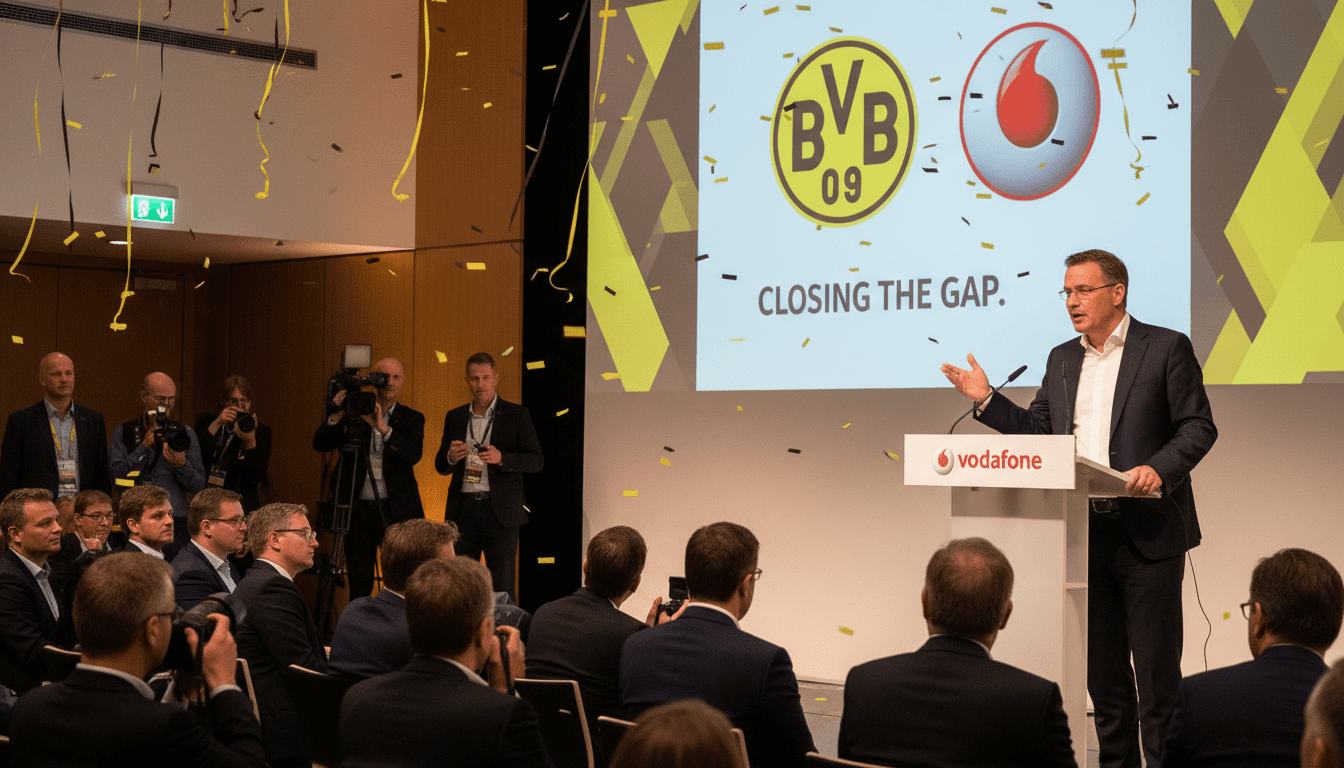
Marcel de Groot used a meeting at Borussia Dortmund’s stadium to tell 500 senior Vodafone Germany managers that the company must act and move faster to win amid fierce competition in the telecoms market. He framed the business as a challenger — calling it implicitly the “FC Vodafone” — and warned that “the pressure for us is greater than ever,” setting the tone for a series of strategic shifts across marketing, customer service and network investment.
Leadership meeting staged at Dortmund stadium
The leadership summit lasted roughly six hours and brought together Vodafone Germany’s top executives, including talks on personnel, business customers and organizational change. The choice of the Borussia Dortmund stadium was deliberate: Vodafone became the club’s sponsor last year and executives used the sporting setting to underscore themes of teamwork and performance under pressure.
Niko Kovač, the BVB coach, joined parts of the gathering as Vodafone linked its brand narrative to competitive sport and resilience. Marcel de Groot, who has led Vodafone’s German unit for just over two years, repeatedly used football metaphors to describe shrinking room for manoeuvre and the need to stop projects that no longer deliver value.
Marketing offensive ties Vodafone Germany to Borussia Dortmund
Vodafone Germany’s partnership with Borussia Dortmund is central to a broader marketing push intended to lift brand visibility and customer engagement. Company sources say first-year targets for the collaboration were exceeded, and executives argue that aligning with a high-profile club helps position Vodafone as a bold challenger to incumbents.
The move also draws a neat competitive contrast: Deutsche Telekom’s long-standing sponsorship of FC Bayern highlights how telco rivalries now extend into sports marketing. Vodafone’s leadership presented the tie-up as part of a wider strategy to use major brand moments to accelerate customer acquisition and loyalty.
Mobile market intensity and pricing dynamics
De Groot described the German mobile market as highly contested, with traditional network operators facing pressure from a multitude of service providers and aggressive promotional offers. “The mobile market is burning,” he said, noting that operators fight intensely for every customer and euro, often through short-term discounts and special packages.
He pointed out that customers have benefited from stable or falling effective prices even as data performance improved dramatically over recent years. Still, de Groot cautioned that sustained downward price pressure across the industry is unlikely, and Vodafone will compete by differentiating through customer experience and targeted offers rather than starting a price war.
Customer shifts and brand-layer strategy after 1&1 migration
Vodafone Germany gained momentum when customers formerly served via 1&1’s use of Telefónica’s network migrated to Vodafone’s infrastructure while 1&1 builds out its own radio network. The transfer of roughly 12 million customers provided a notable tailwind, but executives stressed that boost has been absorbed into the base and new approaches are now required for growth.
To expand market share, Vodafone plans to promote its secondary brands more actively and push bundled offers to convert fixed-line customers into mobile subscribers. De Groot emphasized that brand segmentation and cross-selling are key levers to attract customers without relying solely on promotional giveaways.
‘Ask Once’ initiative and operational integration
Improving customer experience is a central pillar of Vodafone Germany’s plan, with a program dubbed “Ask Once” intended to simplify and speed problem resolution. The company said it will deploy AI-driven automation to solve straightforward inquiries within seconds and free human agents to handle complex cases, aiming to become the provider with the best customer experience in the sector.
Executives acknowledged legacy integration issues stemming from the Unitymedia acquisition, which previously left some customers shunted between systems during service incidents. Management says backend improvements have reduced friction and that product delivery cycles are now roughly sixty days faster than before, a measurable sign of operational progress.
Network strategy balances cable investment and accelerated fibre build
Vodafone Germany defended the role of its cable network even as Deutsche Telekom and others press for a broad transition to fibre. De Groot argued most consumers care about stable, fast service at a fair price rather than the label of the underlying technology, and pledged continued investment in cable to keep it a competitive offering alongside fibre.
At the same time, Vodafone’s joint venture OXG, created with fibre partner Altice, is ramping up construction at about 40,000 connections per month, positioning the company as the country’s second-largest fibre builder after Telekom. The long-term target is seven million fibre endpoints, but executives warned the market will likely consolidate as some builders struggle to cover capital costs.
Vodafone Germany enters a critical phase where marketing, customer experience and network expansion must align to convert momentum into measurable market gains. Management’s public posture is unapologetically aggressive: defend the company’s role as the strongest challenger to the market leader, modernize service delivery through automation, and pursue a dual-path network strategy that keeps cable competitive while accelerating fibre rollout.
