
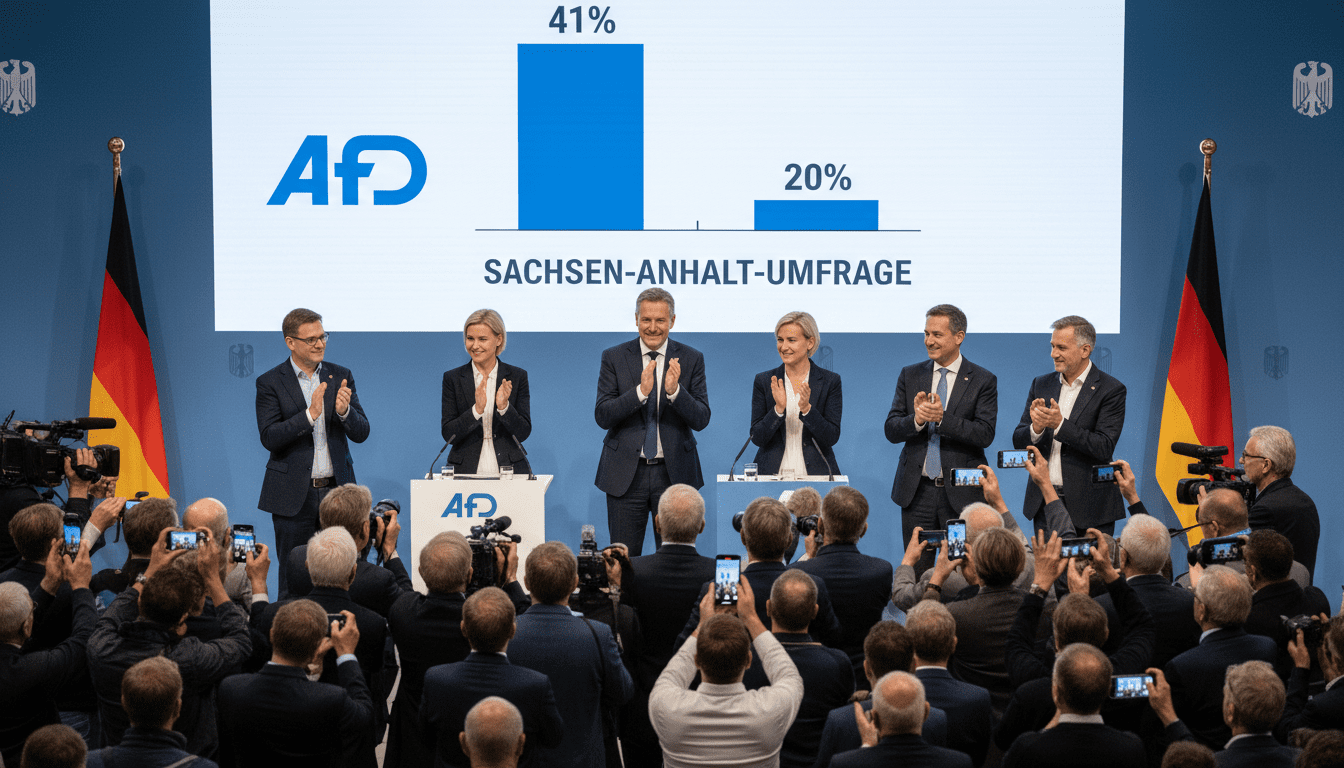
AfD surge in Sachsen-Anhalt poll puts party at 41% ahead of 6 September 2026 election
AfD surge in Sachsen-Anhalt poll: Infratest dimap shows AfD 41% and CDU 26% four months before the 6 September 2026 state election, unsettling parties.
Four months before the state election on 6 September 2026, a new Infratest dimap survey shows a striking AfD surge in Sachsen-Anhalt, with the party recording 41 percent support. The poll, commissioned by MDR, Volksstimme and Mitteldeutsche Zeitung, puts the CDU on 26 percent and signals a major shift in voter sentiment across the state. Analysts and party officials say the numbers could reshape coalition calculations and campaigning ahead of September.
AfD reaches record level in latest survey
The survey marks a high-water mark for the AfD in the state, with the party more than doubling its result from five years ago according to the poll’s trend comparison. The AfD’s 41 percent reading is significantly ahead of the next-largest party and represents a substantial lead in raw vote intention. Pollsters caution that opinion surveys are snapshots of mood rather than predictions, but the scale of the AfD’s advantage has prompted immediate reactions across the political spectrum.
CDU support slips and government preference tightens
The CDU, led in the state by Minister-President Sven Schulze, registered 26 percent support in the same poll, a sharp decline from earlier readings. On the question of who should lead the state government after the election, respondents were almost evenly split, with 44 percent favoring a CDU-led administration and 43 percent opting for an AfD-led government. That erosion of confidence poses a fresh challenge for the CDU as it seeks to defend its governing record and reassert leadership ahead of September.
Head-to-head race between Schulze and Siegmund remains close
When asked to choose directly between Minister-President Sven Schulze (CDU) and AfD challenger Ulrich Siegmund, respondents showed a narrow edge for Schulze, with 36 percent saying they would vote for the incumbent and 32 percent naming Siegmund. Roughly one-third of those surveyed remained undecided in a direct-personality contest, underlining the volatility of voter preferences. Schulze, who assumed office at the end of January after Reiner Haseloff’s decision not to run again, faces an early test of his personal standing even as party-level support falls.
Widespread dissatisfaction with the current coalition
The poll indicates widespread dissatisfaction with the existing CDU–SPD–FDP coalition: 62 percent of respondents expressed unhappiness with the government’s performance, while only about a third voiced a positive view. Trust in state institutions also appears weak, with just 16 percent reporting high or very high confidence in the state’s capacity to perform its duties and a large majority expressing low or no trust. These attitudes contribute to the larger context for the AfD’s rise, as voters cite immigration, education and the economy as the most pressing problems.
Economic perceptions and problem priorities weigh on voters
Respondents rated the state’s economic situation predominantly negative, with 82 percent judging the economy as fair-to-poor or bad and only 14 percent describing it as good or very good. Immigration emerged as the top concern named by voters, followed by education and economic issues, indicating a mix of cultural and structural anxieties shaping opinion. Parties aiming to reverse current trends will need to address both short-term perceptions of governance and longer-term economic and social priorities.
Coalition arithmetic points toward minority government scenarios
If the poll’s figures translated directly into September’s result, no clear majority coalition would emerge: the AfD would fall short of an outright majority while centre-right and centre-left blocs together would also lack sufficient seats. Both Minister-President Schulze and the AfD have publicly ruled out a formal coalition with the other, leaving coalition-building options limited. Observers suggest the most likely outcome under these circumstances would be a CDU–SPD minority administration that seeks tolerance or issue-by-issue support from other parties, a model that has governed neighboring Saxony since late 2024.
The poll also shows smaller parties struggling to reach the threshold for representation: The Left party is polling at around 12 percent and the SPD at roughly 7 percent, while the Greens and BSW stand at about 4 percent each and would not enter the Landtag under the survey’s numbers. The FDP’s support was reported as too low to be listed separately in the published breakdown, highlighting the fragmentation of the non-AfD vote and the narrowing of coalition choices.
The Infratest dimap survey offers an early but consequential signal for campaigns in the remaining months before 6 September 2026, intensifying pressure on the CDU to recover lost ground and forcing all parties to sharpen messaging on immigration, education and economic recovery. Political strategists caution that opinion dynamics can change rapidly, but say the current numbers will shape both tactical campaigning and strategic coalition planning in the weeks ahead.
