
AI supply chain bottlenecks take center stage at Milken conference
A comprehensive look at AI supply chain bottlenecks, from chip shortages and energy limits to data scarcity, architecture debates, and geopolitical hardware control.
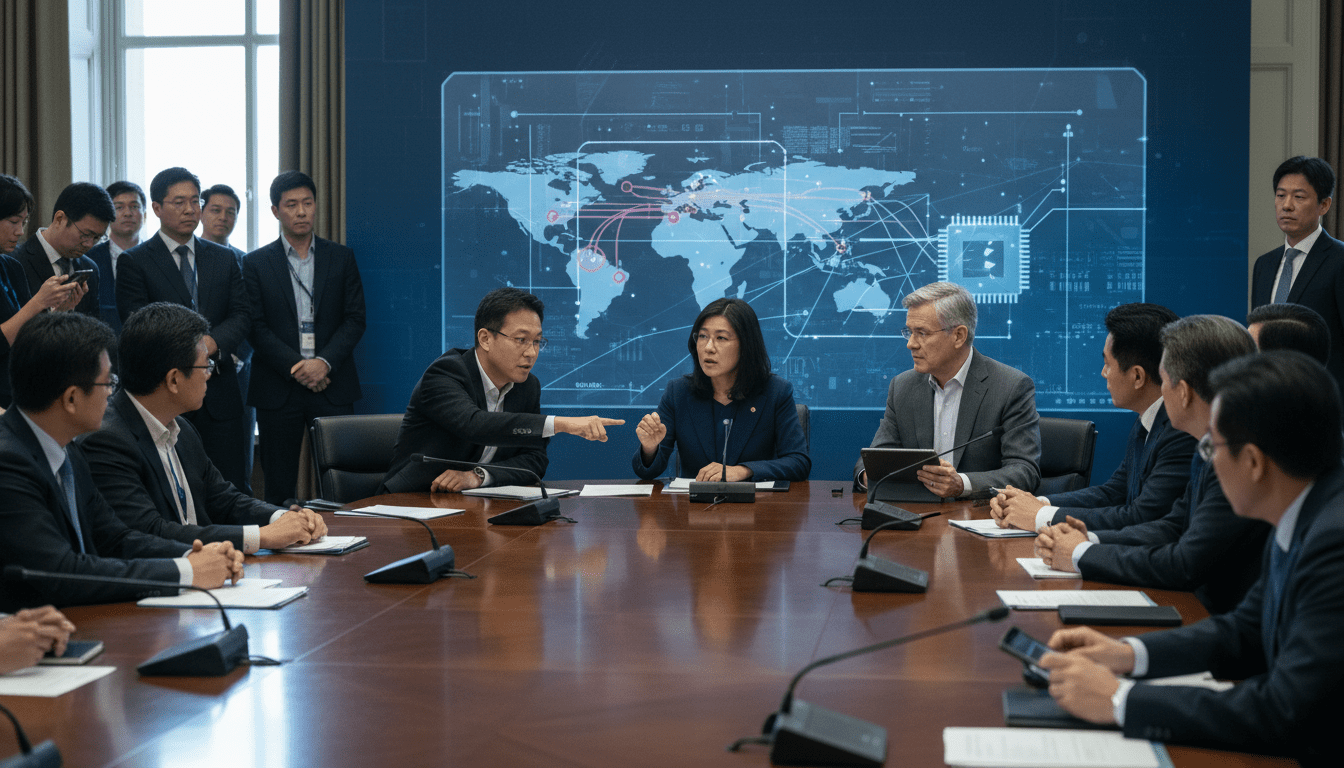
Earlier this week at the Milken Global Conference in Beverly Hills, industry leaders laid bare the growing realities of AI supply chain bottlenecks that could slow the sector’s rapid expansion. Executives from chipmaking, cloud infrastructure, autonomous systems, AI-native search, and alternative-model startups described constraints spanning silicon, power, real-world data and national sovereignty. The discussion highlighted how physical limits may now determine the pace and shape of AI development for years to come.
Panel frames chip availability as the immediate limiter
Christophe Fouquet of ASML warned that semiconductor production cannot ramp fast enough to match demand, creating persistent shortages for hyperscalers. He portrayed a manufacturing surge but said the market will likely remain supply-limited for several years, limiting how much advanced compute companies can actually deploy. That scarcity, executives argued, undercuts the assumption that unlimited compute will always be available to fuel model scaling.
Cloud demand and backlog reveal mounting pressure
Google Cloud’s leadership detailed explosive revenue growth alongside a striking increase in committed but undelivered contracts, illustrating commercial pressure on infrastructure capacity. Company officials noted that a swelling backlog reflects tangible demand for compute and storage that providers must fulfill. Those figures were cited to show the business reality behind theoretical capacity — customers are contracting for resources they still cannot be assured of receiving.
Energy constraints push novel engineering solutions
Speakers emphasized that even if chip supply improves, energy will become the chokepoint for widespread AI deployment. Executives discussed experiments ranging from co-engineering chips and models to far-reaching concepts like orbital data centers, where solar availability is high but heat dissipation is substantially harder. The consensus was that improving flops per watt through integrated hardware-software design will be essential to expand compute without unsustainable energy costs.
Real-world data remains the bottleneck for physical AI
Builders of autonomous systems argued that the primary scarcity for physical AI is not silicon but genuine, high-quality real-world data collected by machines in the field. Simulation helps, but experts said synthetic environments cannot yet replicate the breadth of edge cases found in live operation. For sectors such as trucking, mining and defense, that gap means models must still learn from sensors, vehicles and human oversight in the places they will actually operate.
Alternative architectures challenge large-model orthodoxy
A startup focused on energy-based models presented an architecture that diverges from next-token prediction, arguing it models underlying physical rules more naturally and updates continuously rather than requiring periodic retraining. Its founder suggested that smaller, faster models designed around reasoning about rules could prove more efficient in domains like robotics and chip design. That argument raises a broader question in the room: whether scale alone will continue to dominate AI progress or whether new paradigms will reframe where compute is invested.
Agents, permissions and enterprise trust controls
As AI capabilities move from search to autonomous “digital workers,” companies face heightened demands for granular governance and permissioning. A provider of AI-native agents explained how enterprise deployments can restrict connectors and designate read-only versus read-write access to limit risk. The trade-off between friction and safety was framed as necessary for organizations where client trust and compliance are non-negotiable, and where agents acting on behalf of employees must be auditable.
Hardware access shapes geopolitical competition
Panelists connected physical AI to questions of national sovereignty in ways that purely digital services did not. Observers argued that equipment such as autonomous vehicles and drones operating inside national borders raises regulatory and control concerns that invite government scrutiny. Executives also noted that access to advanced lithography and semiconductor supply chains remains a decisive factor in which countries can sustain cutting-edge AI, making hardware policy as strategically consequential as algorithms.
The session closed with reflections on workforce impacts and opportunity: some predict jobs will evolve rather than vanish, with tools lowering barriers to entrepreneurship even as certain entry-level roles change. Speakers emphasized that AI’s pace will be determined as much by physical realities—chips, power, and recorded experience—as by software ingenuity. The convergence of engineering, regulation and geopolitics, they said, will shape whether the coming years are defined by rapid democratization of capabilities or by concentrated, constrained deployment among those who control the stacks.
