
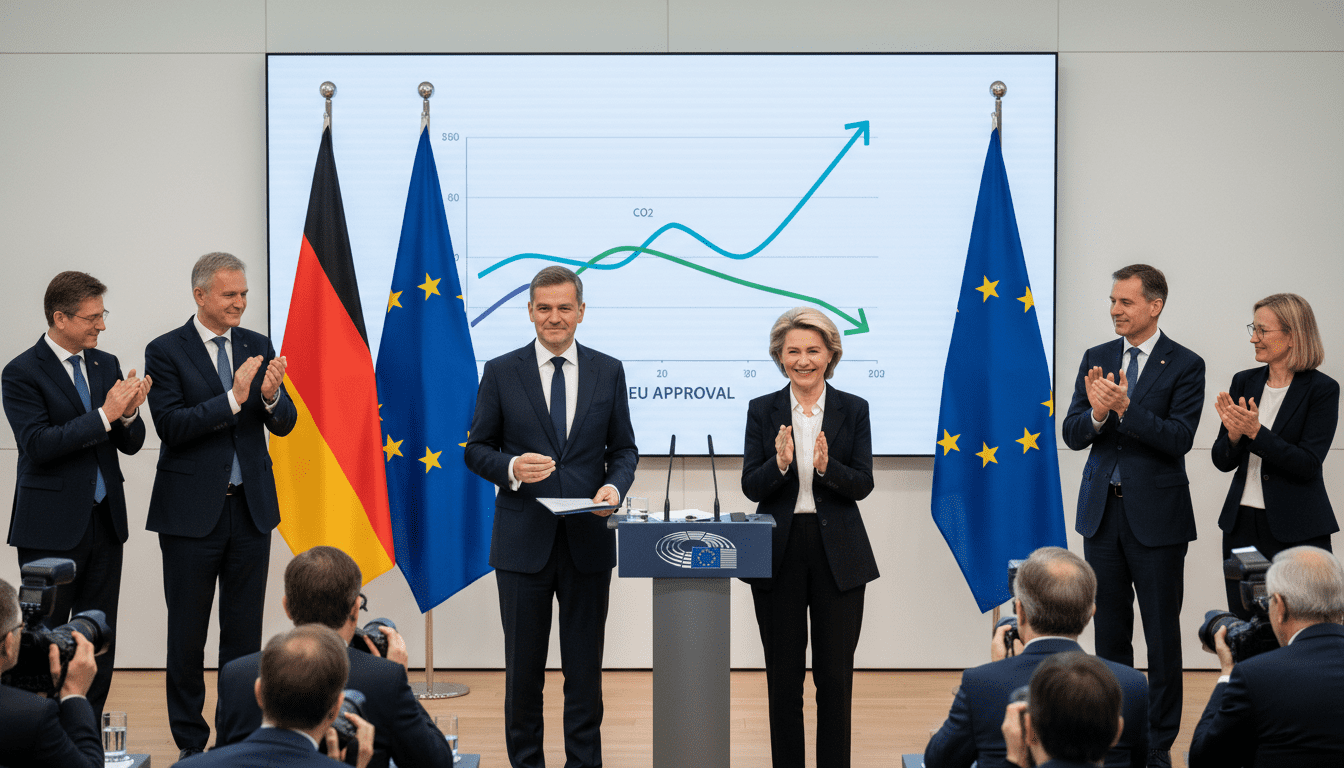
EU Approves €5 Billion Germany Industrial Decarbonisation Funding
EU approves €5 billion package to help Germany decarbonise energy‑intensive industry through competitive tenders and strict CO₂ reduction targets.
Approval of a €5 billion support scheme
Germany’s plan to provide €5 billion in industrial decarbonisation funding has been approved by the European Commission, clearing the way for state-backed aid to accelerate cleaner production methods. The Commission said the programme aligns with Germany’s energy and climate objectives and complies with EU rules for promoting sustainable competitiveness. The decision permits the federal government to offer targeted financial support to companies as they replace fossil fuel‑based processes with lower‑carbon alternatives.
How the competitive tender will work
The funding will be distributed through a competitive auction process in which bidders are assessed on cost efficiency per ton of CO₂ avoided. The tender design prioritises projects that achieve emissions reductions at the lowest subsidy cost, enabling public resources to target the most effective interventions. Successful applicants will receive contracts that tie public support to measured emission savings over a long‑term period, creating incentives for durable decarbonisation.
Eligible sectors and technologies
The scheme targets energy‑intensive industries such as paper, chemicals, metals, glass and cement where process emissions and high heat demand make decarbonisation complex. Companies may choose from a range of eligible measures including electrification of heat and processes, substitution of fossil fuels with low‑carbon hydrogen, use of biomethane, and capture and storage of CO₂. The approval allows flexibility in technology choices so that firms can pursue the technical solutions best suited to their production needs.
Performance thresholds and contract duration
Awarded projects must deliver at least a 50 percent reduction in emissions within four years of implementation and reach a minimum 85 percent reduction by the end of the 15‑year contract term. Those staged targets are intended to ensure rapid deployment of emission‑cutting measures while securing long‑term transformation of industrial processes. Contracts will include monitoring and verification requirements to confirm emissions savings and may incorporate provisions to adjust or withdraw support if performance falls short.
State aid assessment and market impact
In assessing the proposal, the Commission judged the scheme necessary, proportionate and limited in its impact on competition and trade within the EU internal market. State aid rules constrain when public funding can be used to support industry, and the Commission’s approval indicates regulators consider the measure compatible with those safeguards. The decision notes that the targeted, technology‑neutral approach and cost‑efficiency criteria reduce the risk of undue market distortion.
Expected implementation and oversight
Following approval, the German government is expected to finalise tender specifications, application windows and oversight arrangements required to launch calls for projects. Administrative agencies will need to establish evaluation procedures that measure CO₂ avoidance per euro funded and verify compliance with the multi‑year reduction milestones. Public authorities will also be responsible for transparency and reporting to the Commission to demonstrate continued alignment with EU climate and competition rules.
Potential implications for industry and climate policy
Proponents say the funding could unlock investments that would otherwise be delayed or deemed uneconomic, helping to safeguard industrial capacity while cutting emissions. By rewarding cost‑effective abatement, the scheme aims to stretch public funds and accelerate deployment of low‑carbon technologies at scale. Critics may nonetheless question whether state support risks prolonging incumbents’ reliance on certain technologies or creating uneven advantages, issues that the tender’s design seeks to mitigate through competition and performance clauses.
The Commission’s approval marks a significant step in linking fiscal support to measurable industrial decarbonisation outcomes and will be closely watched by other member states designing similar schemes. The German government must now move from approval to execution, publishing the precise rules for bids and establishing the monitoring framework that will determine which projects receive state aid.
