
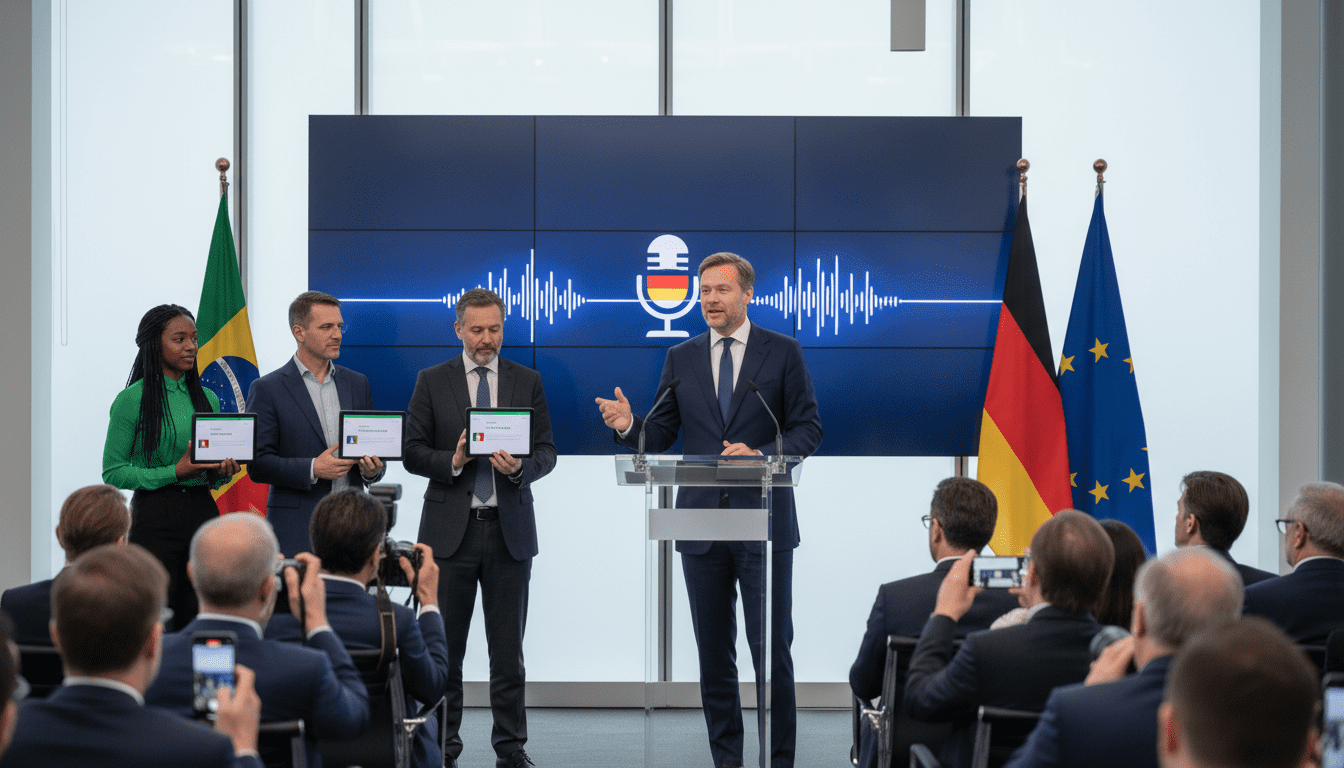
Spotify expands DJ to Germany and eight more countries, adding four new language voices
Spotify expands DJ to nine countries including Germany, adding German, French, Italian and Portuguese voices while rolling out new AI playlist tools.
Spotify announced on May 7, 2026 that its AI-driven Spotify DJ will be available in nine additional markets, including Germany, and will support four new languages. The move extends a feature that blends personalized song recommendations with voice commentary and places the Spotify DJ at the center of the company’s push to make generative AI a core listening experience. The expansion also adds German, French, Italian and Portuguese voice models, which Spotify says are based on recordings of real people though the company has not named the voice contributors.
Global rollout and new languages
Spotify first introduced the DJ feature in February 2023, and it has since been gradually extended beyond its initial U.S. and Canadian launch. From summer 2023 the feature reached more than 46 markets, and the announcement on May 7, 2026 brings the conversational DJ to nine further countries, including Germany. Spotify said the new language options aim to make the service feel more local while preserving the DJ’s conversational format.
The company did not disclose which individuals provided the voice models for the newly added languages, but it emphasized that the models are derived from real human voices. Spotify also noted that some advanced AI playlist tools remain limited to select markets and subscriber tiers.
Voices and sourcing
The DJ’s most widely recognized English voice has been identified in reports as Xavier Jernigan, commonly referred to within Spotify as “X.” For Spanish-speaking users, Spotify has used Olivia “Livi” Quiroz Roa, a curator on the company’s playlist team, since the service added Spanish voice interactions about a year ago. Text and voice prompts to request songs were introduced in May 2025, enabling listeners to shape the DJ’s output through direct feedback.
Spotify stressed that the DJ voices for new languages are based on recordings from real people, but it declined to publish a roster of contributors for the German, French, Italian or Portuguese models. That choice reflects a balance between crediting contributors and managing contractual or privacy considerations tied to voice data.
How the Spotify DJ works
The Spotify DJ offers a stitched listening experience: users receive a stream of tracks tailored to their tastes with short, spoken segments that introduce songs, explain artist context or respond to prompts much like a radio host. The feature is designed to blend machine learning recommendations with contextual commentary to make recommendations feel more immediately understandable. Users can interact via text or voice to ask for different moods, artists or even specific tracks.
Beyond the DJ, Spotify has rolled out several AI-powered playlist tools. “AI Playlist” allows users to create mood- or occasion-based lists through simple prompts, while “Prompted Playlist” gives more sophisticated access to a listener’s own history and supports complex instructions. Spotify indicated that some of these features are not yet available in every market, with AI Playlist and Prompted Playlist still rolling out to countries including Germany.
Competition from Apple, YouTube, Amazon and Deezer
Spotify is not alone in using generative AI to rework music discovery. Amazon Music and Deezer began testing prompt-driven playlists in 2024, and YouTube Music added a comparable DJ-like function for U.S. subscribers last year. Apple has also announced AI playlist-building tools, and multiple platforms are exploring integrations with services such as ChatGPT to extend conversational capabilities.
Streaming services increasingly reserve the most advanced AI features for paying subscribers, a common strategy to bolster premium tiers and differentiate products despite all outlets sharing largely the same music catalog. Spotify’s DJ, like similar capabilities at YouTube, is generally gated behind subscription plans and is not available on the ad-supported free tier.
Industry response: AI-generated music, labeling and verification
Generative AI is reshaping music creation and distribution, and platforms are grappling with how to classify and compensate works created entirely or partially by AI. Deezer reported in mid‑April that nearly 75,000 fully AI-generated tracks were being uploaded daily to its platform, a figure the company said represented roughly 44 percent of daily uploads at that time. Deezer also flagged that only a small share of those tracks account for plays, and it detects what it describes as fraud patterns in a majority of item-level accesses.
In response to transparency concerns, several services have begun to require or encourage labels and distributors to disclose AI involvement when uploading content. Spotify started asking for clearer signals around AI use in April and has introduced a new verification marker for artist profiles, promising to label profiles that represent established, human-driven artists. The company said profiles primarily representing AI personas are not currently eligible for the same verification status.
Generative AI is likely to continue changing how listeners discover and contextualize music, and platforms are adopting a mix of product rollouts and policy changes to manage that shift. Spotify’s expansion of the DJ and related tools reflects both competitive pressure and an effort to monetize AI-enhanced listening.
The rollout of Spotify DJ to Germany and other markets marks the latest phase in streaming services’ race to embed generative AI in everyday listening, with implications for user experience, artist visibility and how platforms police AI-created content. As the technology spreads, listeners and rights holders alike will be watching which features stick, how voice contributors are credited, and how services balance innovation with transparency and fair compensation.
