
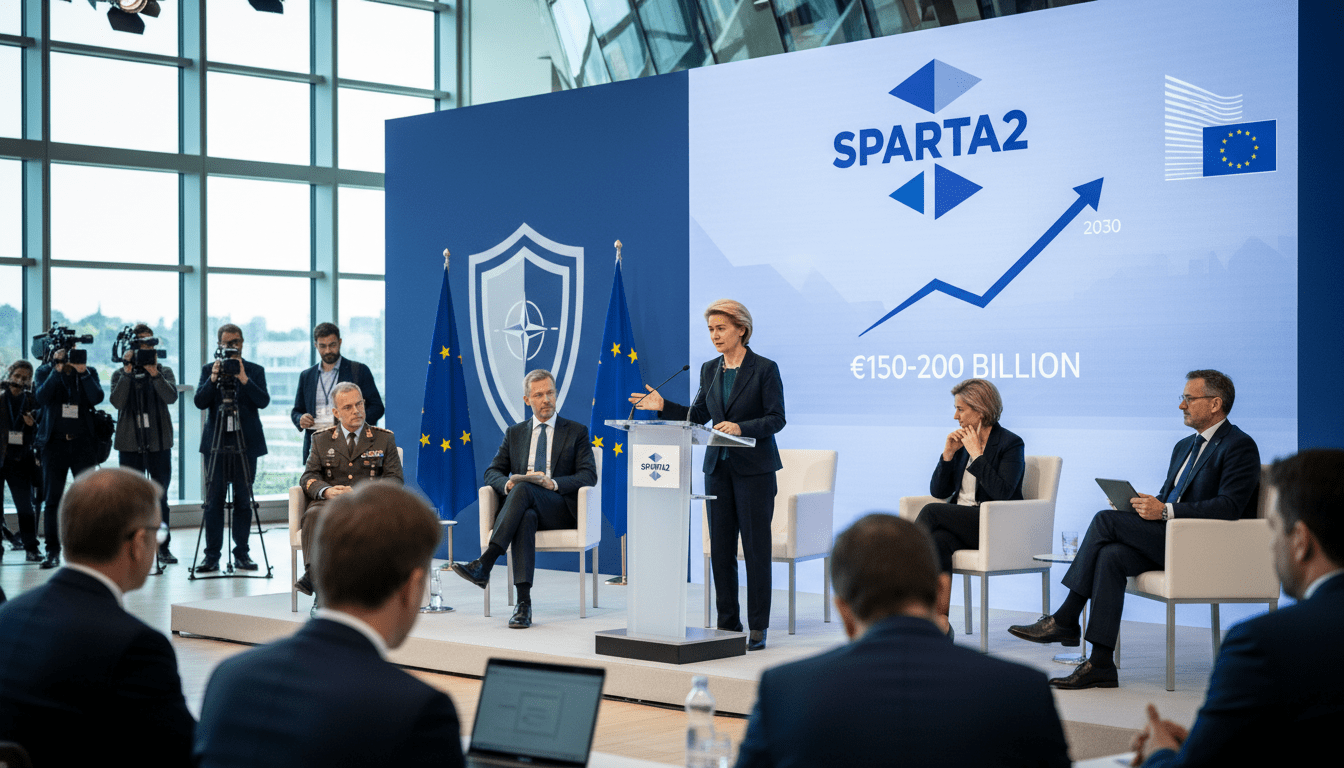
Europe urged to speed up European strategic autonomy in new Sparta2 report
Sparta2 report urges accelerated European strategic autonomy with €150–500bn programs, coalition-led procurement, startup contracts and urgent political will.
The Sparta2 paper released this week warns that Europe must accelerate plans for European strategic autonomy to close critical defence gaps and reduce dependence on the United States. The report, authored by a group of policymakers, economists and industry figures, maps priority capability shortfalls and estimates the costs of closing them through 2030 and beyond. Its central message is that money and technology exist, but political will and coordinated action are missing.
Authors and headline findings announced
The Sparta2 study was published by a team that includes former industry executives, economists and policy advisers who previously sparked debate with an earlier Sparta paper. The authors list Europe’s key capability gaps and propose concrete programmes to be prioritised in the coming years. They estimate a bill of €150–200 billion by 2030 and roughly €500 billion for the next decade to build a credible independent deterrent.
Political will named the main constraint
Lead contributors argue the principal obstacle is not funding or technological capability but the political willingness to act together. A senior author said rapid, pragmatic decisions and sustained coordination among capitals are required to turn plans into capability. The paper stresses that reallocating existing defence spending toward shared strategic programmes is preferable to creating costly new bureaucracies.
Short-term priorities: air defence, drones and command systems
Sparta2 identifies a group of programmes that could show measurable progress within three to five years, including layered air defences, counter-drone systems and reinforced command-and-control architectures. The report highlights initiatives such as laser-based interceptors, counter-uncrewed aircraft systems and European alternatives to existing US systems as immediate targets. Authors contend that investment in these areas would significantly increase deterrence while buying time for longer-term projects.
Longer-term projects: satellites and sovereign launch capability
The paper places space-based surveillance and a domestic launch industry in a second tier that will take at least five years to mature. Building a resilient European satellite reconnaissance architecture as a credible alternative to commercial constellations, and developing the transport infrastructure to support 50 or more launches a year, are described as strategic imperatives. Those programmes require both sustained funding and industrial ecosystems that current procurement models do not yet favour.
Coalition approach and national roles recommended
Instead of pushing for a single new European agency, the report recommends forming “resilient lead coalitions” among willing states with clear coordinating roles. Germany, France, Poland and the United Kingdom are named as likely coordinators for different capability clusters, while Nordic countries, the Baltic states and the Netherlands are urged to lead maritime autonomy efforts. This pragmatic, coalition-driven model is presented as faster and politically more feasible than sweeping institutional reform.
Startups, procurement and economic returns
The authors call for governments to use procurement — not equity stakes — to spur a new generation of defence technology firms, arguing that public contracts create investor incentives and industrial ecosystems. The report cites recent purchases of tactical systems from small firms as important but insufficient steps, and recommends scaling state demand to foster suppliers and suppliers’ supply chains. An economist among the authors projects a multiplier of roughly 15 for each euro spent on high-tech defence investment, underscoring the report’s claim that such spending would also deliver economic growth.
Europe stands at a decisive moment, the paper argues, where timely political decisions could translate current defence spending into interoperable, sovereign capabilities. The authors urge immediate programme launches, clearer national roles, and procurement practices that privilege strategic independence. If implemented, these measures would reshape Europe’s defence posture and reduce the strategic burden currently shouldered by transatlantic partners.
