
Tour de France 2026: Route, Early Winners and the Road to Alpe d’Huez
Comprehensive guide to the Tour de France 2026: route, stage winners, key climbs including Col du Galibier and Alpe d’Huez, favorites, teams and TV coverage.
The Tour de France 2026 began in Barcelona on July 4 and will conclude on the Champs-Élysées in Paris on July 26, featuring 21 stages and 184 riders across 23 teams. Early racing has produced a string of decisive stage results and left the general classification battle shaped around the season-long duel between Tadej Pogacar and Jonas Vingegaard. This article summarizes the route, the standout stage winners to date, the major climbs ahead and the teams and broadcast arrangements for the remainder of the race.
Race overview and opening itinerary
The 2026 route covers 3,321 kilometers through 29 French departments with a total of roughly 54,450 meters of vertical gain. Organizers split the race into seven flat stages, four hilly stages and eight mountain stages, and scheduled two time trials along with two rest days on July 13 and July 20. The race opened with a 19.6 km team time trial in Barcelona, an unusual start outside France that sets early gaps before the peloton reaches the high mountains.
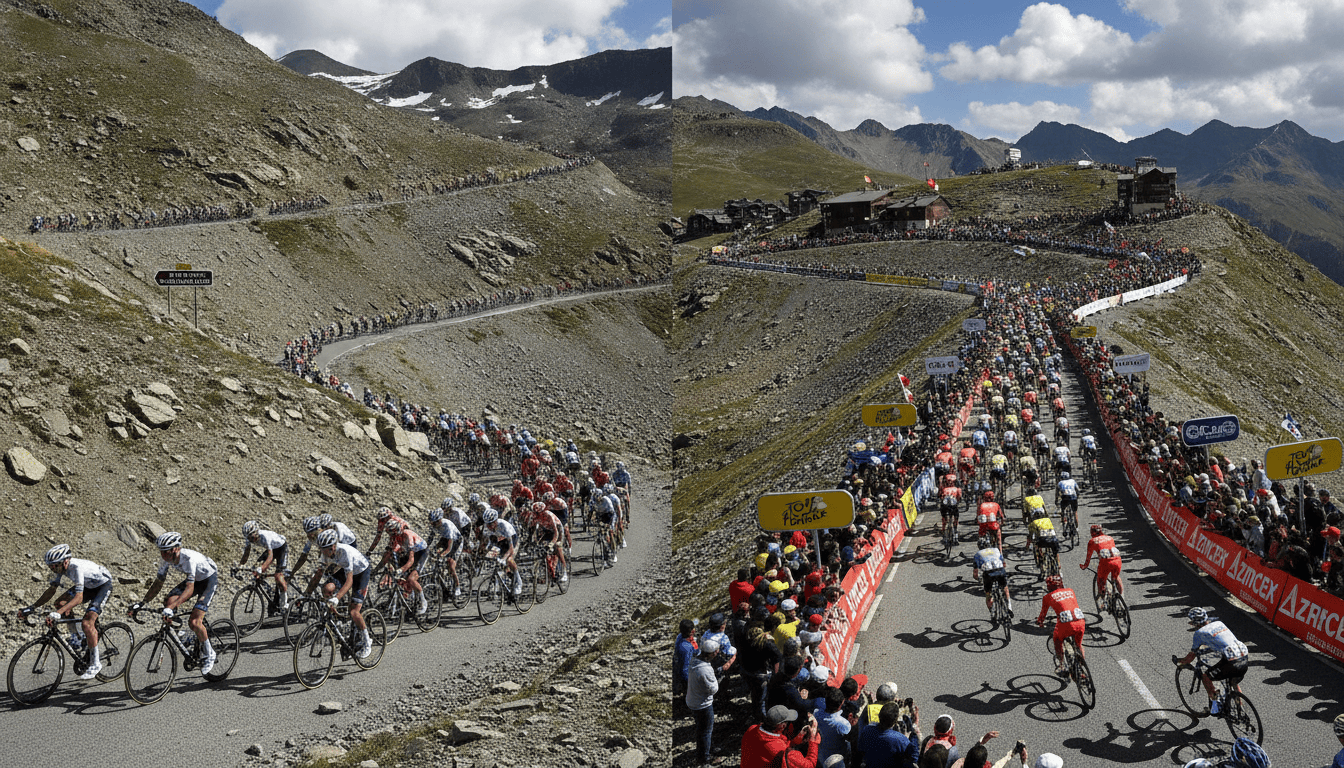
The parcours places several decisive tests in the third and final weeks, with back-to-back summit finishes and a dramatic king stage the day before Paris that includes the Col du Galibier and finishes at Alpe d’Huez. Those mountain days will likely determine the overall outcome, while the intermediate flat stages remain crucial for sprinters and breakaway specialists.
Stage winners and early classification leaders
Team Visma-Lease a Bike took the opening team time trial in Barcelona, putting their captain Jonas Vingegaard and his squad into an early commanding position. Individual stage victories have come from a mix of sprinters and all-rounders, with Isaac del Toro and Olav Kooij among the early flat-stage winners. Tim Merlier has collected multiple sprint triumphs, while Mathieu van der Poel and Mauro Schmid have taken wins on more selective terrain.
Tadej Pogacar has already claimed several mountain stage victories and sits with a clear margin in the overall standings after strong performances on key ascents. Pogacar’s UAE Team Emirates-XRG rode aggressively on the mountain days, converting form from a successful spring and summer campaign into stage wins and time gains that put him on course for a potential fifth Tour title.
Mountain tests and the Galibier–Alpe d’Huez double
The race’s hardest climbing arrives in the final weekend. The penultimate weekend features two finishes on Alpe d’Huez, with the 19th stage scaling the classic 21 hairpins after a short, intense day, and the 20th taking a novel route via the Col de Sarenne. Organizers have reintroduced the Col du Galibier on the king stage, sending riders above 2,600 meters and into sustained high-altitude climbing that includes roughly 5,450 meters of ascent across the stage.
That king stage, scheduled for July 25, packs multiple high-category climbs including the Col de la Croix de Fer and Col du Télégraphe before the Galibier, then a final push toward Alpe d’Huez. The sequence offers multiple opportunities for time gaps and tactical attacks, and teams will need to manage resources carefully after earlier mountain efforts and the individual time trial.
Vosges stage and German interest near the border
On July 18 the race passes through the Vosges in a stage that starts in Mulhouse and finishes at Le Markstein Fellering, bringing the race within roughly 20 kilometers of the German border. That day’s parcours features three first-category climbs including the Grand Ballon and Ballon d’Alsace, yielding 3,800 meters of climbing over 155 kilometers. German fans have particular reason to follow the stage closely because Florian Lipowitz, who finished on the Tour podium last year, is among the race favorites and is expected to draw vocal domestic support along the route.
The Vosges stage can reshape the top 10 and serves as a final major test before the second rest day, giving both GC contenders and opportunists a chance to animate the race well before the high Alps arrive.
Favorites, young hopes and the Pogacar–Vingegaard rivalry
The overall picture still centers on the rivalry between Tadej Pogacar and Jonas Vingegaard, with Pogacar seeking a fifth title and Vingegaard hoping to close a margin that has widened in recent seasons. Vingegaard arrives after victories in the Giro d’Italia and Paris–Nice, while Pogacar’s season featured wins at Strade Bianche, Milano–Sanremo and Liège–Bastogne–Liège plus strong performances in shorter stage races.
France’s 19-year-old Paul Seixas has emerged as a young dark horse and national hope after wins in the Basque Country and aggressive rides in the spring classics. Other names to watch include Remco Evenepoel and Florian Lipowitz from Red Bull – Bora-hansgrohe, Remco’s co-leadership pairing, plus seasoned contenders such as Egan Bernal and Richard Carapaz who can alter dynamics with a single bold move.
Teams, captains and broadcast coverage
Twenty-three teams field 184 riders in this edition, with leaders distributed across the WorldTour landscape: Tadej Pogacar for UAE Team Emirates-XRG, Jonas Vingegaard for Team Visma-Lease a Bike and Remco Evenepoel for Red Bull – Bora-hansgrohe among the headline captains. The start list also features sprint specialists, domestiques and several German riders making notable appearances, including John Degenkolb and Nils Politt.
Broadcast coverage for the Tour de France 2026 is available on public and pay channels. In Germany the race is shown live on ARD with daily broadcasts beginning around 14:00 CET, while Eurosport and streaming services such as Discovery’s platform, HBOMax and DAZN provide additional live or streaming options.
The coming stages—particularly the individual time trial at Évian-les-Bains and the final Alpine block—will test team depth and individual endurance, and they are likely to decide who stands on Paris’s podium on July 26.
