
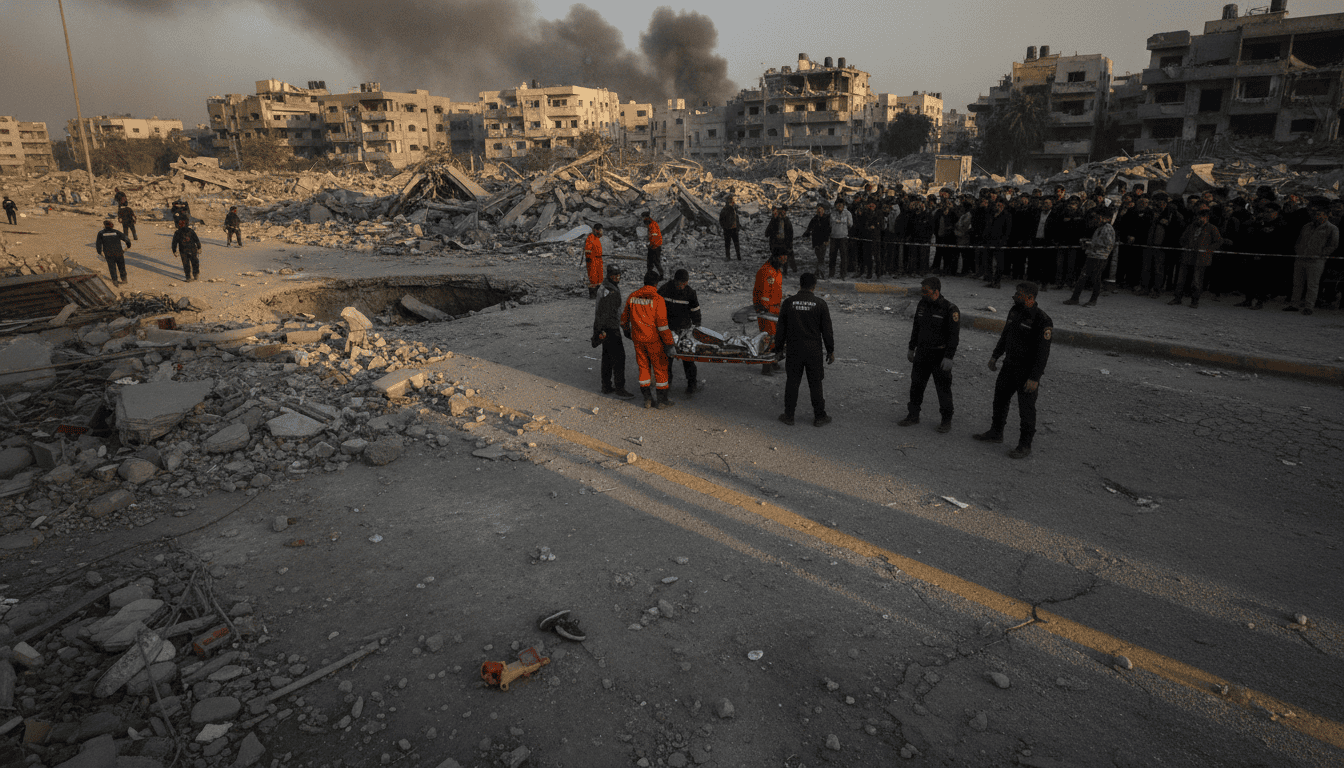
Gaza City attacks kill at least eight as strikes hit al-Nasr and al-Zeitoun beyond ceasefire line
Gaza City attacks kill at least eight Palestinians after Israeli strikes struck al-Nasr and al-Zeitoun on July 18, 2026, pushing beyond the ceasefire “Yellow Line.”
Israeli strikes on Saturday struck two residential neighbourhoods in Gaza City, killing at least eight people and damaging civilian buildings, medical sources and witnesses said. The attacks, which included a warplane strike and artillery fire, hit areas that had been considered outside the frontlines under the October ceasefire agreement.
Fatal strikes in al-Nasr and al-Zeitoun
Medical staff at the Al Shifa hospital complex reported that a missile detonated in a second-floor apartment block in the al-Nasr neighbourhood, killing five people and reducing the building to rubble. Witnesses said adjacent blocks were badly damaged and rescue crews were digging through debris to reach possible survivors.
Earlier on the same day, artillery fire in the nearby al-Zeitoun district killed three residents, according to hospital sources, and similar strikes have recently affected the Tel al-Hawa area. Local responders warned that casualties could rise as search-and-rescue operations continue amid dense urban rubble.
Expansion of strikes beyond the declared “Yellow Line”
Officials and local reporting said the strikes mark a widening of the areas Israeli forces are striking inside Gaza, moving beyond the so-called “Yellow Line” that had been used to delineate operational limits during the ceasefire. Israeli media have reported that military control has extended into a larger portion of the territory than previously acknowledged.
Observers in Gaza described the move as a shift in the practical frontlines, with Israeli forces carrying out operations across multiple districts. The Associated Press reported that Israel confirmed it conducted strikes across Gaza on Saturday, reflecting differences in how the parties interpret the ceasefire boundaries.
Casualty figures and hospital strain
Gaza’s Health Ministry has reported sustained civilian losses since the ceasefire took effect, citing more than a thousand Palestinian deaths and a high number of child fatalities in the months that followed. Medical facilities in Gaza City, already operating under severe strain, say they are treating dozens of wounded from daily strikes while dealing with shortages of equipment and supplies.
Al Shifa and other hospitals are continuing to receive trauma cases from densely populated neighbourhoods, hospital sources said, and rescue teams face difficult conditions when accessing collapsed buildings. Local health officials repeatedly warned that any escalation in strikes would further overwhelm medical capacity.
Fragmentation of urban areas and movement restrictions
Journalists reporting from Gaza described how the expansion of operations is fragmenting the urban landscape, effectively shrinking contiguous safe areas and making civilian movement perilous. Field reporters said residents are finding it increasingly hard to travel between districts for food, medical care and shelter as frontlines shift.
Aid workers and local officials expressed concern that the fragmentation will deepen humanitarian hardship by cutting communities off from markets, services and humanitarian corridors. The breaking up of neighbourhoods into smaller, disconnected pockets could also complicate coordinated relief efforts and evacuation planning.
Political and diplomatic backdrop
The strikes occurred against the backdrop of a US-brokered ceasefire struck in October, which was part of a broader plan proposed by then-President Donald Trump to halt hostilities and begin reconstruction. Despite the agreement, both sides have accused each other of violations while limited operations have continued across Gaza.
Israel has said its strikes target military assets and militants operating within densely populated areas, while Palestinian authorities and witnesses report civilian harm and extensive damage to homes. International actors monitoring the situation have called for restraint and for mechanisms to ensure the protection of civilians under any ceasefire framework.
Outlook and risks for civilians
Humanitarian groups in Gaza warn that continuing strikes beyond previously agreed lines raises the risk of further civilian casualties and long-term damage to urban infrastructure. Residents who have remained are confronting a steady erosion of normal urban life, with livelihoods, schools and markets disrupted by the shifting security landscape.
As rescue and medical teams work to reach victims in al-Nasr and al-Zeitoun, the immediate priority remains locating survivors beneath rubble and delivering critical care. The trajectory of operations and any diplomatic response in the coming days will be pivotal for civilians who face mounting losses and displacement.
