
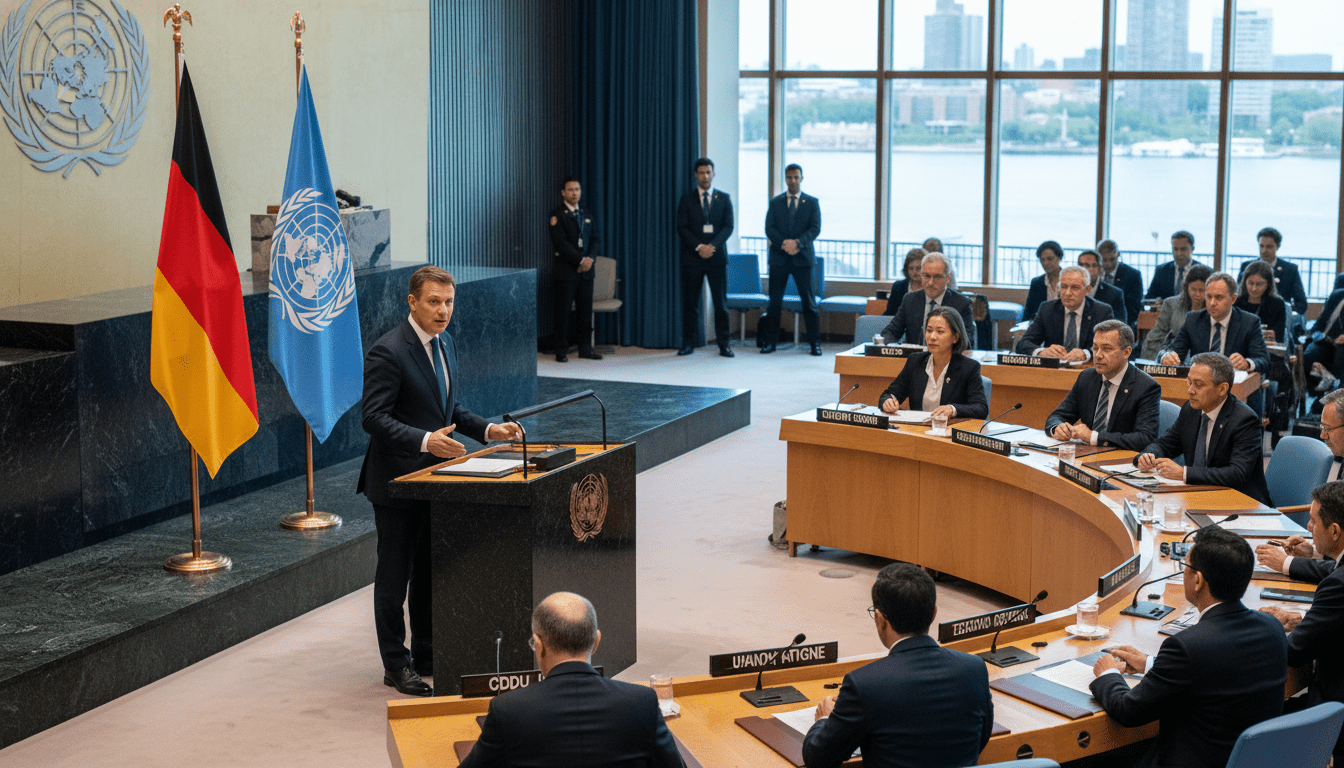
Germany’s bid for a UN Security Council seat: Wadephul says international goodwill could secure victory
Germany’s bid for a UN Security Council seat faces Austria and Portugal; Foreign Minister Johann Wadephul cites international sympathy and aims for 129 votes.
Germany’s bid for a UN Security Council seat was cast in confident terms this week by Foreign Minister Johann Wadephul, who said diplomatic conversations indicate a “basic sympathy” for Berlin’s candidacy. The campaign pits Germany against Austria and Portugal for two non-permanent seats covering 2027–2028, with the final decision to be made by secret ballot in the UN General Assembly in New York. Wadephul acknowledged the competitiveness of the race but expressed belief that Germany can marshal the two-thirds majority required for election. The statement frames a high-stakes diplomatic push as member states begin final consultations.
Wadephul signals optimism after outreach to UN capitals
Wadephul told German public radio that talks with envoys from other countries left him encouraged about Germany’s standing. He said the interactions revealed a reservoir of goodwill that could translate into votes when members convene for the secret ballot. The Foreign Minister also stressed that campaigning in a contest with close European partners requires careful diplomacy rather than abrasive competition. His remarks underline Berlin’s strategy of blending quiet lobbying with public confidence in its qualifications.
Three-way contest for two 2027–2028 seats
Germany is competing with Austria and Portugal for two non-permanent seats on the Security Council that will cover the two-year term 2027–2028. The three EU candidates must secure enough support among the 193 UN member states in the General Assembly where two seats are available for the regional group. The presence of three relatively well-regarded European candidates increases the likelihood of multiple voting rounds if neither side reaches the threshold immediately. Observers say the close ties among the contenders make the campaign distinct from more adversarial contests.
Voting mechanics: two-thirds majority and secret ballot
Election to a non-permanent Security Council seat requires a two-thirds majority of those voting in the General Assembly, which equates to 129 votes when all 193 UN members cast ballots. The process is conducted by secret ballot and may extend to successive rounds if the initial vote fails to deliver the necessary majority. That structure elevates the importance of sustained diplomatic outreach in the weeks leading up to the vote and means backroom negotiations often determine outcomes. Campaign teams therefore focus on securing pledged support and persuading undecided delegations through policy commitments and bilateral engagement.
Germany’s history on the Security Council and campaign rhythm
Since reunification, Germany has repeatedly sought a non-permanent seat on the Security Council roughly every eight years and has been successful in previous bids. Berlin has served on the Council six times, most recently during 2019–2020, and has used those terms to press on issues ranging from conflict prevention to arms control. The country’s recurring candidacies reflect a broader ambition to play a more prominent role in global governance, including long-standing calls by some German leaders for permanent representation reforms. That legacy bolsters Germany’s credibility but does not guarantee votes in a competitive EU field.
Diplomatic outreach, goodwill and electoral challenges
Campaigning for a Security Council seat in the General Assembly is rarely a televised spectacle; it is won by building coalitions and addressing regional and programmatic concerns voiced by small and medium-sized states. Wadephul’s reference to a “basic sympathy” signals that Germany believes its record and policy priorities resonate across diverse regions. Yet diplomats caution that Austria and Portugal are also persuasive candidates, both with strong ties to many member states, particularly in Latin America, Africa and among Mediterranean partners. The contest may therefore hinge on targeted promises, such as increased development cooperation or support in multilateral forums, that sway undecided delegations.
What a seat would mean for Germany’s international role
A non-permanent seat on the Security Council confers greater opportunity to shape the body’s agenda and to chair or influence key committees, although it does not carry veto power. The Council remains the United Nations’ only organ able to pass binding resolutions on international peace and security, a fact that makes membership valuable for countries seeking leverage on crises. Critics point out that the Council’s effectiveness is often constrained by divergent interests among its five permanent members, but even so, non-permanent members can drive negotiations, lead initiatives and spotlight crises that might otherwise be sidelined. For Berlin, a seat would be both symbolic and practical: a platform to project policy priorities and to defend international norms.
Germany’s bid for a UN Security Council seat will therefore be judged not only on diplomatic niceties but on the technical arithmetic of the General Assembly ballot and the comparative appeal of programmatic offers. As campaigning continues, attention will focus on which delegations commit early and whether the contest requires additional voting rounds to produce two winners. The outcome will gauge not just bilateral affinities but the wider appetite among UN members for Germany’s vision of multilateral action.
