
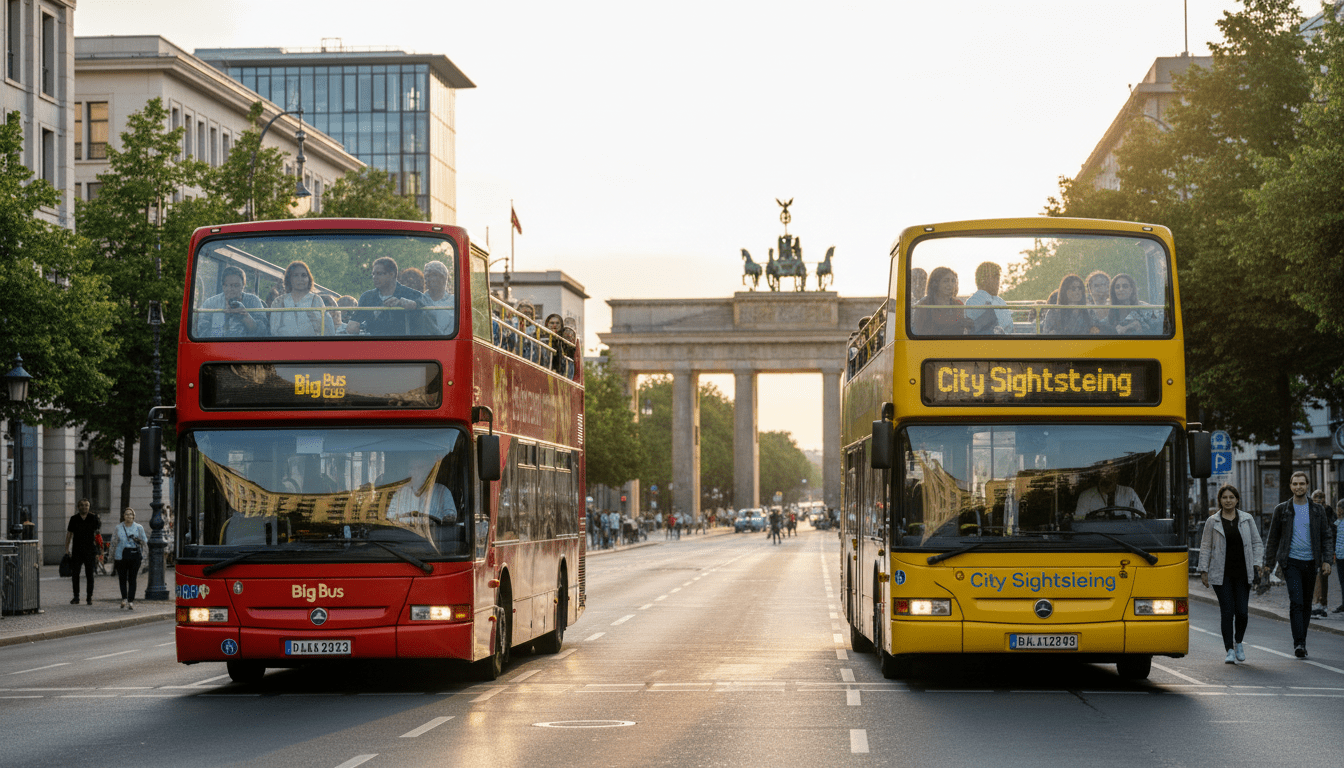
Berlin hop on hop off buses: updated comparison of Big Bus and City Sightseeing for visitors
Compare the two main Berlin hop on hop off buses—Big Bus and City Sightseeing—in this updated guide, including routes, schedules, fares and practical tips for visitors.
Berlin’s two principal hop on hop off buses are being presented side by side in an updated practical guide that summarizes routes, ticket options and key differences for visitors wanting a quick orientation of the city. The comparison focuses on Big Bus Berlin and City Sightseeing Berlin, laying out operating hours, route lengths, audio-guide languages, child and family fares, and ancillary extras to help travelers pick the right option. This report highlights the differences that most frequently affect decisions, such as child-age policies, family ticket availability, date flexibility and bundled extras, so readers can plan an efficient sightseeing day.
Two leading operators compared
Both companies operate double-decker sightseeing services across central Berlin and provide hop on hop off flexibility, but their commercial offers diverge in several practical ways. Big Bus groups its core itinerary into a red city loop plus a shorter blue line to the East Side Gallery, while City Sightseeing markets a “classic” central route plus a separate East Berlin route that includes historical memorials. These structural differences determine how many stops you can visit without switching tickets.
Price structure and included extras form the most visible distinctions. Big Bus sells a variety of 24- and 48-hour products that bundle walking tours, evening tours and food vouchers at higher tiers, and it offers a family ticket option priced for two adults and two children. City Sightseeing tends to price its standard single-route ticket slightly lower and offers add-on packages that combine the bus with attractions such as the TV Tower or an Ice Bar visit. Date-change and cancellation policies also differ between the operators and can influence planning flexibility.
Operational details such as frequency, route duration and child-age thresholds make a practical difference for many travelers. Big Bus typically runs its central line at 20–30 minute intervals and a blue East Side service on an hourly schedule, while City Sightseeing schedules roughly 25-minute frequency on the classic route and longer intervals for its East Berlin line. Child fare bands and the age at which a passenger is considered an adult vary by operator and can alter the total cost for families.
Who benefits from a Berlin hop on hop off bus
Visitors with limited time in Berlin benefit most from a hop on hop off service because it delivers a fast, low-effort orientation and direct access to major landmarks. Travelers who have only one or two days in the city can cover highlights such as Brandenburg Gate, Museum Island and the East Side Gallery without navigating multiple transit changes. The format is also useful for people who prefer minimal walking or who want a curated overview before they decide where to spend more time.
Families with young children will find value when ticketing aligns with their group: Big Bus offers a designated family ticket that may be more economical for two adults and two children, while City Sightseeing’s per-person pricing and bundled attraction options can suit different family itineraries. Runners, athletes and visitors seeking an easy pre-event day—such as before a marathon—also use these buses as a low-impact way to see the city while keeping their feet rested.
Hop on hop off buses are less suitable for travelers seeking off-the-beaten-path experiences or extended stays at a single site. Those who want to explore neighborhoods slowly, delve into local cafés, or discover hidden cultural venues will likely prefer walking neighborhoods on foot, bike tours, or public transport for deeper exploration. Similarly, visitors who seek the most economical way to move around for multiple days might find Berlin’s transit passes more cost-effective than repeated hop on hop off tickets.
Big Bus Berlin: routes, schedules and ticket features
Big Bus Berlin operates two distinct lines: a red central route that covers most major central sights and a blue route aimed at the East Side Gallery corridor. The red route includes roughly 17 stops and can be completed in about two hours if you remain on board for the full circuit. The blue route, designed to connect both ends of the East Side Gallery, comprises four stops and takes approximately 40 minutes to run end to end.
Standard operating hours for the red line fall within a daytime window and the blue line runs with a shorter daily span; frequencies are typically every 20–30 minutes on the red route and about every 60 minutes on the blue route. Big Bus also provides multi-language audio commentary covering English, German, Italian, French, Spanish, Russian and Brazilian Portuguese, which can help international visitors contextualize landmarks without a separate guide.
Ticket options from Big Bus include 24-hour and 48-hour variants with tiered inclusions. The 24-hour Discover ticket is priced, as published in late 2024, at about 33.30 euros for adults aged 16 and over and 22.50 euros for children aged 5–15, while a family ticket package for two adults and two children was listed at 90 euros. The provider’s 48-hour Essential and Explore tickets add features such as guided walking tours, free local food vouchers and evening guided walks at higher price points; travelers should note that 48-hour tickets generally require consecutive-day use.
Big Bus’s booking terms include a specific date choice for 24-hour tickets that cannot be changed after purchase, whereas 48-hour products can offer flexible date changes. Children under the age of five typically travel free when accompanied by an adult, and the adult age threshold is 16 and older, which aligns with many local ticketing standards but requires attention if traveling with children who are near the age cutoffs.
City Sightseeing Berlin: routes, schedules and ticket features
City Sightseeing Berlin organizes its hop on hop off service around a main “Classic” route covering central attractions and a second route that extends to the East Side Gallery and Bernauer Strasse Wall Memorial. The company’s classic circuit lists about 18 stops and takes roughly two hours to complete if passengers stay aboard. The East Berlin route is shorter, taking about one hour for a full loop.
Service hours for City Sightseeing have a broad daytime window, with a typical operating span from mid-morning until early evening, and the classic route runs at approximately 25-minute intervals. The East Berlin route is scheduled less frequently, near 40-minute intervals, which means riders should plan for slightly longer waits on that line. Audio commentary is widely available in many languages, including English, Spanish, French, German, Italian, Hebrew, Japanese, Chinese, Portuguese, Polish, Arabic and Turkish.
City Sightseeing’s ticket menu includes a Classic single-route 24-hour ticket, a Two Routes ticket that covers both itineraries in 24- or 48-hour formats, and combo packages that combine the bus with local attractions. Published pricing from September 2024 shows a 24-hour Classic adult ticket at about 25 euros and a child ticket for ages 6–15 at roughly 12.50 euros. The Two Routes 24-hour ticket was listed around 30 euros for adults and 15 euros for children, while the 48-hour Two Routes option carried a slightly higher adult fare.
The operator’s bundled extras offer a different set of choices compared with its competitor. For example, City Sightseeing makes available a bus-plus-TV-Tower fast-track ticket and bus-plus-Ice-Bar options, in addition to combined bus-and-boat sightseeing tours along the Spree. City Sightseeing’s voucher policy permits redeeming within a three-month window from the selected calendar date and typically includes free cancellation up to 24 hours before the chosen date, adding planning flexibility for visitors.
Practical comparisons and decision scenarios
Cost-conscious travelers should calculate total group cost rather than simply comparing single adult fares, because family and child policies substantially affect the final price. For a family of four with two adults and two children, Big Bus’s dedicated family ticket can yield savings compared with buying individual child tickets on City Sightseeing, where no equivalent family package exists. Conversely, solo travelers or couples who plan to pair the ride with a single attraction might find City Sightseeing’s lower standard 24-hour adult fare and bundled attraction packages more economical.
If itinerary flexibility and date changes are a priority, City Sightseeing’s three-month voucher window and relaxed change/cancellation terms can be advantageous. Big Bus requires a fixed date for its 24-hour Discover product, which is non-changeable, though its 48-hour products do allow date adjustments. Travelers should therefore consider whether they need the instant certainty of a fixed-date pick or the contingency of a flexible voucher when making a booking.
Route coverage and frequency matter if you intend to rely on the bus as a primary transport tool rather than as a single orientation ride. Big Bus’s red route is tightly focused on the city center with more frequent loops, and the supplementary blue line targets the East Side. City Sightseeing’s Two Routes option can cover equivalent ground but may require buying a higher-tier ticket to access both itineraries. For visitors who plan to spend lengthy periods at particular stops, frequency differences on the East-oriented lines could influence how much waiting time they accept between loops.
Booking tips, accessibility and operational notes
Both operators typically offer mobile tickets or printable vouchers and run Wi‑Fi on board, which helps with navigation and on-the-spot planning. Travelers should save digital tickets and allow extra time at busy stops during high tourism months to account for boarding queues and peak loads. When using combined offers such as boat cruises or TV Tower entries, check seasonal availability since river cruises generally operate in spring through early autumn and certain attractions have restricted opening hours.
Accessibility and physical comfort vary by vehicle and stop infrastructure; double-deckers provide upper-level views but require stair access, while lower-level boarding is generally possible for those with mobility constraints. Visitors with limited walking capacity can plan routes with fewer transfers and longer stays at accessible stops; customer service at both companies can advise on step-free options and assistance where available. Weather can affect comfort and top-deck use, so carry suitable outerwear and consider enclosed seating on colder or rainy days.
Large public events and road closures occasionally interrupt hop on hop off services, so it is prudent to verify planned operation on the intended date. Notable annual events can result in restricted routes or suspended service on particular days; for example, major running events that close central streets may prevent buses from completing their normal circuit. If traveling during a festival, demonstration or large sporting event, confirm service status directly with the operator before departure.
Sights covered and alternatives to bus sightseeing
Both operators route past Berlin’s headline landmarks: Brandenburg Gate, Museum Island and Alexanderplatz appear on central loops, while the East Side Gallery and Bernauer Strasse Wall Memorial feature on extended eastward itineraries. The hop on hop off format allows visitors to disembark at principal points to tour museums, memorials and public squares, then rejoin a later bus to continue the circuit. For many first-time visitors, the combination of panoramic views and on-site visits provides a balanced first-day experience.
For travelers who prefer a more active or intimate approach to the city, walking tours, bicycle tours and guided neighborhood walks can uncover local architecture, food markets and smaller museums that buses do not reach. Boat tours along the Spree present a waterborne perspective on the same central landmarks and are often offered as an add-on by both bus companies. Budget-minded visitors who will use public transit intensively may save money with a Berlin transport day pass or a multi-day transit card instead of relying solely on hop on hop off tickets.
Local walking guides, themed tours—such as Cold War history walks—and neighborhood-focused food experiences complement bus sightseeing by offering depth in a compact time frame. Combining a morning bus loop to orientate and an afternoon guided walk or museum visit can yield a fuller understanding of Berlin’s layered history without incurring major additional travel time. For travellers with limited time, planning in advance which stops to prioritize prevents wasted rides and ensures the day meets personal interests.
This comparison is intended to equip visitors with the facts they need to choose between the two main hop on hop off bus operators in Berlin based on price, flexibility, route coverage and extras. For the most current schedules, prices and availability—particularly if you are booking close to your travel date—confirm details with the operators directly and review seasonal notices that could affect service.
