
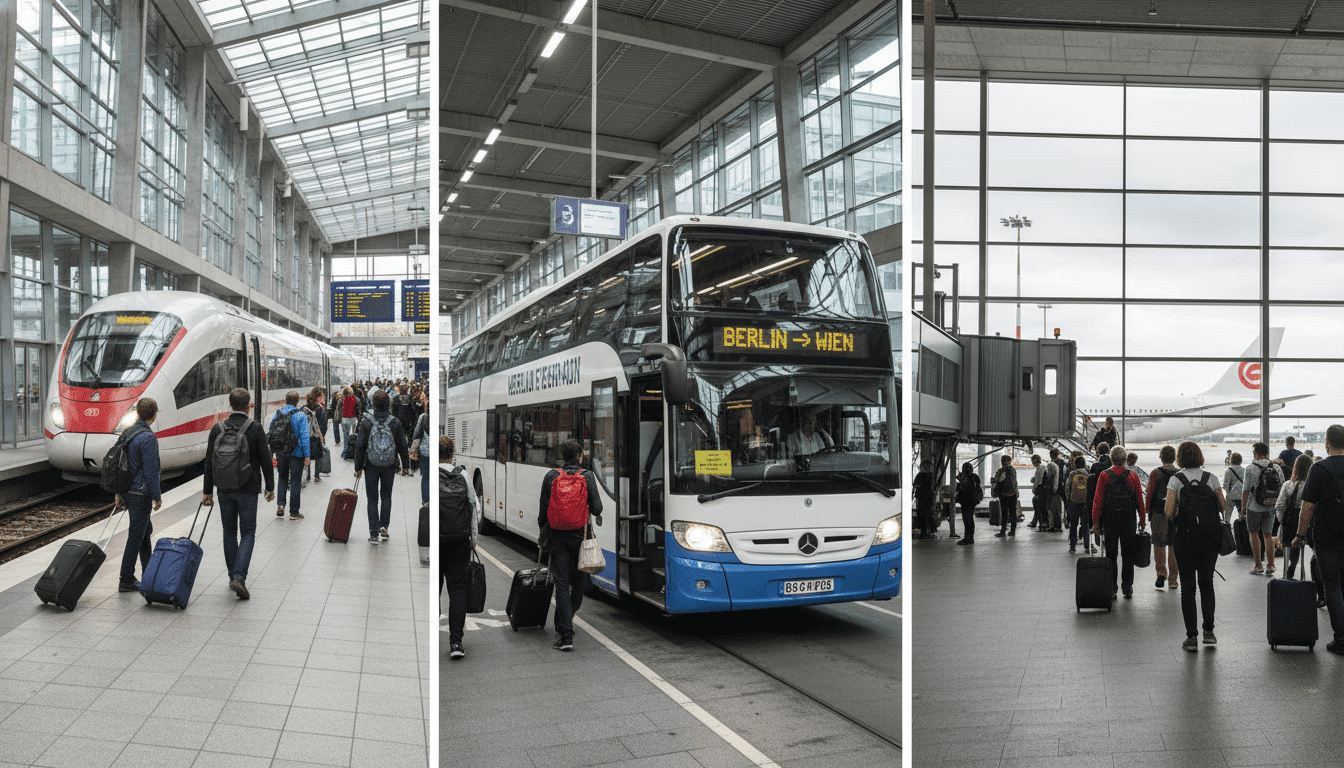
How to get from Berlin to Vienna — trains, buses, night trains and flights
How to get from Berlin to Vienna — a guide to trains, night trains, buses and flights with travel times, price ranges and booking tips for a smooth trip.
Berlin to Vienna remains one of Central Europe’s most-trafficked city-to-city corridors, and travellers now have a range of practical options to choose from. This guide explains how to get from Berlin to Vienna by train, night train, bus, car and plane, summarising journey times, typical prices, reservation rules and booking tips. It is aimed at readers seeking clear, up-to-date choices so they can match time, comfort and budget priorities.
Train services between Berlin and Vienna
Long-distance trains link Berlin Hauptbahnhof and Vienna Hauptbahnhof several times each day, offering a reliable and comfortable overland option. The fastest services are operated as high‑speed or intercity connections and typically take around seven and a half to eight hours when a direct or single‑change itinerary is available. Rail service operators include Deutsche Bahn for German segments and Austrian operators for cross‑border legs, and ticketing for most options can be purchased through the national booking platforms.
Direct or one‑change routes most commonly use ICE (Intercity‑Express) and Railjet stock, with some services shown as EC or IC on timetables where international operators participate. Railjet services often include more intermediate stops and can extend the journey to about eight and a half hours, while ICE connections tend to be slightly quicker when they run with minimal intermediate calls. Travel time can vary with the specific route chosen, so checking the detailed timetable for the selected day remains essential.
High‑speed trains bind you to a specific departure when you buy a discounted fare; the less restrictive Flex fare allows same‑day changes but costs more. Second‑class tickets commonly do not include a seat reservation, while an added reservation typically costs a modest supplementary fee. First‑class tickets often include reservation options and more space, which some travellers find worthwhile on this long daytime run.
Regional rail combinations are technically possible but impractical for most visitors: stitching together only regional services can stretch the trip to well over 15 hours and requires multiple connections. That approach is best suited to travellers planning slow, scenic itineraries or who require maximum flexibility, not to those aiming to move efficiently between the two capitals.
Night train alternatives and sleeper services
For travellers who prefer to travel overnight and save a hotel night, dedicated night train services offer couchettes and private sleepers on the Berlin–Vienna corridor. Night trains typically depart late in the evening and arrive early the next morning, turning travel time into sleeping time and often taking roughly 11–12 hours door‑to‑door. That timetable makes night services an attractive option for those who want to preserve daytime hours in either city.
Night train configurations range from reclining seats to shared couchettes and private sleeper cabins with or without en‑suite facilities. Prices scale with comfort level: reclining seats are the cheapest, couchettes provide basic berths in shared compartments, and private sleepers are substantially more expensive but provide privacy and a higher level of comfort. Choosing a couchette or sleeper can compare favourably to the combined cost of a hotel night and daytime transport.
Booking early is recommended because night trains are popular on holiday weekends and during peak travel seasons. A sleeper cabin will often include bed linens and sometimes a small washstand; couchettes provide a simpler, lower‑cost sleeping option but may involve sharing with other passengers. For many, the ability to travel while sleeping and arrive early to start the day in Vienna is the deciding factor.
Bus alternatives and budget connections from Berlin to Vienna
Low‑cost long‑distance buses form a strong budget alternative between Berlin and Vienna, and several daily departures mean flexibility for different schedules. Typical direct bus durations range from about eight and a half to nine and a half hours under normal traffic conditions, and overnight services are commonly offered for passengers who prefer to sleep en route. Operators run departures from multiple points across Berlin, though most long‑distance services call at the central bus station known as the ZOB.
Buses generally offer lower fares than rail or air when booked moderately in advance, making them the first choice for price‑sensitive travellers. Onboard amenities vary by carrier but usually include at least basic reclining seats, luggage hold space and an onboard washroom. Seat reservations are optional on many services and can be purchased for a small fee if travellers want to secure specific seating or travel side‑by‑side with companions.
Departure points matter for convenience: while some buses leave from Berlin Südkreuz or Alexanderplatz, the main ZOB facility sits on the western edge of the city and can require additional travel time to reach. Travellers should allow extra time for transfers to the bus station, particularly for early‑morning or late‑night departures, and should weigh any airport or central‑station connections against the overall savings a bus ticket provides.
Flying between Berlin and Vienna and door‑to‑door timing
A nonstop flight between Berlin and Vienna typically spends about one hour and fifteen to twenty‑five minutes in the air, making flying the fastest option in pure airborne time. However, air travel requires additional time for check‑in, security, boarding, taxiing, baggage collection and transfers to and from airports, which means total door‑to‑door time commonly ranges from around five to six hours. For many travellers the modest time saved versus rail must be balanced against airport procedures and additional local transfers.
Nonstop routes between the two cities are offered by national and low‑cost carriers, with frequency and schedules changing seasonally. Fares for direct flights are highly variable: with early booking and off‑peak travel they can be competitive with train fares, while last‑minute purchases or travel during busy periods often push prices higher. Travellers should compare the total journey time and cost for flying with the train and bus, taking into account the location of airports relative to their point of departure or arrival.
Flying can make sense for those with tight onward schedules or when airport transfers in one city are particularly convenient. Conversely, many passengers prefer rail travel for its city‑centre to city‑centre convenience, lower overall environmental impact and reduced pre‑departure time, especially when the train journey is under nine hours and avoids multiple security checks and baggage waits.
Costs, ticket types and reservation rules for Berlin to Vienna travel
Price patterns vary considerably by mode, season and how far in advance a ticket is booked, so planning ahead typically yields the best savings. Discounted rail fares are often available several weeks or months ahead and can place second‑class tickets at substantially lower rates than walk‑up prices, whereas last‑minute rail fares can be expensive. Buses usually maintain the lower end of the price spectrum, with fares often starting in the low‑to‑mid tens of euros for a one‑way trip when purchased in advance.
Train fares come in different categories: cheaper advance fares tie passengers to a specific train on a chosen date, while more flexible fares allow same‑day travel on alternative services for a higher price. Seat reservations for long‑distance trains are inexpensive and advisable on popular routes; second‑class tickets do not always include a seat allocation by default, and a reservation typically costs a small additional fee. First‑class fares normally include the option to reserve a seat, and the greater space and services can be beneficial on an eight‑hour daytime crossing.
Bus ticketing is straightforward: a purchased ticket guarantees a seat on the chosen bus, and seat reservation options are available for a small surcharge. Airlines vary with fare classes and baggage rules, so the headline air fare may exclude hold baggage and other services; travellers should compare all-in costs rather than base fares alone. In every mode, early booking increases choice and reduces the chance of paying a premium for last‑minute travel.
Practical station, transfer and luggage advice for the Berlin–Vienna corridor
Berlin Hauptbahnhof and Vienna Hauptbahnhof are the principal rail hubs for the route and offer direct public‑transport links into the respective city centres. Bus services use a variety of Berlin departure points, but most international coaches call at the ZOB; passengers should check which stop the ticket references and plan the inner‑city transfer accordingly. Airports sit further out from the central districts and require additional time for transfers, so factoring those movements into the overall journey plan is essential.
Ticket purchase options include station ticket offices, multilingual ticket machines, official apps and national booking platforms; using the official rail operator app or an emailed PDF ticket on a smartphone is now a common and accepted practice. Travellers who prefer a printed ticket can obtain one at a station counter or a ticket machine. Night travel requires packing essentials handy in carry‑on luggage, while long‑distance daytime travel benefits from a small travel pillow and layered clothing for variable onboard temperatures.
Driving remains an option for those who want maximum itinerary flexibility; the most direct driving distance is roughly 680 kilometres, and typical driving time exceeds seven and a half hours depending on route, traffic and border formalities. Touring by car offers the chance to stop en route, for example in Prague, but city‑centre parking is limited and can be costly in both capitals. For most visitors who do not need a car locally, rail or bus travel avoids parking hassles and simplifies arrival in the heart of Vienna.
Choosing the best option by time, comfort and budget
Define priorities first: if door‑to‑door speed is the top concern and connections to airports are quick for your location, flying can save a few hours compared with surface options. If comfort, scenic value and city‑centre arrival are higher priorities, long‑distance day trains strike a strong balance between speed and convenience while avoiding airport procedures. Budget travellers who accept a longer travel time will find coach services to be the lowest‑cost option in most scenarios.
Night trains occupy a distinctive niche, converting overnight hours into travel time and saving the cost of an extra hotel night while delivering morning arrival. For families or groups seeking to travel together on a budget, booking a private couchette or sleeper can sometimes be cheaper than separate hotel rooms plus daytime transit. Ultimately the choice depends on the traveller’s tolerance for transfers, desire for privacy, luggage needs and willingness to trade time for savings.
Travellers with flexible dates and an interest in lower fares should monitor prices and purchase when a good combination of departure time and fare class appears. For peak dates and holiday weekends, reserve in advance and consider seat reservations on trains or selected seats on buses to guarantee comfort. Last‑minute planners should compare all three modes on total journey time and all‑in price, remembering that rail often becomes competitive with air once airport transfer times are included.
Deciding between speed, comfort and price will shape the right travel plan for each trip, and the Berlin–Vienna corridor offers reliable choices across the spectrum.
Whether you prioritise arrival comfort on a daytime ICE or Railjet, the cost savings of an overnight coach, the bundling of travel plus accommodation on a night train, or the time advantage of a direct flight, clear planning and early booking will make the chosen itinerary predictable and comfortable.
