
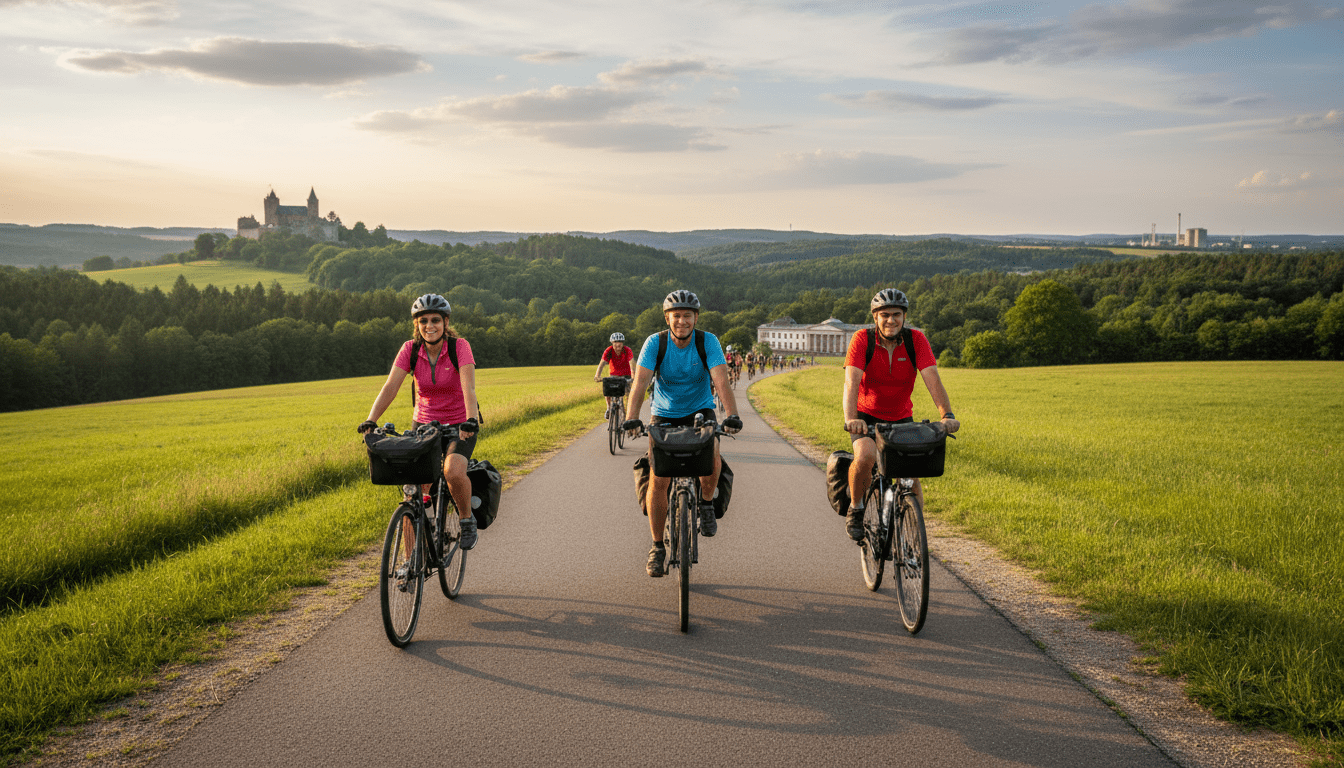
Thüringer Stadtketten: Cycling 230 km Through Thuringia’s Cultural Heart
Thüringer Stadtketten: a 230 km cycle route from Eisenach to Altenburg linking Wartburg, Weimar and Thuringia’s forests, culture and travel essentials in one guide.
The Thüringer Stadtketten cycle route offers a continuous 230-kilometre corridor across central Thuringia, tracing three centuries of German intellectual and artistic history by bike. The route runs from Eisenach in the west to Altenburg in the east, passing key sites such as Wartburg Castle and Weimar while threading through forests, university towns and market squares.
Cyclists are increasingly discovering the Thüringer Stadtketten as a compact way to combine active travel with concentrated cultural sightseeing. The route bundles famous names—Bach, Luther, Goethe, Schiller, Liszt and the Bauhaus—into a single itinerary that can be tackled in stages or as a continuous loop.
Eisenach anchors the western end with Wartburg Castle
Eisenach is the natural starting point for many riders on the Thüringer Stadtketten, sitting on the northwestern edge of the Thuringian Forest. The town’s medieval centre, with a Romanesque gate and a Renaissance town hall, signals the region’s layered history to arriving visitors.
Wartburg Castle, perched above Eisenach, is the landmark that draws most attention and anchors the cultural narrative of the western section. The fortress is known for its ties to Martin Luther and its long tenure as a seat of regional power, making it a visible symbol at the beginning of the ride.
Eisenach is also the birthplace of Johann Sebastian Bach, and its musical heritage is woven into local museums and guided walks. That cultural weight, combined with practical bike connections, makes Eisenach an effective gateway for the Thüringer Stadtketten.
Weimar and the compact legacy of the Enlightenment and Bauhaus
Weimar sits roughly at the geographic heart of the route and functions as the cultural nexus of Thuringia’s modern narrative. The city’s concentration of museums, memorials and residential sites reflects its outsized role in German literature, music and art from the 18th to the 20th centuries.
Visitors will find the homes and workplaces of Goethe and Schiller, and institutions that preserve their manuscripts and archives. Weimar later became a cradle for modernist education when the Bauhaus school was founded there, and traces of that experimental spirit remain visible in galleries and memorial spaces.
Musical and visual arts history also converge in Weimar: composers, painters and printmakers left tangible legacies that the city curates for visitors. For cyclists on the Thüringer Stadtketten, Weimar is both a day’s highlight and a practical rest stop with services and overnight options.
Jena, Erfurt and other towns that map Thuringia’s intellectual life
East and north of Weimar, the route links university cities and smaller towns that shaped German academic and social thought. Jena’s university, with its history of philosophy and science, hosted figures whose work influenced modern scholarship and pedagogy.
Erfurt, the state capital, adds another layer: it is the birthplace of notable sociologists and intellectuals and features a medieval centre suited to short explorations between stages. Nearby Gotha and Gera contribute art-historical threads, with local museums celebrating painters and avant-garde movements.
These towns offer more than names on a map; they provide compact museums, university collections and civic architecture that make cultural touring manageable by bike. Riders can stop for short visits without losing the continuity of the Thüringer Stadtketten experience.
The Thüringer Stadtketten route: distance, terrain and wayfinding
The route’s official length is approximately 230 kilometres and is designed to be cycled in sections or over a continuous multi-day tour. Terrain varies from rolling farmland to steeper forested climbs as the line crosses the Thuringian uplands, so physical preparation matters for a comfortable ride.
Signage along the Thüringer Stadtketten combines local waymarks with national cycling route symbols, and maps are available from regional tourist offices. Surfaces alternate between quiet country roads, dedicated cycle paths and occasional cobbled streets in town centres; a touring bike or e‑bike with robust gearing makes the route more accessible.
Logistically, the route accommodates staged travel easily: each major town provides accommodation, bike services and public-transport links for those who wish to shorten or extend individual legs. That flexibility is one reason the Thüringer Stadtketten appeals to mixed-ability groups and independent travellers.
Forests, national parks and the Thuringian landscape
One of the route’s principal attractions is the variety of landscapes it threads together, from the shadowed slopes of the Thuringian Forest to the beech woodlands of the Hainich National Park. These natural areas offer a counterpoint to the dense cultural stops and create memorable stretches of riding.
Hainich is notable for its primeval beech forest and biodiversity, providing short detours for walkers and nature-minded cyclists. The Thuringian Forest delivers steeper gradients and panoramic ridges, while the lowlands between towns open into agricultural vistas and market fields.
Seasonal changes reshape the ride: spring and early summer bring blossom and wildflowers, while autumn colours transform the woodlands into a vivid backdrop. Riders should plan around weather windows and daylight hours to make the most of the route’s scenic diversity.
Practical travel advice, services and a suggested five-day itinerary
Public transport connections make the Thüringer Stadtketten easy to reach and flexible to ride. Major rail stations such as Eisenach and Erfurt handle regional traffic and typically offer space for bikes, allowing riders to arrive with their own machine or move between stages by train if needed.
Bike rental and repair outlets are concentrated in larger towns, and many hotels and guesthouses advertise secure storage and e‑bike charging. Advance booking during peak holiday weeks is advisable, since small-town accommodation can fill quickly on long weekends and public holidays.
For riders with five days, a sample itinerary starts in Eisenach with a half-day visit to Wartburg and an overnight in town. Day two moves toward Weimar with a cultural afternoon and evening stay there. Day three follows the route east to Jena for museums and university quarter visits. Day four takes a longer leg through Erfurt or Gera depending on preferences, and day five finishes toward Altenburg with time to explore its market squares and local museums.
Daily distances in this sample range from 35 to 60 kilometres and can be shortened by using regional trains for one or two transfers. Pack for mixed weather, include basic repair tools and carry printed maps as a backup to electronic navigation on longer forested stretches.
Cycling the Thüringer Stadtketten allows riders to combine manageable stage lengths with concentrated cultural immersion. The result is a route that reads like a museum trail on two wheels, with daily opportunities for walking, museum visits and evenings in town squares.
Thuringia’s compact scale and transport links mean the Thüringer Stadtketten works well as an independent self-guided tour or as the framework for a guided group itinerary. Riders of varied experience can adapt the route to match fitness, interests and time available.
The Thüringer Stadtketten presents a rare combination in German regional travel: dense cultural heritage within a condensed, bikeable geography. For visitors seeking to move at human speed while encountering castles, composers and modernist experiments, the route delivers a coherent and richly textured experience that rewards both planning and spontaneous detours.
