
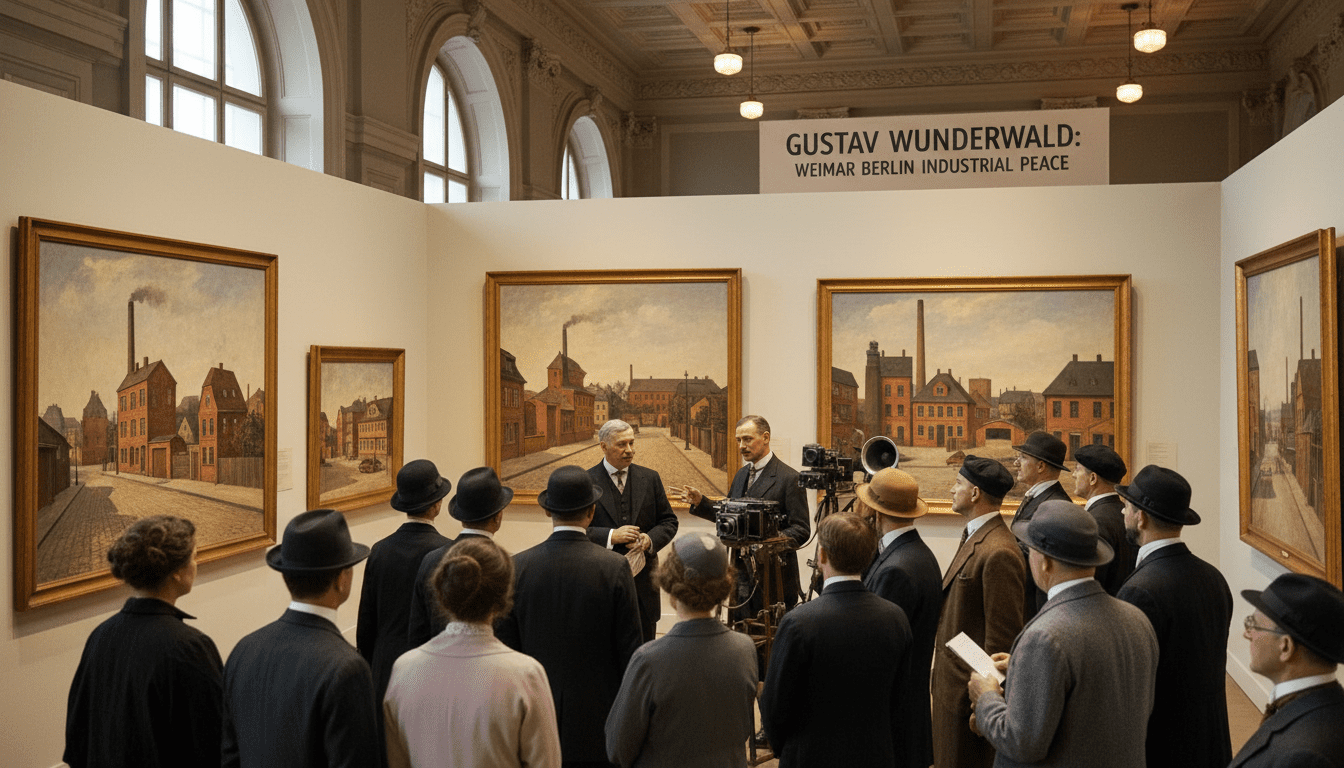
Gustav Wunderwald Rediscovered: Quiet Weimar Berlin and Where to Find It
Discover Gustav Wunderwald’s Weimar-era Berlin: where to see his paintings, the neighborhoods he painted, a walking route and visitor tips and context.
Gustav Wunderwald’s restrained portraits of Berlin are enjoying renewed attention as a quieter counterpoint to the city’s more notorious Weimar-era imagery. The artist’s name has become a shorthand for unostentatious urban views that foreground factories, tenements and everyday streets rather than cabaret or nightlife. This guide outlines where Wunderwald’s work can be seen in the city, the neighborhoods that inspired him, and a practical route for visitors who want to trace his Berlin. The focus throughout is on reading the city through his canvases and understanding why these modest scenes matter to Berlin’s cultural memory.
Gustav Wunderwald and the unadorned Weimar city
Gustav Wunderwald painted Berlin during a period when many artists emphasized social realism and sharp observation. His canvases reject theatricality, favoring sober compositions and careful attention to architecture and light. Unlike some contemporaries who made spectacle of the metropolis, Wunderwald turned his eye to the margins: industrial yards, quiet courtyards and the façades of workers’ housing. Those subjects provide an invaluable visual record of neighborhoods that underwent intense change in the twentieth century.
Wunderwald’s style is often associated with the broader New Objectivity movement that emerged in Weimar Germany. That tendency privileged clarity, controlled form and a matter-of-fact representation of social environments. Yet Wunderwald’s approach is softer than the satirical or clinical tendencies seen elsewhere; his palette and brushwork suggest observation rather than indictment. His cityscapes allow viewers to linger on the everyday textures of Berlin—brickwork, shopfronts and the anonymous faces that populate side streets.
The significance of Wunderwald’s output is both documentary and aesthetic. His paintings register urban conditions—industrial growth, dense housing, and the infrastructure of modern life—while also asserting a restrained visual order. For contemporary visitors, those works offer a way to read Berlin’s built environment across decades. Seeing the city through Wunderwald’s perspective encourages attention to scale, material and the quiet rhythms of daily life.
Where to see Wunderwald’s paintings in Berlin
Several public collections in Berlin hold works by Gustav Wunderwald, making them accessible to residents and visitors alike. Major municipal museums and galleries that focus on twentieth-century art include examples of his urban scenes alongside works by better-known New Objectivity figures. Viewing Wunderwald in such institutional contexts helps place his paintings within broader debates about art and society in the Weimar Republic.
The Berlinische Galerie is one of the city institutions commonly associated with Weimar-era holdings and twentieth-century Berlin art. Its displays regularly combine painting, photography and documentary material to situate artists within the life of the city. Wunderwald’s factory views and street scenes sit comfortably in that narrative, where curators emphasize urban experience over sensational imagery. Museum visits give viewers the chance to study technique up close and compare Wunderwald’s choices with those of his contemporaries.
Smaller municipal collections and local history museums may also include Wunderwald’s work or reproductions of his paintings in exhibitions about specific neighborhoods. Those venues are useful for understanding the local topography that inspired him. They also underscore how Wunderwald’s subjects—tenements, factories and corner shops—functioned as social as well as architectural markers in interwar Berlin.
The neighborhoods that shaped Wunderwald’s view
Many of Wunderwald’s most striking images were painted in the northern districts of the city, where industry and dense housing shaped everyday life. Neighborhoods such as Wedding and Moabit recur in his compositions, with their rows of brick factories, narrow residential streets and utilitarian façades. These districts were industrial and working-class areas during the Weimar era, and Wunderwald’s canvases capture their sober dignity.
Wedding and Moabit remain useful starting points for anyone seeking to connect paintings to place. Walking those neighborhoods today reveals traces of the industrial architecture Wunderwald recorded: repurposed factories, courtyards that once served small workshops and apartment blocks that still carry the austere proportions of early twentieth-century housing. The relationship between painting and place is most vivid when viewers can stand on the street and compare built elements with their painted counterparts.
The quieter suburban edges of the city also attracted Wunderwald’s eye. He tended to avoid the glamour of central boulevards, preferring instead the marginal streets and service alleys where everyday urban life unfolded. That choice gives his oeuvre a distinctive topography: a map of ordinary Berlin whose contours remain legible for those who know where to look.
Reading Wunderwald’s factory paintings
Factory interiors and exteriors are a recurring subject in Wunderwald’s output, and they merit particular attention for the way they document industrial Berlin. His views of manufacturing sites often emphasize geometry—rows of windows, chimneys and the repeating shapes of industrial plant. The compositions are calm but rigorous, turning working infrastructure into a subject of formal interest.
One notable painting that exemplifies this strand depicts an industrial complex with stacked roofs and a strict linear rhythm across the canvas. In such works Wunderwald balances attention to material detail with a compositional austerity that frames industry as part of civic life rather than as a dramatic spectacle. The result is a painting that is both an architectural study and a social document.
For contemporary viewers, these factory paintings function as historical evidence. They make visible the scale of production in interwar Berlin and the proximity of industrial sites to residential neighborhoods. Observing the differences between then and now—the disappearance of certain factories, the adaptive reuse of others—adds an evocative layer to the viewing experience.
A walking route to trace Wunderwald’s Berlin
A practical way to engage with Wunderwald’s work is to combine museum visits with a walking route through the neighborhoods he painted. Start at a municipal gallery that holds his works to see the paintings up close and note recurring motifs such as brick façades and factory chimneys. Studying the canvases first allows visitors to keep visual references in mind while they move through the city.
From the gallery, travel north to the districts associated with Wunderwald’s urban views. Walk along streets that still display early twentieth-century housing and former industrial sites. Pay attention to building materials, window rhythms and the scale of courtyards, as these are the features Wunderwald inventoried in paint. Allow time to contrast the contemporary street with reproduced images of the paintings, noting continuities and alterations.
Include pauses at local cafés or small museums that focus on neighborhood history. Such stops not only provide rest but also offer context: local exhibitions, archival photographs and oral histories complement the visual record found in Wunderwald’s canvases. The combination of museum scholarship and street-level observation yields the fullest appreciation of how his work relates to urban change.
Why Wunderwald matters to Berlin today
Gustav Wunderwald’s work offers a corrective to more sensational accounts of Weimar Berlin by attending to ordinary places and everyday life. That perspective matters now because it expands public understanding of the period beyond nightlife and political drama. Wunderwald’s paintings remind us that the Weimar city was also a place of routine labor, modest homes and infrastructural growth.
For contemporary Berlin, his canvases serve as a cultural touchstone for debates about preservation, reuse and urban identity. The neighborhoods Wunderwald painted have been subject to cycles of demolition, reconstruction and gentrification, and his images provide a visual anchor amid those changes. They can inform conservation conversations by illustrating what was once present in the urban fabric.
Collectors, curators and local historians have used Wunderwald’s paintings to reconstruct micro-histories of streets and industrial sites. Even for casual visitors, discovering his work enriches a city trip by opening a different lens on Berlin’s past. His paintings reward slow looking and invite people to notice the material details of the built environment that often go unremarked.
Practical considerations for visitors
Plan museum visits in advance and check opening days for the galleries you intend to see, as public collections sometimes rotate holdings. When moving from galleries to neighborhoods, use public transport or a bicycle to cover ground efficiently while still allowing time for pedestrian observation. Bring reproductions or images of the paintings with you to compare compositions with street views, which deepens the contextual reading.
Respect museum rules on photography and reproduction; institutions differ in their policies and often allow photography only for private study rather than publication. When exploring residential streets and former industrial sites, be mindful of private property and current uses; many former factories are now offices, residences or cultural venues. Local tourist information points and neighborhood museums can provide maps and archival material to support a Wunderwald-focused itinerary.
Gustav Wunderwald’s work rewards patience and attention rather than rush. Allow time to sit on a bench, study a façade or stand in a courtyard the way the artist might have done. That slow engagement with place replicates the observational discipline at the heart of Wunderwald’s practice and provides the most direct route to understanding his vision of Weimar Berlin.
For readers seeking a different picture of Berlin’s past, Wunderwald provides an arresting alternative to boulevardry and spectacle. His paintings direct attention toward the built forms and everyday spaces that sustained urban life in the interwar period, and they remain a useful tool for anyone wanting to connect art, history and place in Berlin.
Gustav Wunderwald’s scenes are a reminder that a city’s history is not only made in its theatres and clubs but also in its factories, tenements and quiet streets. Those who follow his paintings through museums and neighborhoods will find a measured portrait of a city in transition and a richer understanding of how ordinary spaces shape public memory.
