
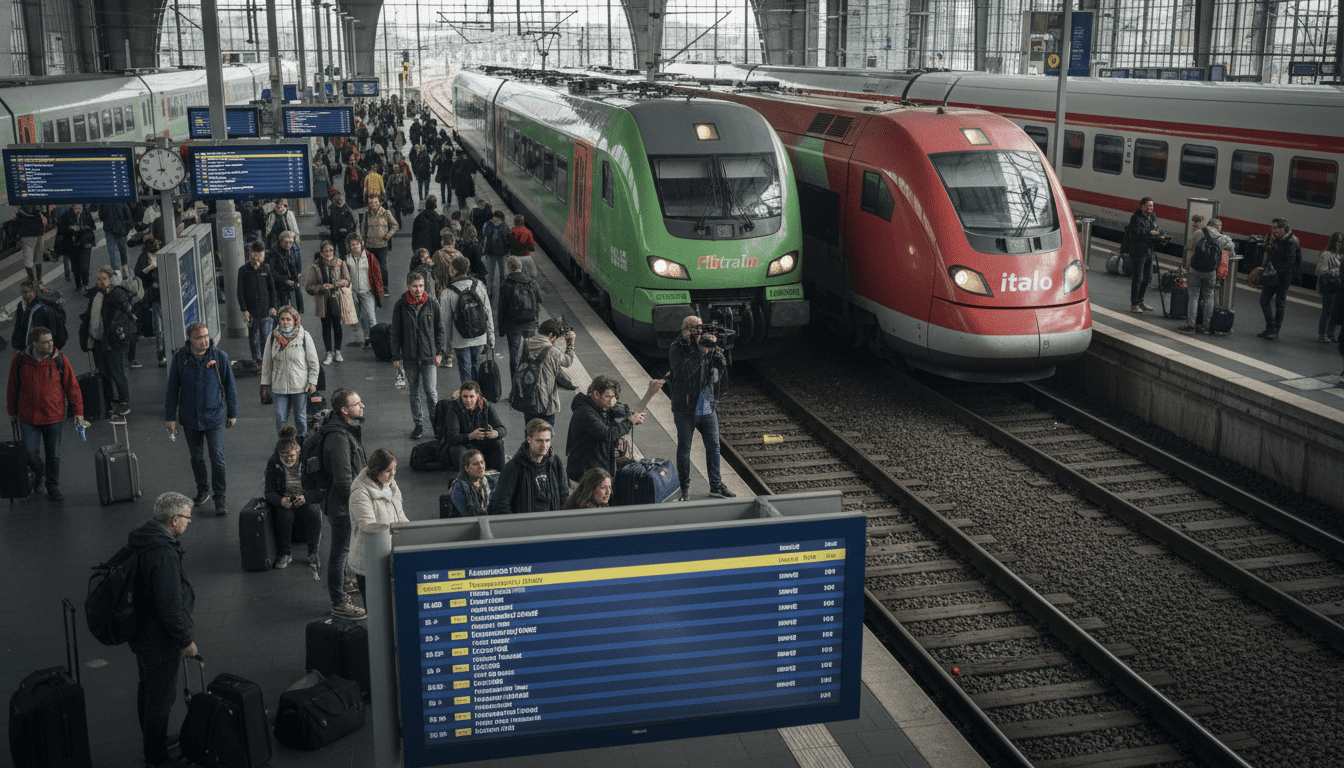
Rail competition in Germany strained by crowded tracks and political resistance
Germany’s dense rail network is constraining rail competition in Germany as new operators like Italo and Flixtrain face capacity bottlenecks, political opposition to new lines, and costly demands for nationwide service.
Germany’s rail network is increasingly congested, leaving trains queued outside major stations and squeezing room for new entrants. The constraint on capacity is a central reason private companies such as Italo have struggled to establish profitable long‑distance services on German rails. Meanwhile established and emerging operators are expanding in freight and regional markets, pushing for a share of a system built without dedicated high‑speed corridors. The debate over whether and how to add new tracks is now as much political as it is technical.
Network bottlenecks threaten new entrants
Persistent congestion at urban terminals and on key trunk routes limits the number of long‑distance paths available for new operators. Many main lines carry a mixture of regional, long‑distance and freight traffic, which complicates scheduling and reduces the flexibility newcomers need to offer competitive timetables. Operators without legacy slot holdings face long waits or suboptimal timetables, undermining commercial viability and passenger convenience.
The lack of dedicated high‑speed corridors magnifies the problem because long‑distance services must share slower tracks with commuter and freight trains. That increases trip times and reduces reliability, making it harder for private brands to compete on speed and punctuality against incumbents that already control favorable paths.
Private operators are consolidating gains in freight and regional markets
In recent years private companies have chipped away at the market dominance of incumbent operators in freight and regional services. Freight rivals now run a growing share of cargo flows, and regional franchises have been awarded to private and municipal providers in many federal states. These shifts illustrate that competition can succeed where network access and regional contracting are more clearly structured.
This incremental success in freight and regional travel has emboldened firms to test long‑distance markets. Flixtrain’s plans for a fleet of high‑speed trains and the interest shown by Italo reflect broader commercial appetite, but translating ambition into sustainable long‑distance operations requires more available capacity and predictable regulatory frameworks.
Italo’s German ambitions collide with structural limits
Italo’s entry into Germany highlights the practical hurdles facing foreign long‑distance operators. The company’s experience in Italy does not fully translate because Germany lacks extensive dedicated high‑speed lines and expects carriers to serve a broader geographic spread, including smaller towns. Those expectations lengthen service patterns, increase turnaround times and dilute the speed advantage that high‑speed operators often advertise.
Regulatory requirements and slot allocation practices also play a role. New entrants must negotiate complex train paths and often accept off‑peak or inconvenient slots that hinder market appeal. Without access to rapid, frequent paths into major hubs, attracting sufficient passengers to cover high fixed costs is difficult.
Local politics and planning disputes block new high‑speed infrastructure
Political resistance at state and local levels has slowed or stalled proposals for new lines, even when national capacity constraints are clear. Opposition in regions wary of new corridors — for environmental, fiscal or land‑use reasons — has repeatedly curtailed projects that would have created dedicated routes and freed capacity on mixed‑use tracks. The result is a patchwork network that accommodates political priorities but limits operational efficiency.
At the same time, politicians often press carriers and planners to maintain service to smaller communities, resisting closures of intercity connections even when demand shifts toward regional trains. Those political trade‑offs increase operating complexity and fiscal burden, complicating the business case for both incumbents and newcomers.
Costs of nationwide service shape competitive outcomes
Delivering a geographically comprehensive rail service is expensive, and those costs are borne through subsidies, regulatory requirements or higher fares. When incumbent operators propose rationalizing underused intercity lines, political backlash can force preservation of routes that are not commercially viable. This tension raises the financial bar for all operators and changes the economics of entering the market.
For new entrants, this means they must either accept public service obligations that reduce profitability or pursue a niche strategy focused on denser, more lucrative corridors. Neither option is straightforward given limited track access and the expectation that rail services serve social and regional policy goals as much as market demand.
Policy choices will determine the scale of future competition
Expanding rail competition in Germany will require a clearer allocation of capacity and a willingness to prioritize investments that unlock long‑distance paths. That could include targeted construction of dedicated high‑speed segments, improved traffic management systems, or reformed slot allocation that balances incumbents’ rights with newcomers’ need for viable timetables. Each option carries political and fiscal consequences that policymakers must confront.
At the same time, regulators and operators will need realistic compromises on network coverage. If private long‑distance services are to grow, they must be integrated into a system that preserves regional connectivity while allowing commercially focused services to operate profitably. Achieving that balance will involve negotiations between federal authorities, states, local communities and rail companies.
Germany’s crowded tracks and political reluctance to build new lines are not insurmountable barriers, but they demand honest choices about priorities and funding. With clearer capacity planning, targeted infrastructure investment and practical regulatory reforms, rail competition in Germany could expand beyond freight and regional niches into a more open long‑distance market that benefits passengers through better service and more choices.
