
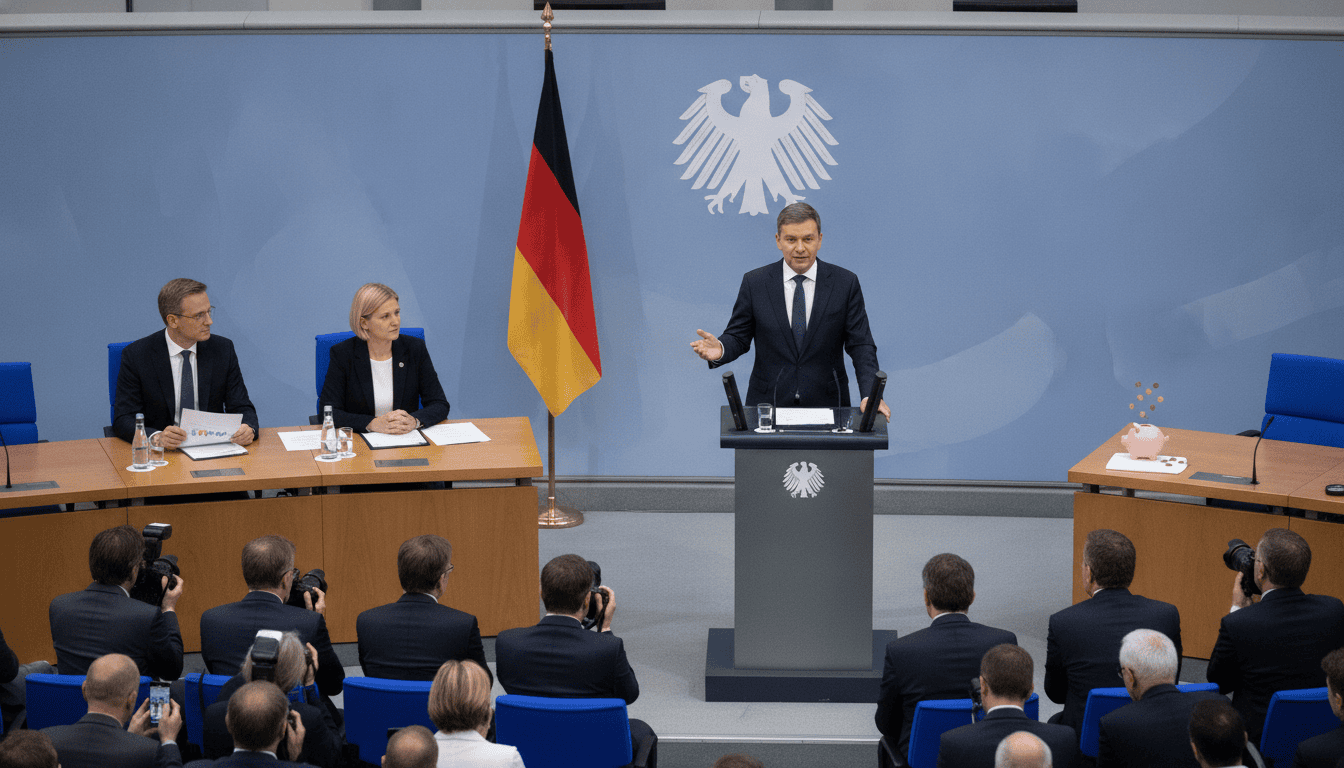
Germany launches Frühstartrente: €10 monthly pension deposit for children starting with 2020 birth cohort
Germany’s Frühstartrente will credit €10 a month into capital accounts for children aged 6–18 if parents opt in; law aims for 2027 with Bundesbank oversight.
The German government has circulated a draft law establishing a state-supported, capital-funded retirement start for children and adolescents known as the Frühstartrente. Under the proposal, six- to 18-year-olds would receive a monthly deposit of €10 into a dedicated savings vehicle if parents sign a contract on their behalf. The scheme is designed to provide a seed capital for private retirement savings and to promote earlier engagement with long-term financial planning.
Start dates and who qualifies
The draft specifies that the Frühstartrente will be introduced for children born in 2020, effectively beginning with the cohort that turns six in 2026. The law is expected to come into force in 2027, and payments for currently six-year-olds would be made retroactively. Importantly, the measure will not apply to older underage cohorts; minors born before 2020 are excluded from this initial rollout.
Parents must actively conclude a contract to channel the €10 monthly payment into a capital-funded account for their child. If no private arrangement is made, the federal government will invest the funds collectively on the capital market as a fallback option.
Account structure, access and transition at adulthood
Funds deposited under the Frühstartrente are intended to remain invested until the recipient reaches the statutory age of 65, with no routine early payout permitted. The proposal envisions a seamless handover to a tax-advantaged private pension product once the beneficiary attains legal adulthood, enabling continued capital accumulation. Parents are permitted to top up the state contribution with voluntary private payments to increase the child’s eventual retirement pot.
The government frames the arrangement as an early introduction to capital-based retirement provision rather than a contribution to the statutory pay-as-you-go pension system. The transition mechanics and specific tax treatment of the adult-stage product are set to be clarified in further legislative detail.
State-managed fallback and Bundesbank role
When families do not choose a private provider, the draft assigns the Bundesbank responsibility for managing a collectively invested fallback fund on behalf of the federal government. That approach is intended to ensure that children still receive the intended capital accumulation even if no private contract is signed. The fallback arrangement also centralizes oversight of state-managed assets and aims to reduce fragmentation of small individual accounts.
Critics within the financial sector have argued that a state-managed collective solution could undermine financial literacy goals by removing the need for families to engage with providers. Proponents counter that a simple default managed by the Bundesbank would guarantee coverage for all eligible children and prevent gaps in participation.
Projected fiscal impact and timeline
The Finance Ministry’s estimates attached to the draft foresee initial fiscal costs of roughly €200 million in the 2027 budget year, rising as additional cohorts are onboarded. By 2030, when several year-groups will have been included, projected annual costs reach about €411 million according to the government’s calculations. Those figures reflect only the direct monthly deposits and do not include potential administrative or market-related earnings and losses.
Officials say program costs will grow incrementally as each new six-year cohort becomes eligible; once fully phased in under the current timeline, annual outlays will stabilize at a higher level. The ministry has presented the projections to coalition partners as part of an internal interministerial review prior to formal cabinet approval.
Responses from industry and consumer advocates
Responses from industry bodies and consumer groups have been mixed. The German Fund Association (BVI) welcomed the objective of broader retirement coverage but criticized the government’s fallback plan, arguing that a centralized state fund could reduce incentives for families to learn about investing. The German Insurance Association (GDV) said private supplementary contributions would be necessary for the scheme to produce materially larger retirement benefits.
The Federation of German Consumer Organisations (Verbraucherzentrale Bundesverband) urged safeguards to prevent the measure from becoming a new sales channel for providers and called for strengthened independent financial education. Consumer advocates also pressed for transparency on fees, governance of the fallback fund and clear information for parents deciding whether to sign private contracts.
Political context and next steps
The Frühstartrente was included in the coalition agreement reached in April 2025 and now moves from political promise toward concrete implementation with the release of the draft. Finance Minister Lars Klingbeil described the initiative as a tool to give young people a “start capital” for private provision, framing it as part of a broader push to bolster long-term saving. The draft has been sent into government-wide consultation and will require parliamentary approval before it becomes law.
Lawmakers will debate the specifics of eligibility, the mechanics of the fallback investment, and consumer protection measures in the months ahead. Opposition parties and stakeholder groups are likely to press for amendments on issues such as account portability, fee caps and measures to promote financial literacy among families.
The Frühstartrente’s effectiveness will depend on implementation details, uptake by parents and the performance of invested funds, with policymakers balancing inclusion, fiscal cost and the goal of fostering early private saving.
