
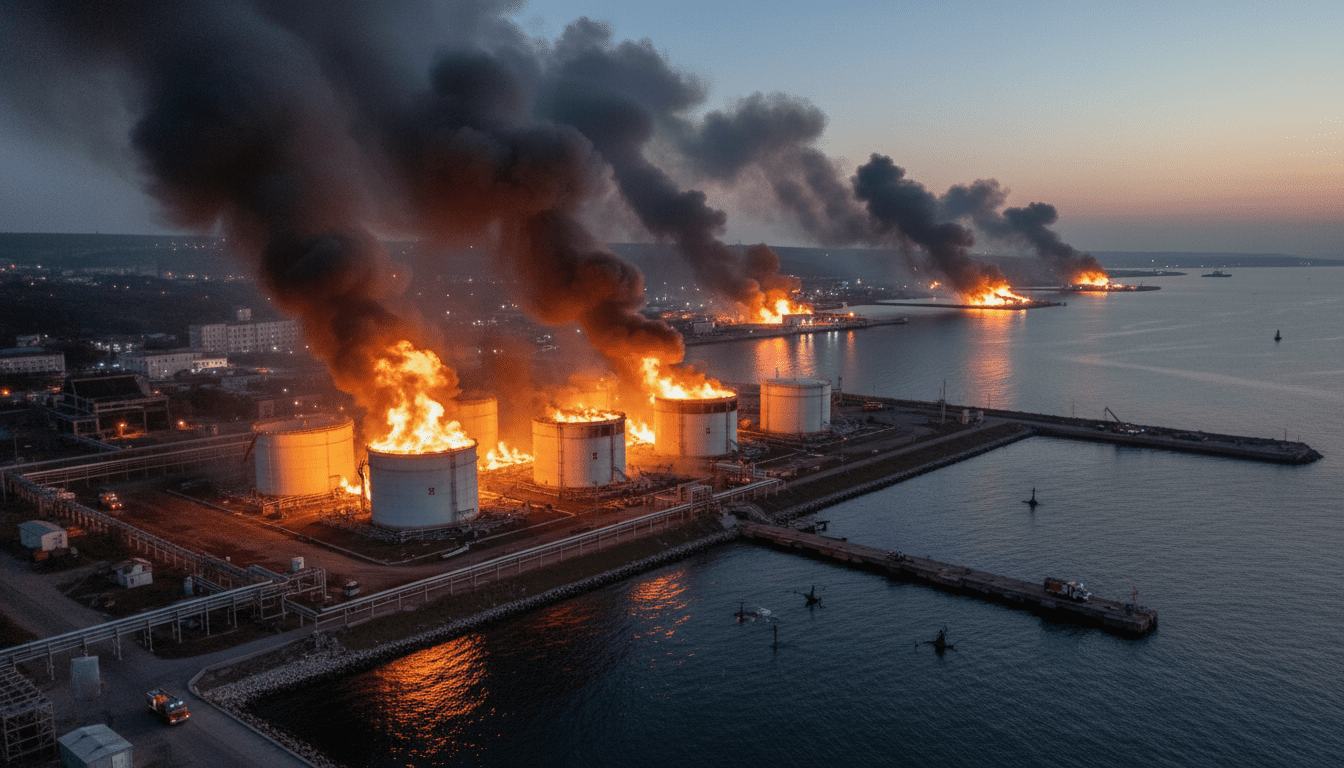
Ukrainian drone attacks ignite fires across Sevastopol and multiple Russian regions
Ukrainian drone attacks sparked fires at an oil depot in Sevastopol and reportedly struck refineries and terminals in several Russian regions, officials and media said.
Russian authorities reported a fire at an oil depot in Sevastopol after what they described as Ukrainian drone attacks during the night. The head of the city administration, Mikhail Razvozhayev, wrote on Telegram that drones had been shot down and a tank containing fuel residues caught fire. City officials said the blaze did not affect Sevastopol’s overall fuel supply and that there were no casualties, though independent verification of the account was not available.
Sevastopol depot fire and air defenses
Authorities in Sevastopol said their air defenses intercepted multiple drones and that a fuel tank with residuals ignited after being hit. The administration emphasized that the incident did not disrupt local fuel distribution and that no injuries were reported.
The report came via Telegram posts from the city administration and has not been independently confirmed by international monitors. Sevastopol sits on the annexed Crimean peninsula which Russia incorporated in 2014 following a referendum that remains unrecognized by most of the international community.
Reported strike at Nowokuibyshevsk refinery in Samara region
Media and social media outlets circulated images and videos showing fires at the Nowokuibyshevsk oil refinery in the Samara region. Local reporting described drone strikes on the facility, which is among Russia’s larger refineries.
Officials have not issued formal confirmation of the attack at the refinery. Publicly available production figures cited in regional reporting placed the plant’s capacity near 8.8 million tonnes per year, making it a significant target if the reports prove accurate.
Port of Vyssozk and attempts to extinguish blaze
In the Leningrad region near St. Petersburg authorities said the port of Vyssozk was targeted in the same wave of attacks and that emergency crews were fighting a fire. Governor Alexander Drozdenko reported on Telegram that teams were attempting to put the blaze under control.
Regional officials also stated that air defenses had repelled dozens of drones during the incident. Drozdenko said 27 drone incursions were intercepted, underscoring the scale of the reported strikes around the region.
Large oil terminal fire in Krasnodar region
Regional crisis authorities reported a major fire at an oil terminal in Tikhoretsk in the Krasnodar region and dispatched hundreds of responders. The emergency response included 224 firefighters and 56 vehicles working to control flames at the terminal, according to the regional crisis center.
No casualties were reported in Krasnodar and authorities gave no immediate cause for the fire. Local updates appeared on regional Telegram channels while outside confirmation of the incident remained limited.
Ukrainian strategy to target Russian oil infrastructure
Ukrainian officials and analysts have in recent weeks highlighted a campaign of attacks aimed at diminishing revenue from Russian oil exports. The recent incidents follow a period of increased strikes on energy infrastructure that Kyiv describes as aimed at weakening Moscow’s ability to fund its war effort.
Russian officials framed the incidents as hostile drone attacks originating from Ukraine and pointed to wider regional tensions related to conflict dynamics involving Iran. Observers caution that the true operational and economic impact will depend on whether reported damage to refining and terminal capacity is confirmed and sustained.
Verification limits and information sources
Much of the information about the incidents has emerged through official regional Telegram channels and social media posts accompanied by photos or video. Independent confirmation from international monitors or on-the-ground reporting remains limited for several of the reported strikes.
The reliance on regional official statements and social media footage means details may be revised as more information becomes available. Analysts note that in an active conflict environment initial claims by either side are frequently updated or contested.
The reported wave of Ukrainian drone attacks on Sevastopol and sites in Samara, Leningrad and Krasnodar regions underscores the expanding focus on energy and port infrastructure in the conflict. Officials have so far reported no fatalities in the incidents, but many of the damage assessments remain preliminary and unverified, leaving the longer term implications for regional fuel supply and export revenues uncertain.
