
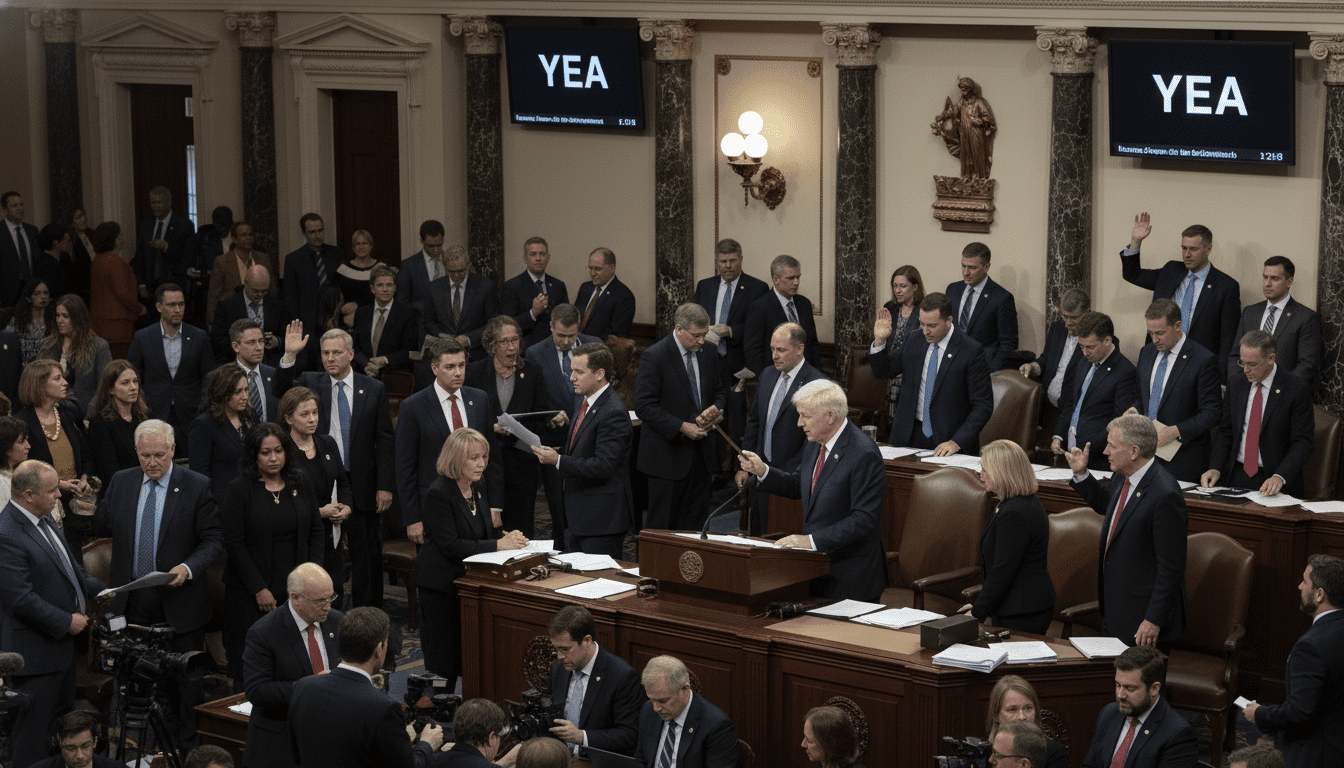
U.S. House Votes to Withdraw Military From Hostilities With Iran
U.S. House votes 215-208 to withdraw military from hostilities with Iran, increasing pressure on President Trump as ceasefire talks and Senate review continue.
The U.S. House of Representatives on Wednesday approved a resolution directing the removal of American forces from hostilities with Iran, a move that significantly raises political pressure on President Donald Trump and marks a rare bipartisan rebuke. The House vote on Iran — carried 215-208 with four Republicans joining Democrats — does not itself force troop movements but makes clear congressional opposition to continued offensive operations. Lawmakers said the resolution requires a formal congressional declaration of war for new combat deployments, while carving out narrow exceptions for imminent defensive actions.
Vote margin and bipartisan defections
The resolution passed by a 215-208 margin, reflecting a close and politically charged decision in a deeply divided chamber. Four House Republicans broke with party leadership and voted with Democrats, signaling widening unease in GOP ranks over the administration’s handling of the Iran conflict. Supporters framed the vote as a constitutional assertion of Congress’s war powers, while opponents warned it could constrain commanders in the field and strain alliance relationships.
Text of the resolution and its limits
The text instructs the president to remove U.S. forces from hostilities unless Congress authorizes a combat role through a formal declaration of war. The measure explicitly excludes operations necessary to defend the United States or its allies against immediately impending attacks, preserving authority for short-term defensive responses. Congressional sponsors and legal scholars emphasize that the resolution is a political directive rather than a binding statute with immediate operational effect.
Practical consequences and the Senate hurdle
Despite passage in the House, the resolution faces a steep path to becoming binding policy. It must clear the Senate before reaching the president’s desk, and any bicameral resolution could be met with a presidential veto. Administration officials have indicated the White House would likely resist congressional limits on the use of force, setting the stage for a high-stakes showdown between branches of government. Even if the Senate were to approve similar language, the prospect of a veto would leave the political balance — not only legal authority — at the center of the dispute.
Political pressure on the White House
By mobilizing cross-party support, the House vote amplifies pressure on President Trump ahead of anticipated diplomatic developments. Republicans publicly breaking with the president voiced concerns about strategic clarity and the risks of an open-ended military engagement. Democrats argued that restoring congressional oversight is necessary to prevent escalation and to ensure civilian leadership remains accountable for decisions that could commit U.S. forces to prolonged conflict.
Ceasefire status and ongoing negotiations
The House action comes as a ceasefire remains in effect and negotiators work toward a framework agreement intended to end hostilities with Iran. President Trump told reporters on Wednesday evening that talks were progressing and that the signing of documents was imminent, suggesting a potential breakthrough could occur within days. He also said the United States would assume custody of Iran’s highly enriched uranium stocks as part of the discussed arrangement, a concession that negotiators view as central to a durable settlement.
Strategic stakes over Iran’s uranium stockpiles
Tehran’s inventories of highly enriched uranium have been a focal point in the talks and a major point of contention between the parties. U.S. officials have long insisted that limits on enrichment and the removal or international control of fissile material are essential to any lasting peace that reduces the risk of nuclear proliferation. Proposals to transfer or secure Iranian uranium would be sensitive and technically complex, requiring detailed arrangements for transport, storage, verification and international oversight.
The House resolution signals a renewed assertion of congressional prerogatives over war-making even as diplomats and combatant commanders navigate a fragile ceasefire and fragile negotiations. Lawmakers on both sides of the aisle said they would continue close oversight of any deal that alters U.S. military commitments or the regional security balance. The measure’s passage reflects mounting congressional impatience with open-ended military operations and a desire to tie diplomatic progress to clear legislative benchmarks.
