
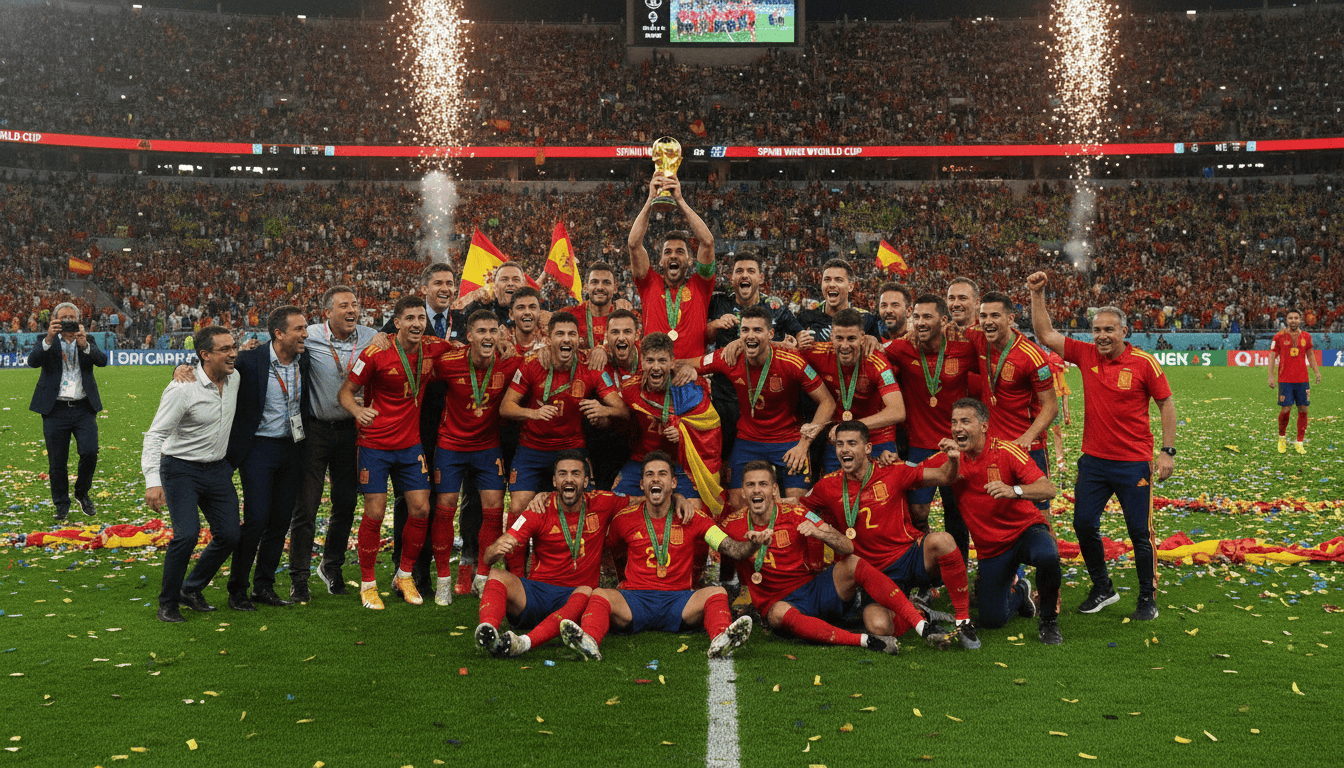
Spain World Cup Glory: Spain Beat Argentina 1-0 to Win 2026 Final
Spain World Cup: Spain defeated Argentina 1-0 to claim the 2026 title, becoming the first nation to hold both men’s and women’s world crowns after a tournament of 104 matches.
Spain completed a dominant run through the expanded 2026 World Cup with a 1-0 victory over defending champions Argentina in the final, a match that closed a 104-game tournament staged across Mexico, Canada and the United States. The Spain World Cup triumph confirmed a team built on tactical discipline, defensive cohesion and collective balance rather than individual brilliance. The final itself was low on drama but historically notable for featuring the tournament’s first-ever halftime show. For Spain, the win also creates an unprecedented national double, with the men now joining their female counterparts as world champions.
Spain Clinches the Title with a Narrow Victory
Spain’s 1-0 scoreline reflected a match decided by fine margins rather than a spectacle of end-to-end play. The Spanish side managed the game tempo, absorbed pressure and struck when the opportunity presented itself, leaving Argentina unable to generate a sustained attacking response. The victory underlined Spain’s patience and organization across the tournament, and it handed a fourth major international title to a cohort that has steadily matured in recent years. Coming at the end of 104 matches, the finale closed a World Cup marked by varied hosts and new pageantry.
Tactical Shape and Coaching That Sealed the Final
Coach Luis de la Fuente’s game plan emphasized compact defending, disciplined positional play and swift transitions that prevented Argentina from establishing control in midfield. Spain shifted as a cohesive unit, limiting spaces between lines and forcing opponents into predictable channels where defensive cover was strongest. The tactical approach masked individual fluctuations and allowed the team to function as a collective, with set roles and clear responsibilities across the pitch. De la Fuente’s management throughout the tournament drew praise for preparation and in-game adjustments that neutralized Argentina’s usual creative threats.
Rodri’s Leadership and the Team’s Collective Strength
Captain Rodri provided a stabilizing presence in midfield, combining ball retention with timely interventions that anchored Spain’s structure. His leadership extended beyond individual performance, evident in how teammates maintained discipline and adhered to the tactical blueprint in critical moments. Spain’s success did not hinge on a single match-winner but on distributed responsibility, with defenders, midfielders and forwards executing a unified strategy. That collective identity proved decisive when the stakes were highest and moments for individual brilliance were scarce.
Argentina Stalled and Frustration Showed on the Field
Argentina, led by a global superstar at the peak of his career, struggled to convert possession into clear scoring opportunities and appeared repeatedly stymied by Spain’s compact defensive setup. As the match progressed and clear chances remained limited, frustration crept into Argentina’s play and physicality increased, which further disrupted their rhythm. The champions-to-be were unable to find a consistent attacking pattern or exploit weaknesses in Spain’s formation. Their inability to break the deadlock ultimately left them as runners-up in a tournament that began with high expectations.
Historical Significance: Both Men’s and Women’s Crowns for Spain
With this victory Spain becomes the first country to hold both the men’s and women’s World Cup titles simultaneously, a milestone that places the nation in a unique moment of football history. The achievement prompts comparisons to earlier Spanish eras of dominance, and it raises the question of whether this group can inaugurate a new period of sustained international success. The dual titles also spotlight Spain’s developmental structures and coaching pipelines, which have produced competitive squads at both senior levels. For national football planners and fans, the triumph offers cause for celebration and strategic reflection.
Legacy and Questions for the Next Cycle
Beyond the trophy, the tournament leaves a series of questions about continuity, squad renewal and how Spain and Argentina will adapt to future competitive cycles. Spain must now balance the demands of elite success with the need to integrate younger players and manage expectations at club and international levels. Argentina will analyze the final as part of a broader review of tactics and personnel to determine how to respond to the challenge posed by tightly organized opponents. The 104-match tournament produced storylines that will influence coaching choices, player valuations and national strategies for years to come.
Looking forward, Spain’s World Cup title will shape narratives in world football and set a benchmark for collective-minded teams aiming for major trophies. The final may not be remembered for spectacular play, but it affirmed a model in which tactical rigor and team unity can prevail on the biggest stage. As football moves toward the next international cycle, both the victors and the vanquished will take lessons from a World Cup that closed with historic significance and clear implications for the sport’s immediate future.
