
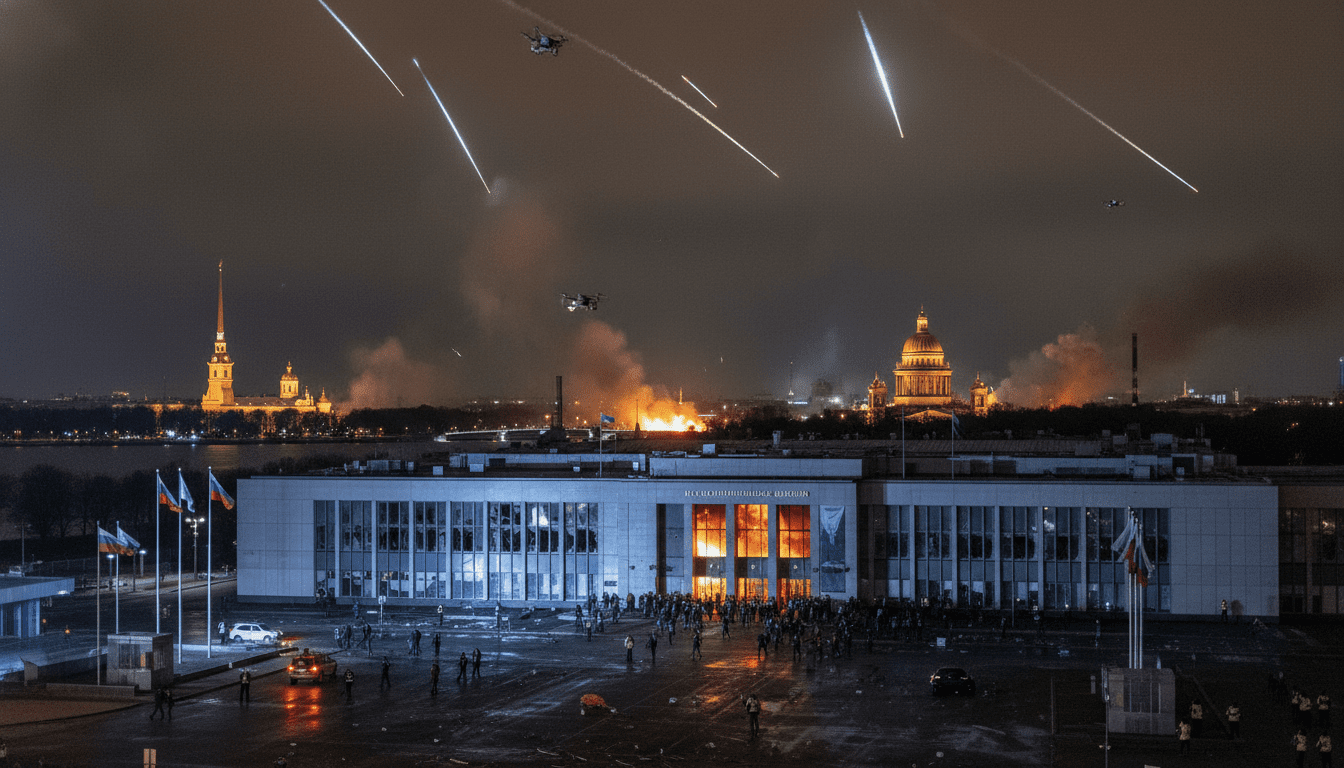
Drone Attacks on St. Petersburg Disrupt SPIEF and Prompt Widespread Air-Defence Response
Ukrainian drone attacks struck St. Petersburg during the SPIEF, triggering widespread air-defence responses, evacuations and temporary Pulkovo airport closures.
The last day of the St. Petersburg International Economic Forum was marked by a new wave of drone attacks that struck the city and surrounding regions, officials said. The incident, which Kyiv acknowledged in part and Moscow said it largely intercepted, forced authorities to warn residents to remain indoors and disrupted airport operations for visiting delegates. Both sides issued public statements blaming the other as air-defence units reported large-scale engagement across western and southern Russia.
Immediate warnings from regional authorities
Alexander Beglov, governor of St. Petersburg, and local civil defence services issued urgent notices asking residents to stay inside and avoid public areas. Communications officials also warned of possible interruptions to mobile internet services as air-defence measures were deployed across the metropolitan area. Authorities said the defence systems were active through the early morning as they responded to multiple incoming aerial targets.
Local emergency services reported evacuations near sites where fires broke out after reported impacts, and municipal authorities temporarily suspended some public transport links. Airport operations at Pulkovo, a key hub for international forum attendees, experienced a halt to arrivals and departures at peak hours because of the perceived drone threat.
Scale of interceptions reported by Russian forces
The Russian Defence Ministry said its air-defence units had shot down hundreds of unmanned aerial vehicles overnight across a broad geographic area. In a nightly tally, the ministry listed dozens of regions and maritime zones where interceptions occurred, describing the operation as nationwide in scope. Those figures included several locations in the northwestern theatre near St. Petersburg and the Leningrad region.
Regional officials provided specific counts in some areas; the governor of Leningrad region reported that air-defence batteries had downed scores of drones in his jurisdiction. Moscow’s official figures framed the operation as a largely successful defensive action, while acknowledging emergency responses and localized evacuations where debris or secondary fires threatened civilian structures.
Reported targets beyond the city
Ukraine’s president said Kyiv had targeted energy and military infrastructure in several Russian regions during the operation. Among the claimed strikes were an oil depot in the Krasnodar region and a military facility near St. Petersburg, according to the Ukrainian statement. Kyiv framed the strikes as a response to Russia’s broader campaign against Ukrainian civilians and infrastructure.
Russian officials confirmed that fires had erupted at some military-related sites after the engagements, prompting firefighting and evacuation efforts in nearby residential areas. Authorities also said that installations tied to the Russian navy in the Gulf of Finland, including facilities in Kronstadt, had been subject to attempted attacks during the same period.
Impact on the International Economic Forum
The assaults coincided with the closing day of the St. Petersburg International Economic Forum, an annual gathering that attracts foreign delegations and business leaders. Organizers and host authorities had to balance public safety concerns with the logistical needs of high-profile visitors, some of whom rely on Pulkovo airport for transit. Temporary interruptions at the airport affected arrivals and departures and added a security overlay to the forum’s final sessions.
Forum participants reported heightened security and visible air-defence activity in the skies during the morning. Russian officials framed the events as an external threat to economic exchange, while also indicating that the forum’s proceedings would continue under reinforced protective measures.
Statements from Kyiv and Moscow and diplomatic fallout
Ukrainian President Volodymyr Zelensky described the operations as targeted strikes on military and energy infrastructure and reiterated Kyiv’s stance that Russia must end its war. He framed the measures as proportionate responses to ongoing attacks on Ukrainian civilians. The messaging from Kyiv emphasized accountability and the continuation of military pressure on strategic targets.
The Kremlin and defence officials accused Ukraine of escalating strikes on Russian soil during an international event and highlighted the risk to foreign participants. President Vladimir Putin acknowledged that the attacks had inflicted “a certain amount of damage” on economic assets but stressed that steps to strengthen air-defence systems were underway and that broader economic risks were being managed. Putin also rejected an offer from Kyiv for bilateral peace talks at this time.
Developments remain fluid as both sides exchange claims and counterclaims, and independent verification of specific hits is limited. International observers and foreign delegations present at the forum are assessing security implications amid heightened tensions.
The incident underscores how the conflict continues to affect not only frontline zones but also major Russian population centres and national events, raising questions about the resilience of infrastructure and the safety of diplomatic and economic gatherings.
