
Canada Joins GCAP as Observer, Boosting UK‑Italy‑Japan Sixth‑Generation Fighter Program
Canada joins GCAP as an observer, backing the UK‑Italy‑Japan effort to build a sixth‑generation jet with drone swarms and AI, targeting service entry in 2035.
The Global Combat Air Programme (GCAP) received a diplomatic boost this week as Canada agreed to join the trilateral effort as an observer, officials announced at the Farnborough Air Show. The move, which stops short of full industrial partnership, signals Ottawa’s intent to diversify its future fighter options beyond U.S. suppliers. Canada’s defence minister is expected to sign a formal declaration in London, while Ottawa will for now remain outside the program’s direct funding commitments.
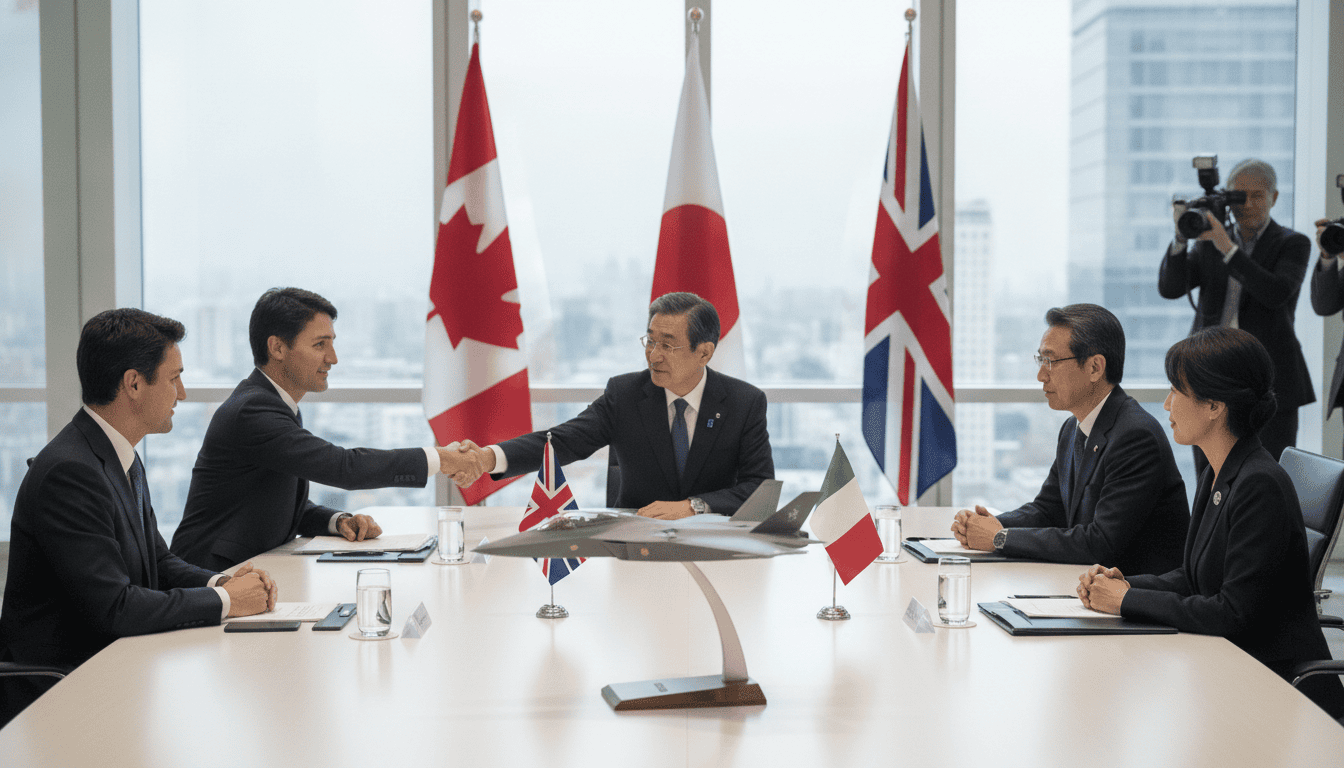
Canada signs observer agreement at Farnborough
Canada’s decision to join GCAP as an observer was presented by the three founding partners — the United Kingdom, Italy and Japan — during the aviation gathering in Farnborough. The Canadian government emphasized that the arrangement does not yet entail financial contributions or equal development status. Officials described the step as a way to study the program’s technology, industrial arrangements and timelines before any fuller commitment is made.
Canada’s move is widely read in defence circles as a political pivot away from an exclusive reliance on U.S.-built fighters. Ottawa is retiring its CF‑18 Hornet fleet and had planned to replace them with F‑35s, but political friction with previous U.S. administrations prompted a search for alternatives. Observers note that GCAP could eventually offer Canada a non‑U.S. option for a next‑generation combat aircraft.
Trilateral industrial leadership and the Edgewing joint venture
The GCAP program is led industrially by BAE Systems, Leonardo and Mitsubishi Heavy Industries, which between them form the backbone of the program’s design and production work. The three nations established the joint venture Edgewing to manage the aircraft’s development, with each partner holding an equal share. The project is the largest defence cooperative effort among the partners and aims to capitalize on shared design work and distributed manufacturing.
Edgewing executives say international cooperation is central to controlling cost, meeting schedules and ensuring access to export markets. The firms have focused on digital design tools and collaborative engineering practices to accelerate development and reduce rework. Senior industry sources describe Edgewing as a deliberately streamlined vehicle for multinational decision‑making, though analysts warn such structures are not immune to political or industrial friction.
Program scope: manned jet, drone wingmen and AI integration
GCAP is designed as more than a single combat aircraft; planners envision a manned sixth‑generation fighter acting as the command node for a networked system that includes autonomous unmanned “loyal wingmen.” The program stresses advanced sensor fusion, secure data links and artificial intelligence to manage swarms of drones and distributed sensing assets. Supporters say the architecture aims to rival projected U.S. and Chinese sixth‑generation air systems by focusing on connectivity and mission modularity.
Proponents argue that combining a manned platform with unmanned collaborators will extend situational awareness and increase survivability in contested airspace. Critics caution that integrating AI decision‑making and autonomous systems raises technical, ethical and operational challenges that must be resolved before deployment. Both sides agree that rigorous testing and robust governance frameworks will be essential as the program moves from design to flight trials.
Development progress, VR engineering and prototype schedule
Industry leaders report significant strides in digital development, including extensive use of virtual‑reality design suites where engineers can inspect, fit and test components before physical manufacture. BAE Systems’ development teams say much of the aircraft’s design is complete and that thousands of parts are being designed in parallel. Pilots have also flown hundreds of hours in simulator environments to validate cockpit layout and sensor integration.
The partners have set ambitious demonstration milestones: a demonstrator is due by the end of 2027, with a first flight planned in 2028. Edgewing officials argue that digital workflows and novel testing methods will compress timelines compared with past programmes. Yet defence analysts caution that flight testing and systems integration commonly reveal unexpected challenges that can extend schedules and increase costs.
Costs, funding commitments and fiscal estimates
Estimating the full lifecycle cost of GCAP remains difficult, but independent analysts place development bills in the tens of billions. Early figures cited by national parliaments and think tanks range widely, with some estimates converting to roughly 70–88 billion euros as a program total. RUSI and other experts have suggested a per‑partner development bill in the region of 20–25 billion pounds, though Edgewing and government officials caution against premature totals while design work continues.
Financial momentum for the programme has increased in recent months, with the UK government announcing a multi‑billion pound investment package intended to underwrite initial development and demonstrator work. Industry leaders welcomed the clarity, saying it reduces near‑term uncertainty for suppliers and helps maintain the programme’s timetable. Nevertheless, long‑term cost-sharing, export arrangements and industrial participation for potential new partners will shape the project’s final price tag.
Strategic implications and European responses
Canada’s observer status strengthens GCAP’s diplomatic footprint, but the program has also prompted debates in Europe about industrial roles and collaboration models. German officials and manufacturers have so far shown limited appetite to join the trilateral program, with some preferring bilateral or alternative avenues for fighter development. Berlin’s defence industry has explored other partnerships, including work with Sweden’s Saab and further evolution of existing platforms.
Tokyo, London and Rome continue to stress that preserving the 2035 service target is a priority, especially for Japan, which needs a successor to its F‑2 fleet. Program managers acknowledge that adding new partners could complicate workshare and timelines, but they maintain mechanisms exist to accommodate external cooperation without derailing the schedule. For now, the addition of Canada as an observer is being framed by partners as a measured expansion that supports broader export prospects while keeping core delivery objectives intact.
As GCAP moves from design into demonstrator and flight‑test phases, governments and industry will face complex choices about industrial participation, export rules and the integration of autonomous systems. The programme’s success will hinge on balancing technical ambition with tight program management and sustained political backing.
