
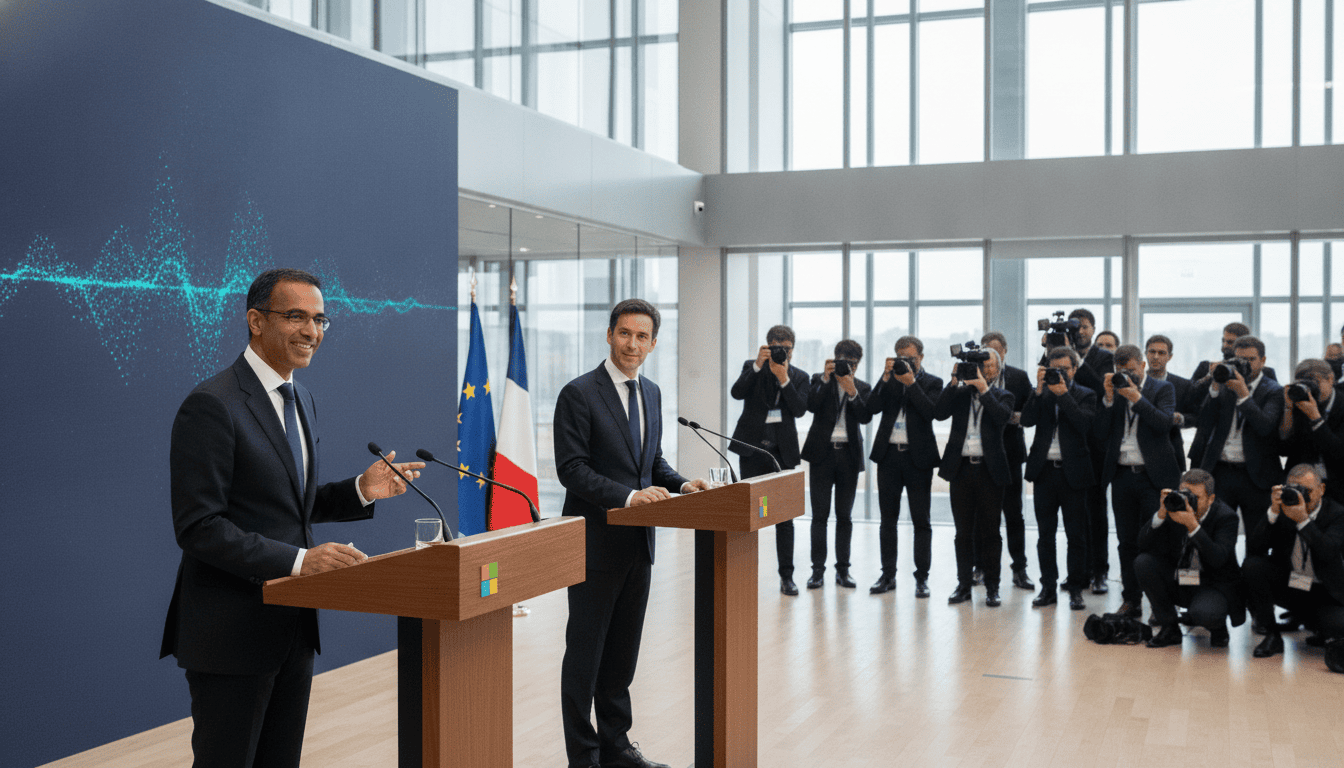
Microsoft-Mistral AI partnership to fund multi-billion euro expansion of European AI infrastructure
Microsoft-Mistral AI partnership to invest billions in European compute, enabling sovereign, flexible AI for businesses and public authorities across Europe.
The Microsoft-Mistral AI partnership announced a strategic, multi-billion euro agreement to expand computing capacity and embed European AI models in enterprise and government systems. The deal commits Microsoft to directly use parts of Mistral’s enlarged hardware footprint in Europe, aiming to meet surging demand for cloud and generative AI services while addressing data sovereignty concerns. Leaders at both companies framed the move as a step toward strengthening Europe’s AI infrastructure and accelerating adoption of locally governed AI solutions.
Deal expands European AI infrastructure capacity
The agreement centers on a substantial build-out of compute and storage resources across multiple European sites that will be operated by or for Mistral and made available to Microsoft customers. While the partners declined to publish an exact headline figure, company statements describe the investment as being in the “several billion euro” range and emphasize long-term capacity commitments. Microsoft’s planned use of this regional hardware is designed to reduce latency for customers on the continent and to demonstrate a tangible commitment to European digital infrastructure following promises made in 2025.
Addressing legal and regulatory hurdles for EU users
European companies and public bodies have routinely cited legal, regulatory and compliance risks when evaluating U.S.-based AI services, particularly around data transfers and governance. The alliance seeks to mitigate those concerns by offering Mistral’s Europe-hosted models inside Microsoft’s product portfolio, giving customers deployment choices that align with local rules. By combining a European model provider with a major cloud and software vendor, the partners say customers will be able to meet stricter privacy, auditability and residency requirements without sacrificing the performance or tooling enterprises expect.
Deployment options tailored to sensitive sectors
Under the new arrangement, customers will be able to run AI workloads in the public cloud, on locally attached infrastructure, or in fully air-gapped systems that are physically isolated from external networks. That flexibility is aimed at sensitive sectors such as banking, healthcare, energy and critical manufacturing where data confidentiality, business secrecy and continuity are paramount. Vendors and regulators have increasingly emphasized the need for modular deployment patterns; this agreement packages those options with enterprise contracts and service-level assurances that large organizations typically require.
Integration into Microsoft software and services
Beyond hardware, the partners have agreed to integrate Mistral’s European models with Microsoft’s suite of cloud and productivity offerings to simplify enterprise adoption. That software-level tie-in means corporations and government agencies will be able to access Mistral models through familiar Microsoft interfaces and management tooling while retaining control over where models run. Analysts say the integration lowers technical and procurement barriers for customers who have hesitated to pilot generative AI in regulated environments, potentially speeding up wider commercial rollout.
Strategic diversification for Microsoft and market access for Mistral
For Microsoft, the pact represents a deliberate move to diversify its generative AI supply chain beyond existing partnerships, signaling that the company intends to work with multiple model providers. This reduces vendor concentration risk and gives Microsoft a broader set of technology options to offer customers with distinct policy or performance needs. For Paris-based Mistral, the deal provides immediate access to Microsoft’s global sales and channel network, which could accelerate deployment in enterprises and public administrations and boost Mistral’s standing as a European AI champion.
Potential market and policy implications in Europe
The deal is likely to reshape competition in the European AI market by coupling a fast-growing regional model developer with one of the world’s largest cloud providers, and it will attract scrutiny from regulators and customers alike. Policymakers will watch whether greater onshore capacity genuinely improves data protection practices or simply relocates dependency to a new provider-hosting model under a transatlantic vendor. Observers also note that the expansion will raise questions about how infrastructure investments are governed, who controls access to model updates, and how transparency and auditability will be enforced in critical deployments.
Looking ahead, the Microsoft-Mistral AI partnership sets a template for how cloud scale, model development and regulatory sensitivity can be combined to accelerate responsible AI adoption in Europe. The immediate priorities for both companies will be rolling out the promised hardware, completing software integrations, and convincing heavily regulated sectors that these new options materially reduce legal and operational risk. If implemented as described, the pact could strengthen Europe’s digital autonomy while creating a commercially viable path to scale generative AI across public and private institutions.
