
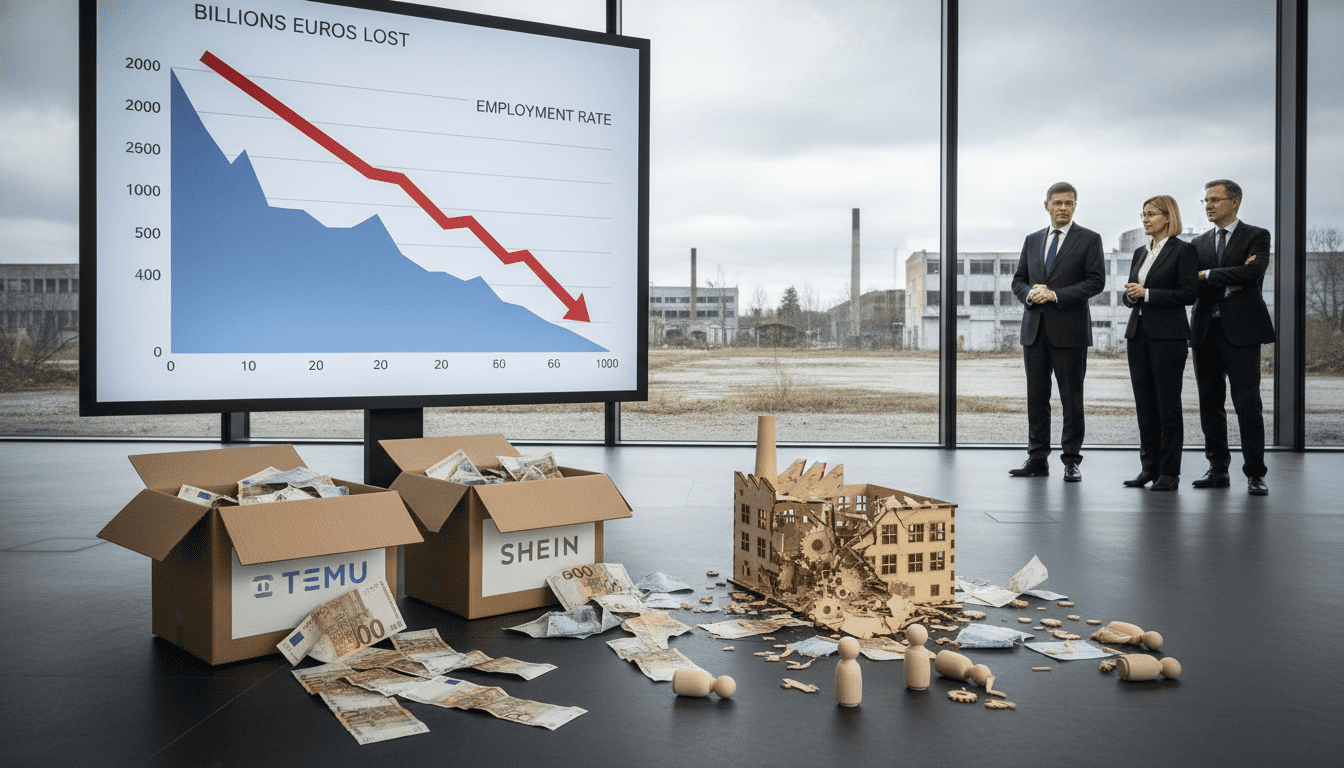
Temu and Shein cost German economy billions, study finds
Analysis: Temu and Shein cost Germany €2.5bn in retail each year and cause wider economic losses, job cuts and tax shortfalls, prompting calls for stricter rules.
The rise of the Chinese online marketplaces Temu and Shein is inflicting measurable damage on the German economy, according to a new analysis commissioned by the Handelsverband Deutschland (HDE). The study, carried out by IW Consult, estimates that German retail loses about €2.5 billion in annual sales to purchases made on those platforms, with broader economic effects pushing the total impact considerably higher. The finding has intensified calls from retailers and politicians for stronger enforcement and regulatory changes.
IW Consult analysis: retail losses and economic multiplier
The IW Consult study is based on an online survey of 4,000 consumers aged 16 to 69 conducted in February and extrapolates purchase displacement from responses. Survey respondents who use Temu and Shein said that 51 percent of the items they bought on those platforms would have been purchased elsewhere at the same price, while 19 percent would have been willing to pay more elsewhere. Using standard input-output techniques, the authors calculate direct retail losses of €2.5 billion and estimate a roughly twofold effect on the wider economy because retail spending generates upstream demand.
IW Consult’s economist Marco Trenz quantified the ripple effect, saying each euro of retail turnover supports about two euros of output across related sectors. That calculation includes rents, energy, logistics and payrolls, and it is the basis for the study’s headline claim that the total economic loss is about double the retail shortfall. The report frames the displacement as not only a sales problem for shops but also a structural reduction in domestic economic activity.
Employment impact: more than 40,000 jobs affected
The analysis attributes more than 40,000 lost jobs in Germany to the shift of purchases from domestic retailers to Temu and Shein, with the majority of job losses concentrated in brick-and-mortar retail. IW Consult argues that had those sales occurred in Germany, additional staff would have been needed in stores and in supplier industries that support retail operations. The study warns that continued market share growth by the platforms could deepen the employment impacts over the medium term.
Retail groups point to these figures as a sign that local shopping ecosystems are under pressure, citing not only store staffing but also jobs in logistics, wholesale and local services that depend on in-person commerce. The HDE has used the employment estimates to support demands for policy responses aimed at leveling the playing field between domestic retailers and foreign marketplaces.
Consumer behavior driving cross-border purchases
Survey responses suggest convenience, low prices and product range are the primary reasons German consumers turn to Temu and Shein. According to the IW Consult questionnaire, a significant share of customers would have purchased comparable items from German shops if the platforms had not offered them, indicating direct substitution rather than the creation of new demand. That behavior helps explain why the platforms’ expansion translates rapidly into measurable losses for domestic sellers.
Critics highlight concerns about product quality, safety checks and after-sales service as additional drivers of unease among retailers and consumer advocates. Consumer protection groups and trade associations say that where returns, warranty processing and compliance enforcement are weaker on cross-border platforms, the competitive advantage from lower prices is amplified at the expense of regulated local firms.
Regulatory responses: EU fees and national enforcement calls
In response to the surge of small parcels coming from third countries, the EU has introduced a processing fee for low-value imports and plans further changes to customs rules. From July a temporary €3 charge for packages valued up to €150 is expected, and a new digital customs platform will ultimately aim to make imports dutiable from the first euro. Brussels officials have also opened examinations under the Digital Services Act (DSA) into the conduct of large online platforms, and German regulators are monitoring compliance.
Germany’s Handelsverband and other industry voices are pressing for swifter national enforcement as well as EU-level measures, arguing that fees and tighter customs enforcement alone will not address unfair pricing practices or insufficient product controls. HDE President Alexander von Preen has called for stronger action, saying some marketplace practices put compliant domestic retailers “at the edge of ruin” and should be met with decisive regulatory steps.
Investigations and platform responses
Both Temu and Shein reject the portrayal of their operations as harmful to the German economy and point to their contributions to cross-border trade and employment. Temu told analysts that its marketplace provides access for thousands of traditional companies to global customers, while Shein said it hosts hundreds of German sellers and has paid substantial taxes in recent years. Each platform described allegations of regulatory breaches as unfounded and warned against singling out global competition as a scapegoat for structural retail challenges.
Regulatory scrutiny is nevertheless under way: the German Bundeskartellamt opened proceedings in October against Technology Limited, the company behind Temu, to examine whether marketplace rules on pricing and seller conduct may amount to anticompetitive restrictions. The European Commission has also signalled interest in enforcing the DSA and other trade rules where platforms potentially undermine consumer protection or market fairness.
The debate triggered by the IW Consult analysis pits retailers and consumer advocates against platforms that emphasize market access and scale. With EU measures scheduled to alter the cost calculus of small-value imports and national authorities pursuing investigations, the outcome will shape whether the balance shifts back toward regulated domestic sales or whether major foreign marketplaces continue to expand their footprint in Germany.
