
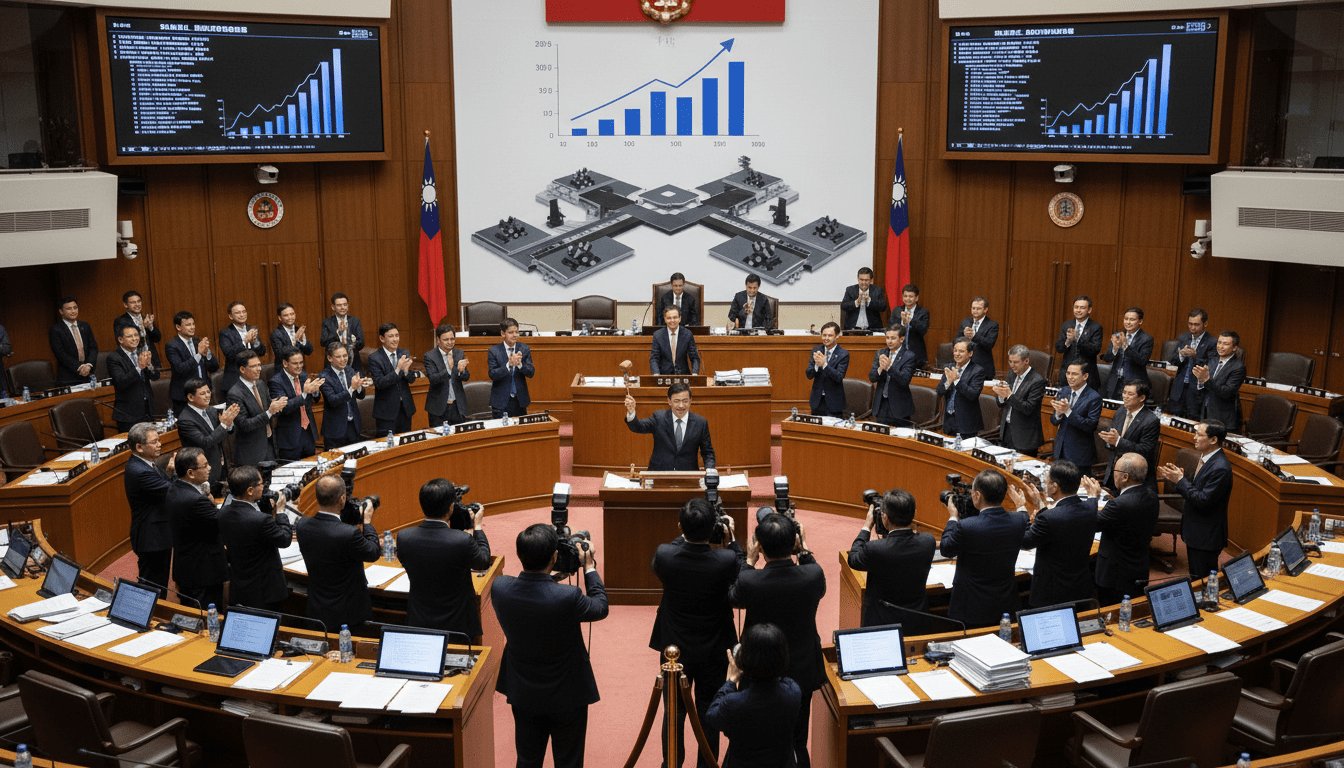
Taiwan defence budget: Parliament passes record €21bn special arms fund after months of negotiation
Taiwan’s parliament approved a record €21 billion special defence budget Friday after months of negotiation, marking the largest emergency military appropriation in the island’s history and reshaping near‑term procurement plans. The Taiwan defence budget passed amid opposition control of the legislature and is roughly €13 billion lower than the package President Lai Ching‑te and the ruling Democratic Progressive Party proposed last year. Lawmakers framed the vote as a compromise that accelerates purchases of US systems while leaving domestic development to the regular defence accounts.
Parliament Approves €21 Billion Special Defence Budget
The bill cleared the legislature after prolonged debate and partisan standoffs, with the opposition Kuomintang (KMT) and the Taiwan People’s Party using their joint majority to steer the outcome. The approved sum, just under €21 billion, is the largest special fund the island has ever authorized and represents a middle path between the executive’s larger request and the KMT’s far smaller plan. Lawmakers said the measure balances urgency to bolster deterrence with concerns about budget transparency and procurement oversight.
Compromise Between KMT Proposal and Government Plans
The compromise reflects internal tensions within Taiwan’s political landscape. KMT chair Cheng Li‑wun had initially proposed a much smaller special budget and recently traveled to Beijing, a move that underscored the party’s divergent stance from the government on cross‑Strait policy. Neither Cheng’s minimal proposal nor President Lai’s full request prevailed; instead, the legislature adopted an intermediate package that doubled the KMT’s proposal while trimming the executive’s ambitions by about €13 billion.
Funding Priorities Center on T‑Dome and US Deliveries
A substantial portion of the special fund is earmarked for development of a new missile‑defence architecture dubbed “T‑Dome,” which combines US systems with domestically produced components. The bulk of the expenditure is slated for 2026–2033 and is intended to finance purchases such as HIMARS multiple‑launch rocket systems and heavy artillery. The law explicitly provides roughly €8 billion for weapons deliveries that the US Congress has already approved, while a further €13 billion is contingent on an official US offer‑and‑acceptance letter being presented.
Domestic Defence Industry Must Rely on Regular Budget
Under the parliamentary decision, growth of Taiwan’s indigenous defence sector will be financed through the standard defence appropriation rather than the special fund. The ruling Democratic Progressive Party warned that shifting domestic procurement off the emergency budget risks delaying or constraining projects aimed at strengthening local capabilities, including drone programs and other asymmetric systems. Industry representatives have expressed concern that without dedicated special‑fund support, smaller manufacturers could face cash‑flow problems while awaiting allocations from the regular budget cycle.
Geopolitical Timing Heightens Diplomatic Sensitivities
Observers note the vote’s timing is geopolitically sensitive: it comes days before a scheduled US‑China summit in Beijing that could reshuffle strategic calculations. Chinese leader Xi Jinping has raised objections to US arms sales to Taiwan, and Beijing’s foreign ministry reiterated that the Taiwan question touches the foundation of Sino‑American ties and that any move toward formal independence must be opposed. Taipei officials fear Beijing could seek to tie concessions on other bilateral issues to pressure over weapons transfers, adding urgency to Taiwan’s efforts to secure and pre‑finance critical systems.
US Statements and Delivery Backlogs Shape Expectations
Senior US military officials have also urged Taiwan to demonstrate a willingness to invest in its own defence, with the commander of US Indo‑Pacific forces saying earlier this year that Taipei must show it can shoulder part of its security burden. Former and current US political leaders have repeatedly framed sales as transactions that require payment and preparation from Taiwan’s side. Meanwhile, Taiwanese officials point to an existing backlog of roughly €27 billion in US systems that have been ordered and largely paid for but remain undelivered as American manufacturers contend with competing global commitments.
The parliamentary approval of the Taiwan defence budget signals a pragmatic, if imperfect, consensus in Taipei to accelerate deterrent capability while managing domestic political divisions. Implementation now hinges on timely US offer letters, export logistics, and the ability of Taiwan’s regular defence budget to sustain indigenous programs that lawmakers deliberately kept outside the special fund. Observers say the next weeks will be critical as diplomatic exchanges between Washington and Beijing unfold and as Taiwan begins to translate the new appropriation into concrete contracts and deployments.
