
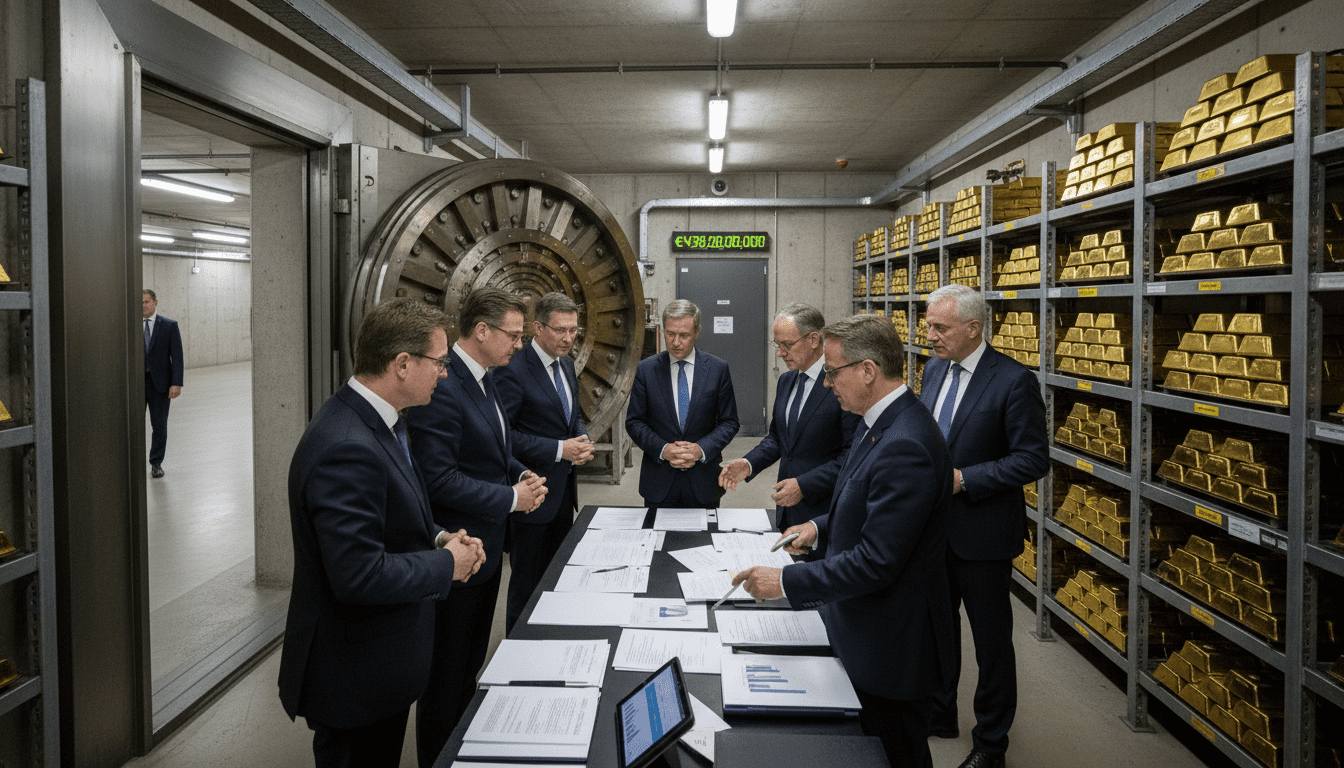
German gold reserves emerge as a possible source to close widening budget gap
German gold reserves valued around €438bn could be used to close a growing budget gap, prompting debate over sales, market effects and political feasibility.
Germany’s budget shortfall and an energy shock have renewed discussion about using German gold reserves to finance relief measures and prevent deeper economic contraction. The federal government faces choices between tax increases, spending cuts or tapping alternative assets as energy prices surge after disruptions in the Strait of Hormuz. Policymakers and economists are weighing whether selling part of the Bundesbank’s gold holdings could provide a one-off fiscal buffer without weakening investment in the future.
Budget shortfall forces immediate choices
The federal budget is confronting a gap that analysts warn could be significantly larger than the €20–30 billion figures circulating in initial debates. At the same time, companies and households face rising costs from an energy supply shock that has intensified calls for relief measures. Those measures — tax relief for firms, an energy-cost allowance for households and targeted industry support — would require substantial funding that the current budget framework cannot easily supply.
Debt brake offers limited, politically fraught relief
Invoking Germany’s constitutional debt brake requires a formal declaration of an extraordinary emergency and a broad parliamentary majority, a threshold that appears politically difficult. Even if lawmakers agree, using the debt brake once buys only limited fiscal flexibility and may have to be repeated if the energy shock persists. Relying on repeated exceptions would undermine the rule’s credibility and expose the government to recurring politically charged showdowns.
Size and valuation of the reserves
Germany holds one of the largest official gold stocks in the world, totaling roughly 3,352 tonnes of fine gold. Using recent spot prices near $4,750 per troy ounce and an exchange rate around €1 = $1.17 produces a market valuation in the vicinity of €438 billion. That headline figure sharply exceeds the roughly €270 billion value the Bundesbank carried on its balance sheet at the end of 2024, reflecting a significant appreciation of the metal since then.
The paper valuation swing has added more than €160 billion to the market value of the holdings since early 2025, according to the same pricing logic. That rise has renewed questions about how much of that unrealized gain, if any, might legitimately be mobilized for one-off fiscal needs without jeopardizing long-term monetary and reserve policy objectives.
Where the gold is stored
The bulk of Germany’s gold is split among three vaults: a little over half is held in Frankfurt at the Bundesbank’s own reserves, while roughly 37 percent remains at the Federal Reserve Bank of New York and about 12 percent is stored with the Bank of England in London. The geographic dispersion reflects historical arrangements and confidence-building practices dating back decades, but it also complicates any rapid plan to repatriate or sell bars, since logistics and custody agreements would need to be navigated.
Rules and precedent for coordinated sales
Between 1999 and 2019, European central banks operated under Central Bank Gold Agreements that set voluntary limits and coordination mechanisms for sales to avoid destabilizing markets. Those accords permitted shared annual sales up to substantial tonnages, and several central banks used the framework to reduce holdings in an orderly way. The Bundesbank, however, has sold almost no bullion in recent decades, typically releasing only one or two tonnes per year to finance commemorative coin minting.
Any modern sale at scale would raise questions about whether similar coordination — among other central banks or through informal consultation — would be necessary to prevent a sharp price reaction. Market participants and sovereign partners would likely seek assurances that sales would be paced and transparent.
Policy options, market impact and political feasibility
One option for Berlin would be a calibrated sale of a modest tranche of gold, using proceeds to close immediate fiscal holes while keeping a large core reserve intact. Economists note that modest, well-signaled sales are less likely to disrupt prices than abrupt, large disposals, especially if coordinated with other reserve holders. Yet even modest sales carry reputational and political costs: selling national gold can be portrayed as a loss of a strategic asset and would face scrutiny in parliament and the public.
Alternative uses of the gold proceeds would also need clear rules. Lawmakers would have to decide whether funds channelled from a sale go to one-off relief payments, to a stabilization fund, or into debt reduction. Each choice has different implications for fiscal sustainability and future borrowing flexibility, and all would be subject to legal and institutional constraints involving the Bundesbank and the finance ministry.
Germany must weigh the immediate benefits of releasing liquidity against long-term reserve policy and market stability. Selling too much risks eroding a buffer that central banks historically hold for credibility and crisis insurance, while selling too little could leave pressing fiscal needs unmet. The choice is further complicated by the domestic political environment, where coalition divisions make broad consensus difficult to achieve.
The debate over German gold reserves will test how fiscal pragmatism and monetary prudence can be balanced in the face of an energy-driven downturn. Officials in Berlin must decide whether this historic stockpile should be treated as a fiscal backstop in a time-limited emergency or preserved as a strategic reserve for future shocks.
