
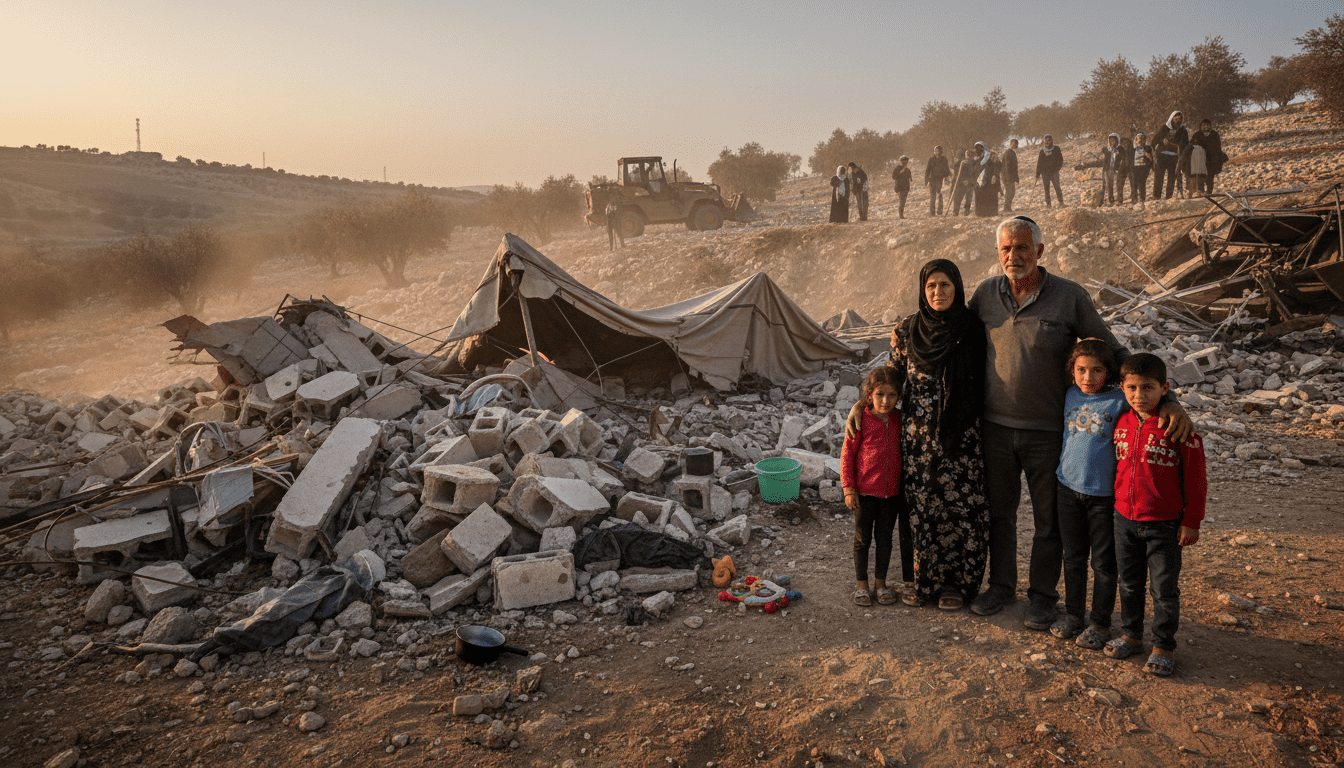
Masallam family in Khirbet al-Marajim say repeated settler attacks have left homes burned, infants taken and livelihoods destroyed
Masallam family in Khirbet al-Marajim report settler arson, infant abduction and restrictions that have ruined livelihoods and risk displacement.
The Masallam family in Khirbet al-Marajim say a series of coordinated settler attacks, accompanied by military patrols and administrative measures, have transformed daily life on their ancestral hill into a cycle of arson, beatings and dispossession. The March 2025 assault that saw their home torched and two infants briefly seized has become emblematic of an intensifying campaign that the family says aims to displace them from their grazing lands. Residents describe destroyed olive groves, broken vehicles and frequent roadblocks that limit access to markets, schools and medical care. Despite injuries, fear and repeated demolitions nearby, the family continues to live on the compound and to insist they will remain on the land.
Attack on the Masallam compound and infant abduction
The family recounts that on a night in mid-March 2025 some 30 settlers arrived on foot and ATVs, smashing windows, setting a car and a house alight and firing live rounds in the vicinity. In the chaos two infants were taken from a burning room and abandoned minutes later in a nearby field; both were found alive and returned to the family. The attack lasted roughly 20 minutes according to witnesses, and the Israeli army — which family members say had been present at the entrance — arrived after the perpetrators had left.
Relatives say soldiers at the scene did not intervene to stop the assault, and family members report beatings by both settlers and soldiers during subsequent incidents. Complaints filed by the family, they say, have produced little accountability; no one from the attackers has been detained for the March incident, and Palestinian residents describe repeated frustrations when seeking redress from local authorities.
Expansion of nearby outposts and restrictions on movement
Settler encroachment around Khirbet al-Marajim accelerated after an outpost established near the compound in 2015 was formalised as a settlement in 2023. A satellite outpost set up in late 2024 sits less than a kilometre from the Masallam household, and residents say the presence of armed young settlers on grazing expeditions has become a daily threat. The family reports frequent incursions in which settlers release cows onto their lands, eat olive-tree branches and force the family’s flocks to remain penned.
The expansion of outposts has been accompanied by roadblocks and closures that cut the compound’s links to the nearby town of Duma, complicating access to schools, markets and health care. Activists who had lived alongside the family to provide protection were expelled under a temporary closed military zone order, and respondents say that absence triggered a rise in the frequency and severity of attacks.
Loss of olive groves, wheat and income
For generations the Masallams farmed wheat, produced olive oil and grazed sheep and goats; the hill around their home once yielded up to 1,000 litres of olive oil each season. Family members say that sustained damage to roughly 450 olive trees by settler livestock and restricted access to fields have reduced production to a fraction of that, delivering a catastrophic hit to household income. The wheat harvest has been largely inaccessible for several years, and fodder costs have surged as the family is forced to keep animals penned for safety.
Those economic pressures are compounded by repeated destruction of property: the family car was torched in the March attack and later vandalised again by soldiers and settlers, according to residents. The cumulative financial strain, they say, is precisely what drives efforts to make life untenable so families will sell or abandon their land.
Allegations of military collusion and administrative measures
Members of the Masallam household assert a pattern in which settlers, soldiers and Civil Administration officials act in ways that facilitate displacement. They describe soldiers arriving before some attacks, limiting movement during assaults and in some instances enabling settlers to carry out acts of violence. The family also reports forcible demolitions and orders to remove protective fencing from around their flocks, along with declarations that parts of the area are archaeological zones — measures they fear could be used to justify removing homes.
Those administrative actions have direct consequences on the ground: one multigenerational house in al-Marajim was demolished without warning, and a Civil Administration order demanded the dismantling of the family’s animal enclosures. Family members say these enforcement steps follow patterns of settler pressure rather than neutral rule enforcement.
Daily life, cultural resilience and psychological toll
Despite recurring violence, the Masallams maintain daily routines that include milking sheep, making baladi cheese and singing folk songs passed through generations. The household — spanning four generations — still gathers in the stone-domed home for tea and conversation, and elders say humor and song are critical to surviving the psychological strain. Children continue to play and attend school when transport is available, though parents describe constant anxiety over journeys that have become hazardous.
At the same time, the emotional scars run deep: young children tremble at the sight of settlers, elders recall nights when sleeping outdoors was once safe and now feels impossible, and family members report a pervasive fear of further attacks and demolitions. The combination of physical danger and economic collapse has pushed relatives to stay elsewhere temporarily, even as most have returned to the compound.
Demolitions, roadblocks and the prospect of displacement
Since the wave of attacks intensified after October 2023, families along the Allon Road have reported forced displacements and the erasure of entire communities. Administrative demolition orders and physical obstacles such as roadblocks and water-pipe sabotage have further isolated Khirbet al-Marajim, residents say. The Masallam household describes deliberate efforts to curtail their access to grazing land and markets that, if sustained, could make permanent relocation the only viable option for survival.
The family insists they will remain despite the pressures, framing their presence on the hill as a defence of both livelihood and heritage. “God willing, we will overcome them all and stay here,” one relative said, underlining that endurance on the land is both a personal decision and a political act. For now, the charred shell of a burned home and the dented metal door at the Masallam compound stand as material records of repeated assaults, while the sound of ATVs on the horizon continues to mark each day.
