
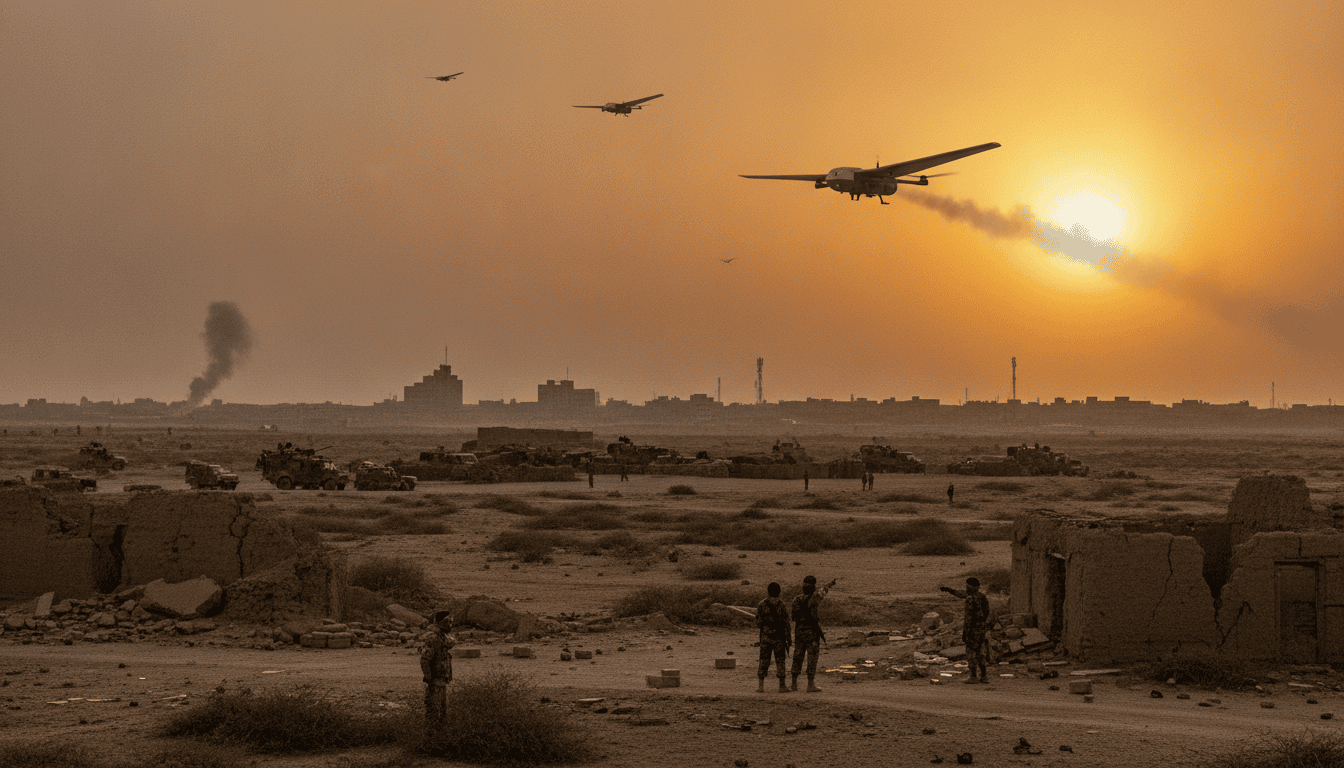
RSF Drone Campaign Tightens Siege on El Obeid as Humanitarian Crisis Deepens
RSF drone strikes on El Obeid are crippling water and power, driving mass displacement and prompting war-crimes alarms amid limited international action.
El Obeid has become the new epicenter of Sudan’s conflict as paramilitary Rapid Support Forces (RSF) intensify drone attacks and siege tactics against the city held by the Sudanese Armed Forces (SAF). Drones, including so-called “Sunflower 200” models reportedly produced in China, have been used to strike power plants, water infrastructure and civilian neighborhoods, cutting essential services and driving large-scale displacement. International observers and humanitarian groups warn the attacks mirror earlier RSF campaigns that investigators say included mass killings and may amount to crimes against humanity.
RSF Deploys Sunflower 200 Drones in El Obeid Assault
The RSF’s growing reliance on kamikaze-style drones has reshaped the battlefield around El Obeid and beyond. The devices described in field reporting are capable of long-range flights and carry substantial explosive payloads, enabling strikes on infrastructure without conventional front lines. Analysts say that this technological shift allows the RSF to conduct targeted destruction of civilian systems while avoiding protracted ground engagements.
Satellite imagery and open-source monitoring have documented repeated strikes on key facilities, while video footage circulated by combatants shows drone impacts in populated zones. Human rights officials have flagged the pattern as a deliberate strategy to weaken city resilience and force population movement, rather than isolated battlefield collateral damage.
Siege Tactics and Systematic Infrastructure Destruction
The RSF campaign around El Obeid combines aerial strikes with encirclement and intermittent ground pressure to degrade basic services. Hospitals report repeated loss of electricity and fuel, water supply points have been damaged or rendered inoperable, and market access is increasingly restricted. Prices for fuel and food have spiked, straining household coping mechanisms and pushing already vulnerable families into deeper crisis.
Aid agencies warn that the removal of power and water is not merely incidental but forms part of a broader tactic to make urban life unsustainable. With fuel scarce and supply routes compromised, logistics for humanitarian deliveries face mounting obstacles, prolonging shortages and complicating relief efforts.
Humanitarian Toll and Displacement Pressures
Civilians in El Obeid are experiencing acute shortages and a collapse of routine services that sustain daily life. Medical centers operating on limited generators face overcrowding and supply shortfalls, while markets report skyrocketing costs for staples and fuel. The deteriorating conditions are driving thousands to flee toward makeshift camps or attempt perilous journeys to neighboring regions.
Past RSF offensives in Darfur and elsewhere produced large-scale displacement and reports of mass killings; UN investigators and independent researchers have documented extensive civilian suffering caused by similar tactics. Humanitarian organizations emphasize that even without massive single incidents, the slow attrition of essential services can produce comparable levels of death and long-term devastation.
Strategic Importance of El Obeid in the Wider Conflict
Control of El Obeid carries significant strategic weight for both sides of the conflict. The city sits at a crossroads linking Darfur, Kordofan and central Sudan, and whoever holds it can influence flows of people, food and weapons across a broad swath of the country. For the RSF, capturing or neutralizing El Obeid would disrupt SAF supply lines and consolidate access to regions where the paramilitary holds influence.
Military analysts warn that the struggle over the city could extend for months, as each side seeks to leverage logistics, terrain and external support. That prolonged contest increases the risk that civilian infrastructure will be continually targeted and civilian suffering will expand in scope and duration.
Evidence and Allegations of War Crimes in Recent Campaigns
International investigators and monitoring groups have linked prior RSF operations in West and North Darfur to grave abuses, with some findings describing features consistent with genocide and mass atrocities. Independent research teams have used satellite imagery and open-source footage to document mass graves and large-scale destruction in earlier campaigns, and UN experts have repeatedly raised alarm over patterns of targeted violence against civilian communities.
The recurrence of similar tactics in El Obeid has prompted renewed calls for rigorous fact-finding and accountability mechanisms. Human rights advocates say evidence collection must be prioritized now, while access and security permit, to preserve forensic material and witness testimony that will be crucial for any future prosecutions.
International Coalition Issues Warnings but Offers Limited Leverage
A multilateral grouping formed to prevent atrocities in Sudan — including states such as Canada, France, Norway, the United Kingdom and Germany — has issued statements calling for an immediate halt to attacks on civilians. Yet observers note that strong language has not translated into effective pressure or changes on the ground. Sanctions have targeted some RSF leaders, but analysts argue these measures have so far failed to deter continued operations or to protect vulnerable populations.
Diplomatic efforts are further complicated by external actors that provide material support to one side or the other, a dynamic that reduces the leverage of public rebukes. United Nations officials and rights experts continue to press for more robust intervention to prevent further mass casualties and to ensure unimpeded access for humanitarian relief.
The unfolding violence in El Obeid is a stark illustration of how new tactics and technologies can magnify civilian harm when combined with entrenched political and ethnic divisions. As services vanish and people flee, the international community faces the urgent challenge of translating warnings into measures that protect civilians and preserve evidence for accountability.
