
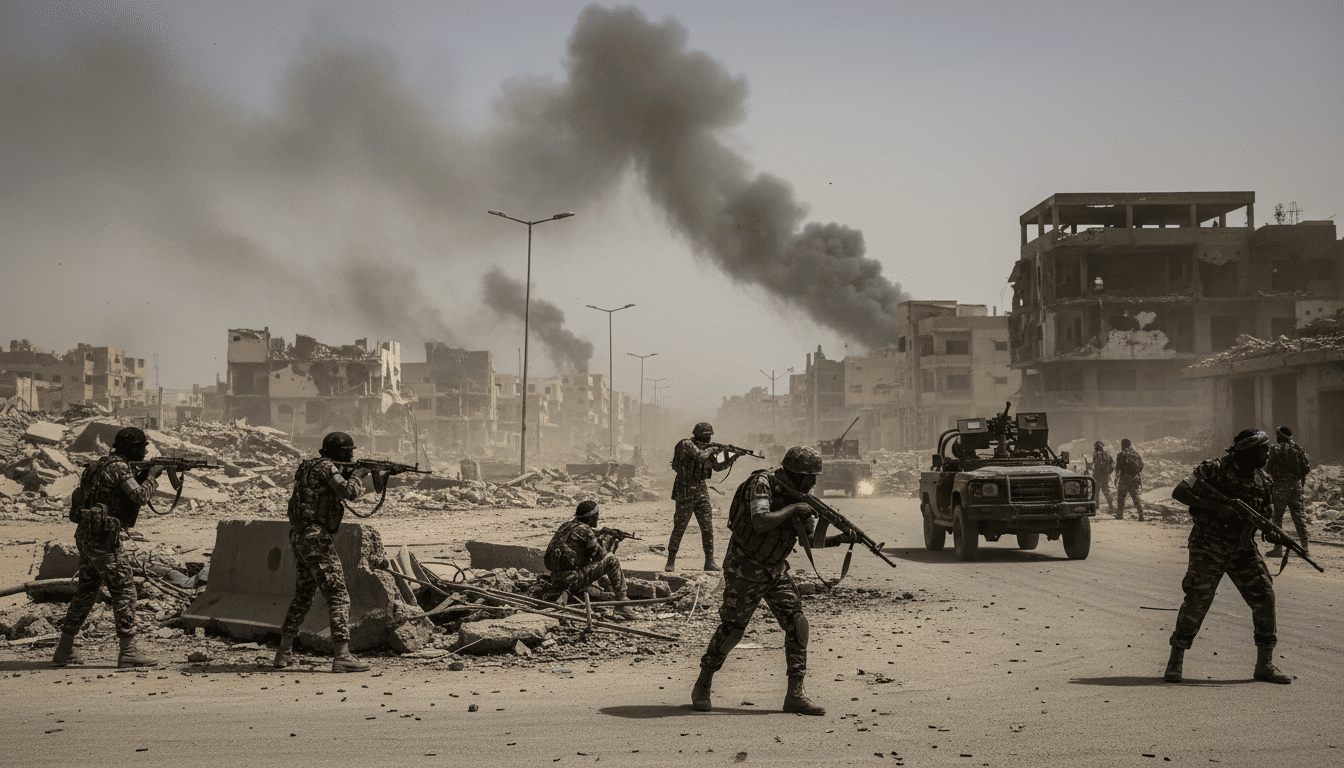
Sudan war grinds into fourth year as frontlines shift and humanitarian crisis deepens
Sudan war enters fourth year with army-RSF stalemate, shifting fronts and a worsening humanitarian crisis that has displaced millions and strained regional diplomacy.
The Sudan war has entered a fourth year with no decisive end in sight as the Sudanese army and the paramilitary Rapid Support Forces (RSF) remain locked in a grinding conflict for control of the country. After a series of territorial reversals through 2024 and 2025, the frontlines now reflect a fractured state: the army holds the capital and large swathes of the north and east, while the RSF controls much of Darfur and key parts of the Kordofan region. Civilians face deteriorating living conditions, and international efforts to broker a settlement have so far failed to halt the violence.
Frontlines and territorial control
The military map of Sudan is sharply divided, with the army dominant in northern, central and eastern states and the RSF entrenched across Darfur and broad areas of the three Kordofan states. The army’s recapture of Khartoum State on May 20, 2025, and a string of subsequent gains gave it control of key population centers, but those advances have not translated into nationwide security. The RSF continues to hold combustible pockets that sustain an active insurgency and intermittent offensives.
Key military reversals and advances
Since early 2025, government forces have reclaimed several strategic towns, including Wad Madani on January 11, 2025, and multiple centres in Kordofan, with el-Obeid’s siege lifted and South Kordofan’s Kadugli and Dilling brought back under army control by February 2025. Yet the RSF has made its own gains: el-Fasher fell to RSF forces on October 26, 2025, and the group expanded its presence in West Kordofan after the army’s withdrawal from the Heglig oilfield. These shifts have produced a fluid battlefield in which control of towns can change rapidly while neither side secures a decisive upper hand.
New fronts and evolving tactics
The conflict has spilled into new theatres, including the Blue Nile region, where the RSF and allied SPLM-North units captured Kurmuk in March 2025. The RSF has increasingly employed drones to strike targets in central and northern Sudan, prompting the army to bolster its own unmanned capabilities and strike RSF supply lines and command nodes. Both sides’ reliance on air-delivered munitions and remote warfare has increased the tempo of engagements and complicated efforts to protect civilians and humanitarian convoys.
Humanitarian toll and displacement figures
Humanitarian indicators paint a bleak picture. A joint assessment by the International Committee of the Red Cross, UNICEF and Intersos found that roughly 14 million people have been displaced over the three-year conflict, while about 26 million face acute food insecurity. The same report said 33.7 million people require humanitarian assistance, including approximately 7.4 million internally displaced persons. The Norwegian Refugee Council and other agencies report widespread erosion of household coping mechanisms, with many families cutting back meals as incomes and markets collapse.
Rising prices and currency depreciation have compounded the crisis. Fuel, bread and basic commodities have surged in price, and the Sudanese pound has weakened sharply against the dollar, with rates hovering around 600 pounds per US dollar in recent weeks. The International Organization for Migration reported that about 3.99 million people had returned to their homes as of April 2026, mostly to Khartoum and Gezira, yet more than 13 million people remain displaced or living as refugees, including an estimated nine million inside the country.
Political developments in Khartoum
The formation of a civilian government under Prime Minister Kamil El-Tayeb Idris in May 2025 marked an important political milestone, as did the government’s return to Khartoum in January 2026 after operating from Port Sudan. Those steps ended a period in which the capital was a contested seat of power, but they have not resolved the core security rivalry between the army and the RSF. International initiatives, notably a Quadrilateral plan presented by the United States, Saudi Arabia, Egypt and the United Arab Emirates in September, and a Sudanese government proposal tabled at the United Nations, have so far failed to produce a sustainable ceasefire or political settlement.
Regional dynamics and possible future scenarios
Analysts warn that the war risks becoming further regionalised, with weapons and fighters moving across porous borders and rival states exerting influence inside Sudan. Military researcher Mohamed al-Amin al-Tayeb has described the conflict as a prolonged stalemate that could persist with modest army advantages, deepen administrative bifurcation between east and west, or escalate into a wider proxy confrontation. The RSF has sought to build parallel governance structures in areas it controls and has at times relied on mercenary recruits, complicating prospects for a negotiated end.
Diplomatic pressure from regional and international actors remains the likeliest path to de-escalation, but mediation will require credible enforcement mechanisms and humanitarian access guarantees to gain traction. Without them, the country faces continued fragmentation, persistent insecurity and the risk of spillover into neighbouring states.
The Sudan war’s fourth year has reinforced a grim reality: territorial gains have not produced political resolution, and the human cost continues to mount. As fighting grinds on, relief agencies warn that without urgent scaling of aid and renewed diplomatic momentum the humanitarian emergency will deepen and the prospects for a stable, unified Sudan will diminish further.
