
German components in Russian drones found in Kyiv garage, INA marking prompts supply-chain scrutiny
Bearings stamped “INA”, a Schaeffler brand, were found in drone motors recovered near Kharkiv, prompting scrutiny of German components in Russian drones.
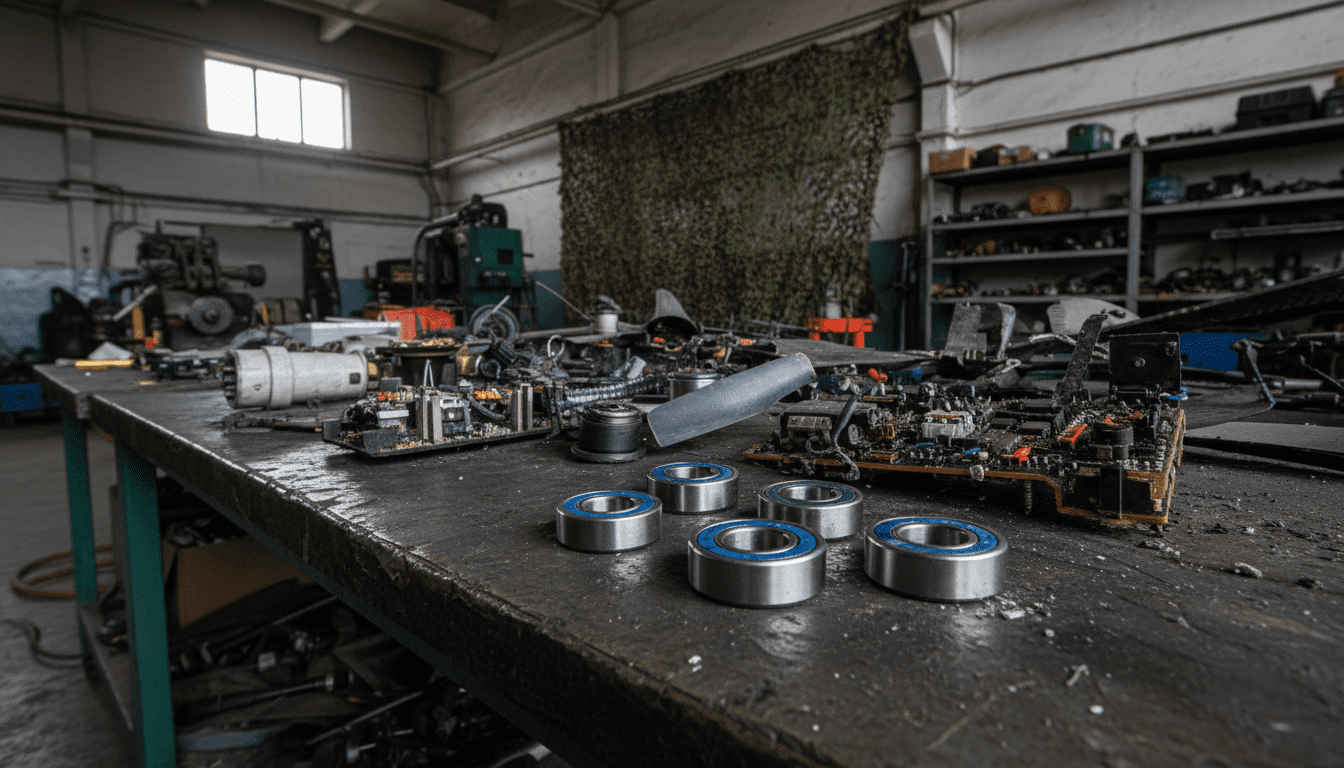
A small, concealed garage in Kyiv became the scene of a forensic discovery when three men who say they served in the Ukrainian armed forces displayed two drone motors they said had been recovered after being shot down in the Kharkiv region. As one of the men cut open an outer casing, an aluminium ring was removed to reveal two needle bearings, each marked with the letters “INA”—a brand name linked to the German Schaeffler Group. The presence of the marking has drawn attention because it underscores how German components in Russian drones can be traced and raises questions about how such parts enter military supply chains.
Motors recovered after strikes near Kharkiv
The motors shown in Kyiv were reportedly removed from unmanned aerial vehicles that crashed or were shot down in eastern Ukraine, according to the men who exhibited the parts. They presented the components in plain clothing and in a setting away from official facilities, saying they intended to document the equipment for investigators and the public. Video and photographs of the examination capture the moment the grinder exposes the bearing assemblies and the engraved brand name, providing tangible evidence for analysts who track component provenance.
INA engraving linked to Schaeffler brand
INA is a trademark associated with the Schaeffler Group, a major German manufacturer of bearings and precision components for automotive and industrial applications. Needle bearings and similar small mechanical parts are widely used in civilian machinery as well as in propulsion and guidance systems for unmanned aircraft. The clear marking on the bearing allows investigators to identify the manufacturer and potentially trace distribution channels back through suppliers and intermediaries.
How German components in Russian drones might circulate
Experts say there are several pathways by which German-made parts can appear in foreign military hardware without direct sales to armed forces. Components may be produced for civilian markets, incorporated into larger systems by third-party manufacturers, or sold through distributors that later export or re-export them. In complex global supply chains, parts can change hands multiple times, be repackaged, or be integrated into assemblies whose final destination is obscured, making it difficult to determine when and how a particular component became part of a weapon system.
Potential implications for export controls and audits
The emergence of identifiable German components in weapons used by an adversary typically prompts scrutiny from regulators and industry oversight bodies. Authorities may seek to determine whether the parts were exported in accordance with existing export controls, whether re-export rules were observed, and whether additional measures are needed to prevent diversion. Policymakers and compliance officials can use forensic evidence such as serial numbers, batch codes, and supplier records to reconstruct transactions and identify weak points in monitoring systems.
Industry and investigative responses likely to follow
When branded components surface in contested equipment, manufacturers and distributors commonly open internal inquiries and cooperate with authorities to trace supply routes. Even when parts are legally produced for civilian use, companies often underscore that they do not authorise military use by specific end-users and may review distribution partners. Independent analysts and defense forensics teams also play a role by cataloguing markings and comparing them with manufacturing data to build a clearer picture of how components move across borders.
Broader context: civilian parts in modern conflict systems
The appearance of commercially produced components in battlefield equipment is not new; modern conflicts increasingly rely on dual-use technologies where civilian-grade parts perform adequately in military applications. That trend complicates efforts to block hostile forces from obtaining necessary hardware without impeding legitimate industrial trade. Forensic revelations such as the INA-marked bearings provide concrete starting points for investigators, but preventing future occurrences typically requires coordinated action across governments, export authorities, and private industry.
The discovery in Kyiv has added a specific, traceable example to longstanding concerns about the flux of civilian components into military systems, and investigators will likely pursue supplier records and shipping documentation to establish when and how the bearings left production lines. Further forensic analysis and official inquiries may clarify whether the parts were diverted intentionally, sold through opaque intermediaries, or incorporated into systems before lawful export controls could apply.
