
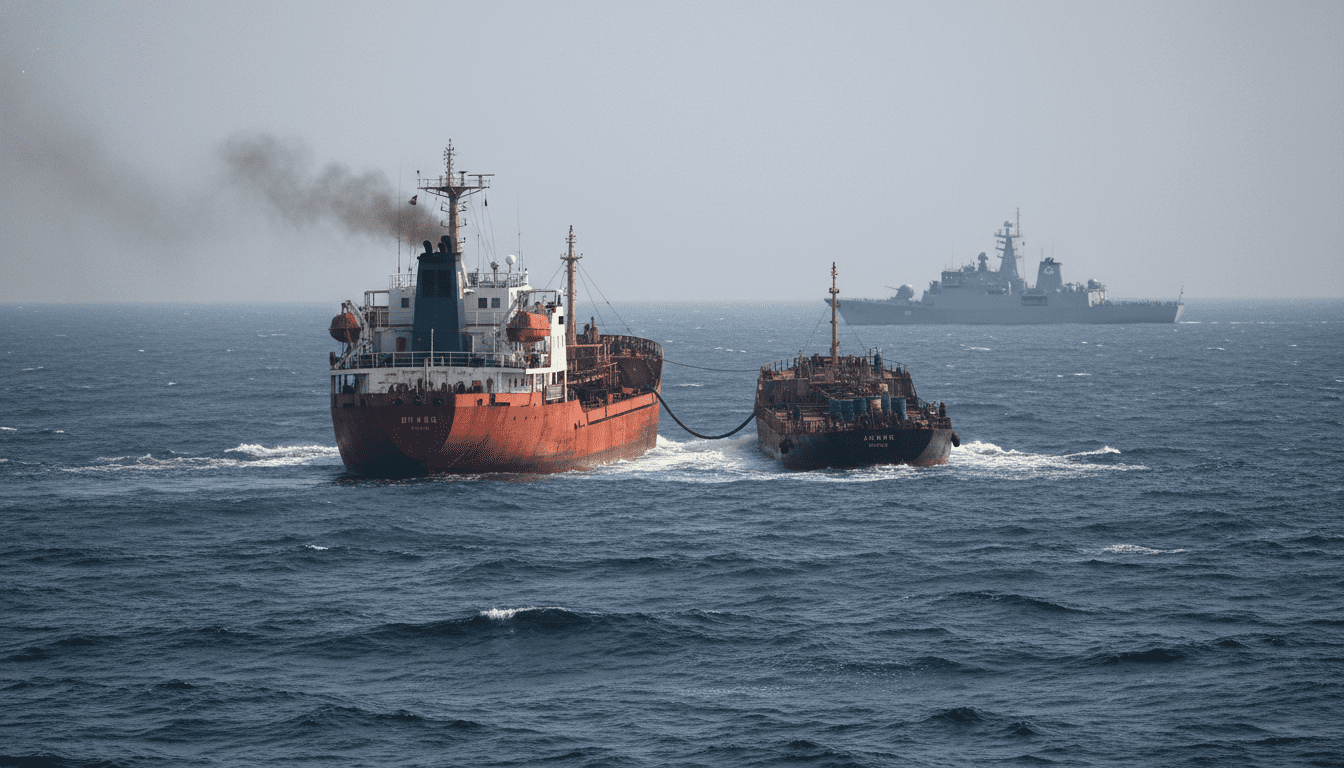
New Zealand Surveillance Captures Possible North Korea Ship-to-Ship Transfer
NZ Defence Force says a Poseidon plane filmed a possible North Korea ship-to-ship transfer in the Yellow and East China Seas, prompting sanctions investigations.
New Zealand’s Defence Force said a long-range P-8A Poseidon reconnaissance aircraft recorded what it believes was a possible North Korea ship-to-ship transfer of illicit goods in international waters near the Korean Peninsula. The surveillance was conducted over the Yellow Sea and the East China Sea and captured an exchange among multiple vessels that New Zealand described as “vessels of interest.” The detection has prompted authorities to review the footage and coordinate with international partners monitoring sanctions compliance.
Surveillance Capture off the Korean Coast
The Defence Force reported that the exchange was observed while the Poseidon was patrolling for suspected breaches of United Nations resolutions. Officials said imagery and sensor data from the flight provided evidence of activity consistent with ship-to-ship transfers, a method frequently used to conceal illicit trade. Air Commodore Andy Scott, the Air Component Commander, said the material collected enables authorities to act against vessels that may be operating in contravention of UN measures.
Evidence released by New Zealand did not specify the exact locations of the rendezvous beyond the general Yellow and East China Sea areas, nor did officials name the vessels involved. New Zealand emphasized that the surveillance occurred in international waters and that the detection contributes to a wider regional effort to enforce maritime sanctions.
Number of Vessels and Patterns Observed
New Zealand said its aircraft was monitoring some 35 vessels of interest in the area when the suspected transfer took place. Authorities characterized the scene as involving multiple contacts between ships within the group, highlighting a pattern of clustered maritime activity that can signal illicit exchanges. The Defence Force did not identify flag states or ship names in its initial statement.
Analysts noted that such concentrations of vessels are sometimes used to mask transfers by interspersing sanctioned cargo exchanges among otherwise routine movements. New Zealand’s monitoring adds to a growing dataset used by partners to track repetitive routes and contacts that may indicate sustained sanctions evasion.
Nature of Transfers and What Remains Unclear
Officials have not disclosed what goods were moved during the observed exchange, and New Zealand’s statement stopped short of declaring a definitive sanctions breach. North Korea has historically relied on ship-to-ship transfers to receive refined petroleum and to export commodities such as coal, iron ore and sand, commodities that have been targeted by UN restrictions. Without cargo manifests or boarding evidence, investigators will rely on imagery, signals and partner intelligence to build a clearer picture.
The Defence Force said that imagery and sensor data allow for follow-up action but did not outline specific enforcement measures. Maritime interdiction typically requires corroboration from multiple sources before states move to detain or sanction vessels, particularly when activity occurs in international waters.
Sanctions Context and Historical Enforcement
North Korea has been subject to successive rounds of United Nations sanctions since its first nuclear test in 2006, with major expansions in 2016 and 2017 that tightened controls on exports and ship-to-ship transfers. Those measures aimed to limit revenue streams that sustain Pyongyang’s nuclear and ballistic missile programs by restricting trade in fuel, minerals and other commodities. International watchdogs and research centres have tracked persistent attempts to circumvent those rules through covert maritime practices.
Despite the sanctions regime, analysts and policy papers have documented ongoing trade between North Korea and a narrow set of external partners. Beijing remains Pyongyang’s largest trading partner, while occasional allegations have surfaced linking North Korean shipments to exchanges with states such as Iran and, more recently, reports suggesting barter or transfers tied to Russia.
Regional Monitoring and International Cooperation
New Zealand participates in the US-led Pacific Security Maritime Exchange, a cooperative network established to monitor and deter illicit maritime activity that could breach sanctions. Since joining the exchange in 2018, New Zealand has contributed surveillance assets and shared imagery and analysis with partner nations. The Poseidon’s detection will likely be integrated into multinational tracking efforts to identify recurrent offenders and inform diplomatic or enforcement steps.
Officials from countries participating in sanctions monitoring typically combine aerial reconnaissance, satellite imagery and open-source tracking to compile cases for potential interdiction or listing. New Zealand’s release of the observation underscores the role smaller partners can play in a broader enforcement architecture that spans multiple maritime domains.
New Zealand’s announcement adds to a string of recent reports of suspected ship-to-ship activity in East Asian waters and will almost certainly increase scrutiny of vessel movements in the region as governments assess whether to pursue formal inquiries, sanctions listings or other measures based on the new evidence.
