
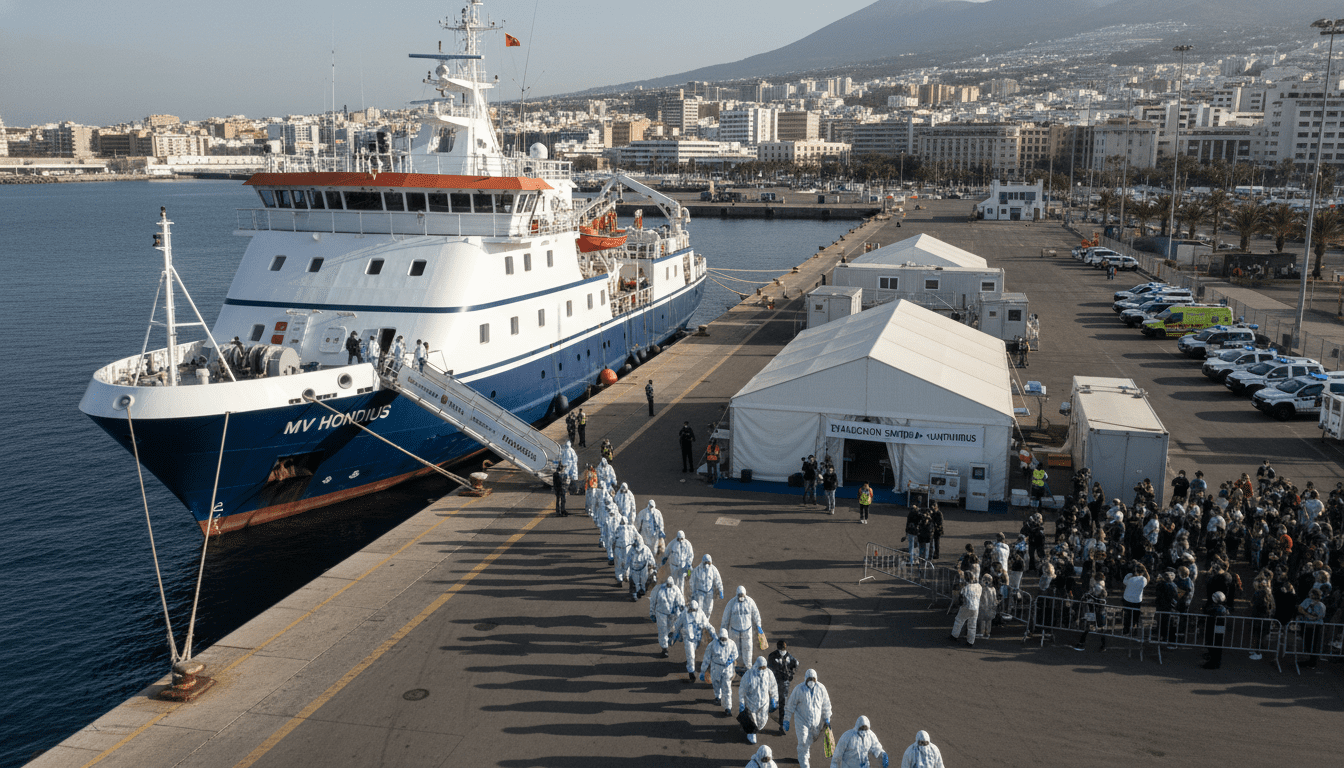
Hantavirus outbreak aboard MV Hondius prompts evacuation as ship docks at Tenerife
Hantavirus outbreak aboard MV Hondius prompts passenger evacuation at Tenerife’s Granadilla; WHO and Spain coordinate testing, quarantine and repatriation.
The MV Hondius, the Dutch-flagged cruise vessel at the center of a hantavirus outbreak, arrived off the Port of Granadilla in Tenerife early Sunday under escort as Spanish authorities prepared to evacuate passengers. The hantavirus outbreak, which has left several people ill and three dead, has drawn an international response led by the World Health Organization and Spanish health officials. Local officials said crews would transfer passengers to land for testing and repatriation while a limited number of crew would remain aboard to sail the ship for disinfection. Vessel-tracking data showed the ship approaching Tenerife after departing the coast of Cape Verde on Wednesday at the request of international health authorities.
Ship arrival and immediate response
The Hondius reached waters near Granadilla de Abona in the early hours, accompanied by a Civil Guard vessel, according to maritime tracking services. Spanish authorities said the decision to dock near Tenerife followed requests from the WHO and the European Union for Spain to manage the disembarkation. Officials planned small-boat transfers to bring passengers ashore, then sealed buses to move groups directly to the island’s main airport. Authorities scheduled the first evacuations to begin between 7:30 and 8:30 a.m. local time (06:30–07:00 GMT).
Confirmed illnesses and fatalities
The WHO has reported at least eight people fell ill in the outbreak, with three deaths among the sick — identified in public briefings as a Dutch couple and a German national. Health agencies confirmed six cases as hantavirus infections and listed two additional illnesses as suspected but unconfirmed. Officials treated all passengers as high-risk contacts as a precautionary step, citing the severity of the confirmed cases and the need for thorough tracing and testing. Emergency teams emphasized that transmission on ships is being closely investigated while protective measures are implemented.
Testing, transport and quarantine procedures
Spanish health authorities said passengers would be screened for symptoms and tested upon reaching Tenerife, and those who remain asymptomatic would be transported off the island by plane to their home countries. Buses used to move passengers would be sealed to prevent potential exposure to the local population during transit to the airport, authorities added. Spanish nationals were scheduled to disembark first, followed by other nationalities in organized groups. Health officials stressed that testing and quarantine protocols would be applied consistently to safeguard both passengers and the island community.
WHO and Spanish government coordination
WHO Director-General Tedros Adhanom Ghebreyesus arrived in Tenerife as part of a delegation that included Spain’s interior and health ministers to coordinate the response, according to official statements. In communications with the local population, WHO leadership sought to reassure residents about the assessed risk to the general public, distinguishing the current situation from the COVID-19 pandemic. WHO specialists and Spanish ministers worked together to oversee the technical and logistical aspects of the evacuation, including testing, contact tracing and the movement of passengers to international flights.
International tracing and flight connections
Health authorities in several countries have launched tracing efforts for passengers who disembarked earlier or who may have been in contact with infected individuals. One passenger linked to early fatalities had briefly been on a commercial flight from Johannesburg to the Netherlands in late April but was removed before departure and subsequently died in hospital in Johannesburg. A KLM flight attendant who had contact with an infected passenger later showed mild symptoms and tested negative for hantavirus, WHO officials said. Singapore and the United Kingdom have reported contact-tracing actions and testing for passengers who had previously disembarked; two Singapore residents tested negative but remain in quarantine as a precaution.
Ship’s next steps and crew arrangements
Spanish authorities said about 30 crew members would remain on the MV Hondius and the vessel would sail to the Netherlands for formal disinfection procedures. The remaining crew will be monitored and managed under maritime health protocols while specialist teams prepare the ship for decontamination. Officials emphasized that the virus is primarily associated with rodents, and experts intend to inspect, clean and sanitize all relevant areas before the vessel returns to service. The planned voyage to the Netherlands also aims to centralize the ship’s management under the owner’s jurisdiction for follow-up actions.
Local life appeared largely unchanged in parts of Tenerife as authorities worked to balance public reassurance with strict health controls. Market stalls, cafes and beaches saw routine activity even as officials moved to contain risk and communicate plans to residents and visitors.
The international response to the hantavirus outbreak on the MV Hondius underscores the complexity of managing infectious-disease events at sea, and the operation in Tenerife will continue to rely on coordinated testing, careful transport and cross-border public-health cooperation as authorities complete evacuations and follow-up investigations.
