
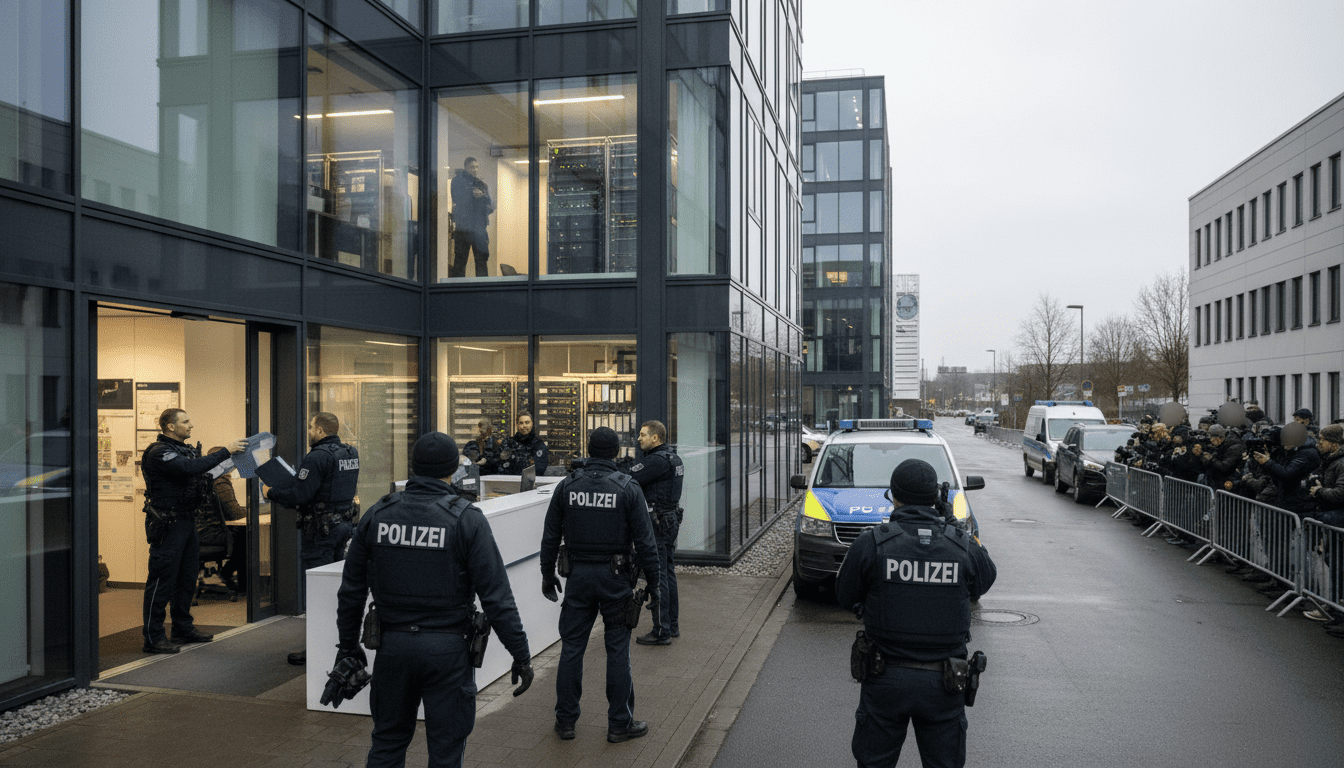
Raids in NRW and Bavaria Target Monheim Tax Haven in Probe of Mailbox Service
Prosecutors confirm searches at 21 sites as investigators probe allegations that a provider helped companies use Monheim tax haven addresses to avoid higher trade tax.
A large-scale law enforcement operation in North Rhine-Westphalia and Bavaria has focused attention on the so-called Monheim tax haven, with searches at 21 locations and more than 100 officers involved. The Düsseldorf public prosecutor confirmed an “extensive search operation” but said tax secrecy and ongoing proceedings prevent further details. Investigators say the raids target a service provider suspected of supplying mailbox addresses that allowed companies to register in low trade tax jurisdictions like Monheim while operating elsewhere.
Police raid 21 sites in NRW and Bavaria
The coordinated action involved investigators from state tax enforcement units and local police, who executed searches at addresses across both federal states. Officials placed the number of search locations at 21, and sources inside the inquiry said more than 100 personnel took part in the operation. The Düsseldorf prosecutor’s office declined to elaborate because the tax secrecy rules bar releasing information that could jeopardize the investigation.
Aftermath teams collected documents and digital records from offices and residences, according to law enforcement sources familiar with the operation. Authorities have not announced any arrests or charges so far, and judicial authorities said decisions on further steps will depend on the evidence seized during the searches.
Probe targets provider of mailbox addresses
Investigators are scrutinizing a commercial intermediary that allegedly arranged registered addresses for firms in trade-tax-friendly municipalities. The suspicion is that this service marketed so-called shell registrations — briefkastenadressen — to companies seeking to lower their Gewerbesteuer burden. Prosecutors want to determine whether those registrations lacked genuine economic substance and were aimed primarily at tax avoidance.
Sources close to the probe said evidence being sought includes contracts, correspondence and billing records that could show a pattern of creating artificial seats for businesses. If proven, the activity would indicate a systematic effort to exploit disparities in local trade tax rates through intermediaries.
Monheim’s low trade tax policy under scrutiny
Monheim am Rhein became synonymous with low trade tax after the local party Peto reduced the municipal Gewerbesteuer rate sharply, drawing businesses from surrounding municipalities. The city has defended its policy as lawful and credits the cut with substantially higher trade tax receipts than larger Ruhr cities such as Essen and Dortmund. Critics argue the migration of company registrations has deprived neighboring towns of revenue and distorted regional competition.
Economic analysts say Monheim’s model highlights how municipal autonomy over trade tax rates can create incentives for companies to move their registered seats for fiscal reasons. Municipal officials in effected cities have repeatedly called for federal or state-level measures to close loopholes that enable such relocations without corresponding changes in real economic activity.
Authorities outline legal risks of shell registrations
Prosecutors and tax investigators emphasize that relocating a company’s registered seat is not illegal per se, but it becomes problematic when the move is only on paper. If businesses continue to carry out their core operations, management and decision-making at their original higher-tax locations, the mere change of address could constitute tax evasion. Investigators are focusing on indicators of continued economic activity outside the declared seat, such as server locations, invoices, employment records and management correspondence.
Legal experts note that proving intent is central to any successful prosecution; authorities must demonstrate that registrations were established deliberately to mislead tax authorities. The evidence gathered in the raids will be critical to show whether the provider’s services enabled deliberate concealment or whether companies genuinely relocated their centers of business.
Political response and enforcement stance
North Rhine-Westphalia’s Finance Minister Marcus Optendrenk (CDU) said the state agency for combating financial crime acts resolutely against tax fraud involving artificial business seats. He did not comment on operational details but emphasized that “tax evasion of trade tax is not a trivial offence” and that distortions to fair competition harm public finances. State officials have faced growing pressure to strengthen enforcement as municipalities report increasing revenue shortfalls linked to registration shifts.
The raids are likely to prompt renewed calls from affected cities for legislative reform to tighten the rules governing the attribution of business activity for municipal taxation. Federal lawmakers and municipal associations have discussed measures such as stricter residency thresholds for company seats and enhanced information sharing between municipalities.
Investigators said further steps will depend on documentary and digital evidence obtained in the searches, and prosecutors cautioned that investigations can take months. Those under scrutiny may face tax assessments, fines or criminal charges if authorities establish deliberate evasion.
The operation marks the latest effort by German authorities to tackle complex schemes that exploit differences in local tax regimes, and it underscores the legal and political tensions that arise when municipal tax competition collides with national principles of tax fairness.
