
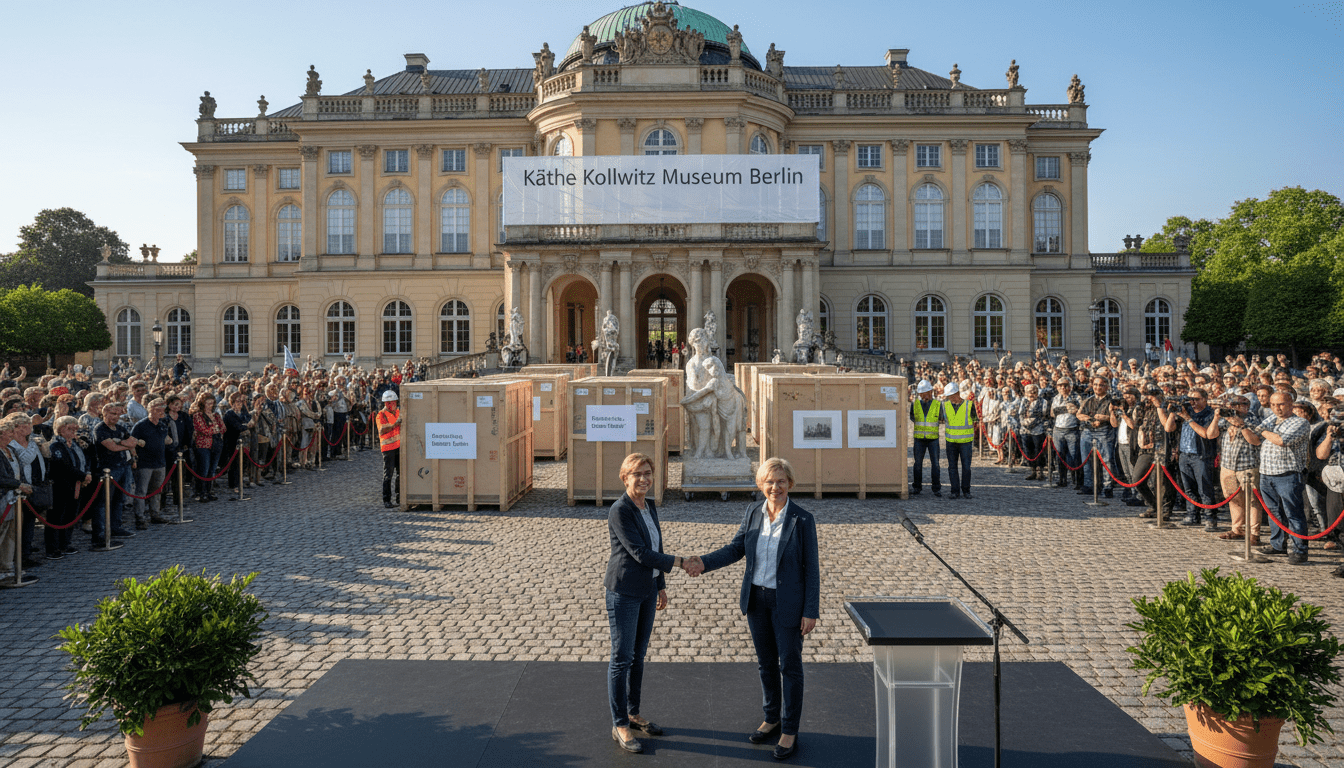
Käthe Kollwitz Museum Berlin reopens at Schloss Charlottenburg with expanded galleries and accessibility
Käthe Kollwitz Museum Berlin moves to Schloss Charlottenburg, doubling space and accessibility to present ‘And yet it is art’, a full retrospective.
The Käthe Kollwitz Museum Berlin reopened in a larger, barrier‑free home at Schloss Charlottenburg, bringing the artist’s work to wider audiences in a space designed for permanent and special exhibitions. The relocation, which followed a sustained rise in visitor numbers and the logistical limits of the former villa on Fasanenstraße, allows the museum to expand its display of prints, drawings and sculptures. Museum curators say the new setting preserves the intimacy of the earlier house while offering greater scope for loans, research and educational programming.
Käthe Kollwitz Museum Berlin relocates to Schloss Charlottenburg
The decision to move the Käthe Kollwitz Museum Berlin followed several seasons of record attendance and an acknowledgement that the 19th‑century villa could not easily be modernised for contemporary museum standards. The new home occupies the former theatre building within the Schloss Charlottenburg ensemble, a setting that combines historical character with improved visitor flows. Officials emphasise that the change was driven by the need to present Kollwitz’s oeuvre in a way that respects its scale and emotional charge.
The relocated museum retains the quiet, reflective atmosphere associated with Kollwitz’s work while offering double the exhibition area of the former premises. Wooden parquet floors and restrained interiors provide continuity with the old villa, yet the layout now accommodates larger sculptures and more substantial temporary shows. Curators describe the move as an opportunity to introduce fresh narratives within the permanent display and to lend greater prominence to rarely seen pieces from private collections.
The transition to Schloss Charlottenburg also addressed accessibility shortfalls that constrained the previous building. Barrier‑free circulation, modern climate control and improved conservation facilities make it possible to show more works and care for them sensitively. For many visitors the practical upgrades mean the museum is now physically open to a broader public, from families with strollers to people using mobility aids.
Expanded galleries and barrier‑free access boost display capacity
The expanded footprint at Schloss Charlottenburg allows the museum to mount more ambitious thematic sequences and to present collaborative loans with other institutions. Where the villa limited the museum to a compact, almost domestic presentation, the new galleries permit chronological and thematic juxtapositions that reveal continuities across mediums. This change broadens scholarly and curatorial possibilities without diluting the concentrated power of individual works.
Improved environmental controls and storage infrastructure enhance the museum’s ability to rotate prints and works on paper, which are particularly sensitive to light and humidity. Curators can plan longer‑term loans and more frequent rotations, giving regular visitors reason to return. The added space also enables a dedicated area for public programming, with room for lectures, workshops and guided visits tailored to schools and specialist audiences.
The museum’s accessibility upgrades are central to its renewed mission. Step‑free entrances, accessible sanitary facilities and clear circulation paths are now standard, enabling visitors with varying needs to experience Kollwitz’s work more fully. Museum staff have coupled these physical interventions with inclusive programming, such as tactile tours and audio descriptions, to make the art both visible and comprehensible to diverse publics.
“And yet it is art” reframes Kollwitz’s oeuvre for new audiences
The title of the permanent display, “And yet it is art”, derives from a notational remark Kollwitz made in 1922 and provides a curatorial through‑line for the exhibition. The sequence frames her output as the result of steady artistic inquiry responding to social and personal catastrophe. Works are arranged largely in chronological order with occasional thematic clusters that highlight recurrent concerns like motherhood, labour and the human cost of conflict.
Visitors encounter a spectrum of printmaking techniques alongside drawings and sculptural work that together map Kollwitz’s development as a social realist. Etchings, lithographs and woodcuts are shown alongside charcoal studies and larger bronze and plaster sculptures, enabling viewers to trace how subject, technique and scale interact. The layout encourages lingering and reflection, inviting visitors to read successive works as a sustained meditation rather than isolated statements.
Curators have retained the intimate tone that characterised the museum’s former home, using measured lighting and quiet sightlines to keep the focus on Kollwitz’s emotional register. At the same time the increased gallery area allows for occasional special exhibitions that place Kollwitz in dialogue with contemporaries or with thematic strands in 20th‑century art. The combination of a stable core display and rotating projects aims to deepen public understanding of both the artist and her historical context.
A life shaped by family, politics and artistic training
Käthe Kollwitz was born in Königsberg in 1867 and trained initially in drawing and engraving before establishing herself in Berlin at the turn of the century. She arrived in the capital as a young artist and young mother, marrying Karl Kollwitz in 1891 and raising two sons in a household that combined bourgeois stability with sharp social conscience. Early encouragement from family and teachers set her on a path toward techniques that favour reproducibility and public reach.
Her family background included several left‑leaning influences that informed her political sensibility without consigning her to any single party affiliation. Relatives who had participated in earlier liberal and reform movements helped shape an early awareness of social injustice, while her husband’s civic commitments reinforced a professional ethic that linked medical practice and social welfare. Kollwitz herself never formally joined the main socialist parties, yet her work consistently engaged with labour movements, poverty and the experience of war.
Self‑portraiture offers a revealing barometer of Kollwitz’s inner life and evolving self‑image. Curators point to an early, smiling self‑portrait signed with her maiden name—Schmidt—which stands out amid a lifetime of much grimmer likenesses. She described many of her self‑portraits as “psychological milestones”, and the collection assembled in the permanent display makes those milestones legible to contemporary audiences. Those images, together with intimate studies of children and mothers, humanise a figure often remembered for public commissions and political content.
Techniques and themes that define Kollwitz’s social realism
Kollwitz’s practice is frequently identified with printmaking because etchings and woodcuts allowed her work to circulate widely and to address social concerns directly. Prints were an accessible medium, capable of reaching a broad public and of functioning as tools of visual argument. In the galleries at Schloss Charlottenburg, multiple print cycles sit alongside sculptural studies that reveal the continuity of her formal concerns—weight, gesture and the architecture of bodies under stress.
Recurring themes in Kollwitz’s work include the burdens of poverty, the grief of loss and the human consequences of industrial and military conflict. Her figures often register fatigue and stoicism rather than idealised heroics, and the tonal range of her prints intensifies their emotional clarity. The museum’s arrangement of works emphasises these thematic resonances, allowing visitors to see how variations in medium and scale amplify similar moral questions.
While Kollwitz is sometimes framed solely as a political artist, the exhibition at Schloss Charlottenburg foregrounds the aesthetic rigor that underpins her social engagement. Close attention to line, mass and composition shows how form and message are inseparable in her work. The curatorial narrative aims to preserve that balance, portraying Kollwitz as both a committed observer of social conditions and a disciplined maker attentive to craft.
Visitor programming, loans and the museum’s future offerings
The museum has used the relocation as an opportunity to expand its educational remit and to cultivate partnerships with other collections. Loans from national and private lenders are now easier to integrate into the rotation, while the increased gallery space makes longer, more thematically varied exhibitions feasible. Organisers have signalled intentions to develop cross‑disciplinary programs that link Kollwitz’s work to contemporary debates about social welfare, migration and remembrance.
Public programming includes guided tours, school workshops and specialist talks designed to situate Kollwitz in historical and artistic contexts. The new layout supports smaller seminar groups as well as larger public events, and the museum has indicated it will host residencies and collaborative projects that connect artists and scholars. These initiatives are intended to make the museum a node of critical engagement rather than a static repository.
Practical visitor information has been recalibrated around the demands of larger audiences without sacrificing the contemplative quality of the galleries. Timed entry slots, extended opening hours and a more capacious public foyer aim to manage flows while reducing pressure on individual works. Staff training in mediation and accessibility is part of a broader institutional shift toward inclusion and deeper public service.
Despite the expanded programme, the museum still recommends allowing ample time for the permanent exhibition; what can be seen in a quick pass takes on more meaning when experienced slowly. The curatorial intention is to preserve the kind of close looking that reveals the subtle shifts in emotion and form that mark Kollwitz’s best work. For repeat visitors, the museum intends to create reasons to return through frequent rotations and focused thematic displays.
Kollwitz’s relevance in contemporary cultural conversations stems from her capacity to translate individual suffering into images that feel immediate and humane. The Käthe Kollwitz Museum Berlin’s relocation to Schloss Charlottenburg both preserves and amplifies that legacy, making the artist’s voice accessible to new generations in a setting equipped for 21st‑century museum practice.
The new venue offers a chance to encounter Kollwitz’s art with fresh attention, and to consider how an artist engaged with social injustice continues to speak to the present.
