
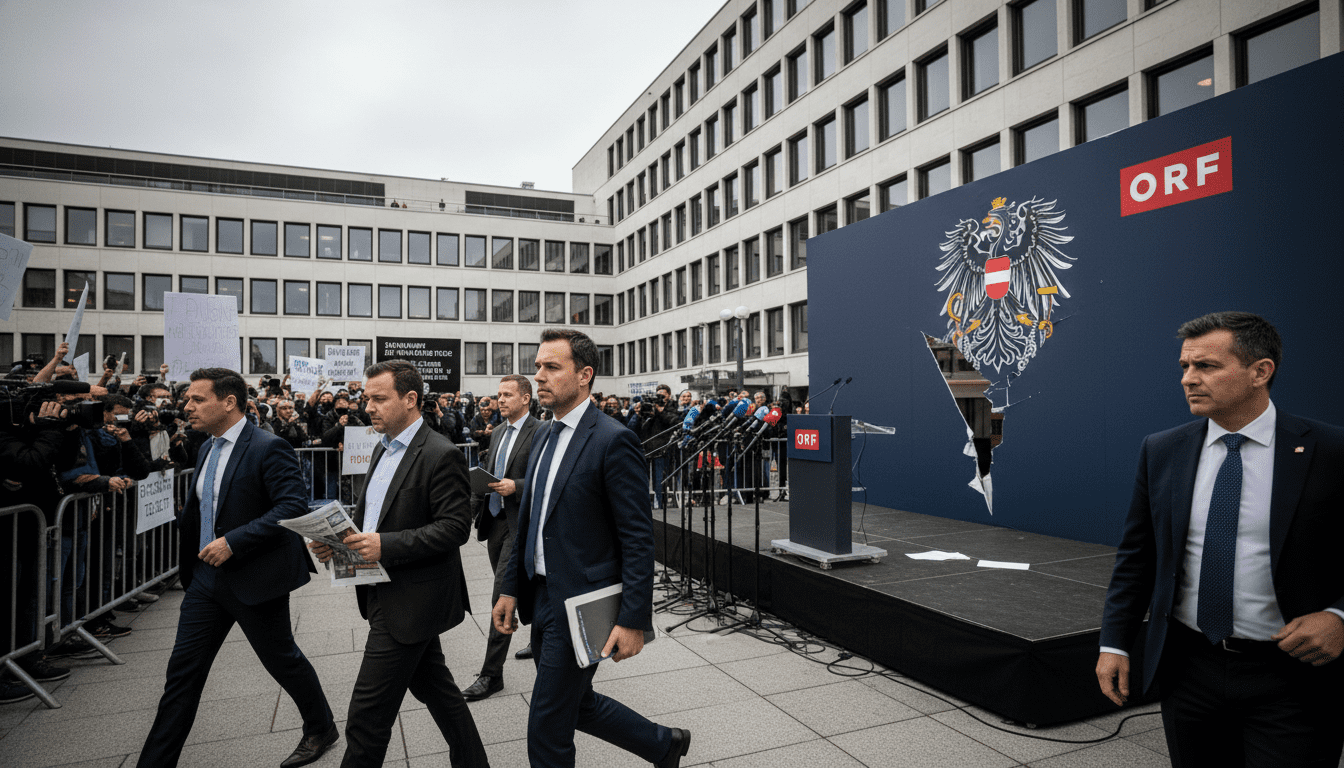
ORF crisis deepens as scandals, board fights and political pressure shake Austria’s public broadcaster
ORF crisis: Scandals, board infighting and alleged political interference have intensified calls for reform at Austria’s public broadcaster, spurring wider scrutiny.
The ORF crisis has moved beyond episodic controversy into sustained institutional turmoil, with scandals, factional disputes and accusations of political influence converging to unsettle Austria’s flagship public media organization. Coverage and commentary have repeatedly referenced episodes that critics say reveal systemic weaknesses in governance and editorial independence. The growing public debate and pressure from opposition parties and civil-society groups have pushed reform of the broadcaster’s structures onto the national agenda.
Scandals and allegations unsettling the ORF
Reports of misconduct and internal mismanagement have dominated headlines and public debate, feeding perceptions that the broadcaster is in crisis rather than merely facing problems of personnel. Observers cite a string of incidents—some personal, others managerial—that have exposed lapses in oversight and damaged the institution’s reputation. While a number of allegations remain unresolved, their cumulative effect has been to erode public trust and intensify scrutiny from politicians and media watchdogs.
Those developments have prompted internal inquiries and vocal demands for accountability from within the newsroom and from outside stakeholders. Journalists’ associations and some members of the Stiftungsrat have publicly called for transparent processes to address allegations and restore confidence. The repeated cycle of revelations and denials has made it harder for the ORF to pivot back to routine operations and programming.
Board turmoil centers on the Stiftungsrat and Heinz Lederer
The dispute over governance has focused attention on the Stiftungsrat, the supervisory board that plays a central role in appointing leadership and shaping strategy. Tensions within the Stiftungsrat have manifested as competing blocs and public rows, complicating the body’s ability to present a coherent reform agenda. Heinz Lederer, the Stiftungsratsvorsitzender, who was photographed at a board meeting on April 23, 2026, has become a focal point for criticism and calls for clearer accountability.
Board members and outside critics say institutional rules and informal practices have allowed partisan interests to influence decisions at the top of the broadcaster. Those dynamics have heightened calls for changes to appointment mechanisms, transparency rules and the Stiftungsrat’s remit. For many analysts, the board’s visible discord signals a deeper governance crisis that cannot be resolved through personnel changes alone.
Political influence and funding under renewed scrutiny
Concerns about political influence have been amplified by the dual role politics plays in funding and oversight of the public broadcaster. Critics argue that the structure of appointments and financing creates opportunities for political actors to exert pressure on editorial priorities and leadership choices. That argument has been central to debates about whether current safeguards are sufficient to guarantee editorial independence in practice.
In response, opposition parties and civic organizations have intensified scrutiny of the legal and financial framework that underpins the ORF. Proposals on the table range from tightening conflict-of-interest rules to overhauling the appointment process for board members. Any substantive change would require legislative action or broad political consensus, a prospect complicated by the very partisan divisions that critics say undermined the broadcaster in the first place.
Impact on newsroom morale and programming choices
Inside the ORF newsroom, the prolonged crisis has affected morale and editorial planning, with staff reporting a sense of fatigue amid repeated controversies. Journalists say that ongoing investigations, internal reviews and public pressure have taken time and attention away from reporting and production. The ensuing uncertainty has also made it more difficult to recruit and retain senior editorial talent at a crucial moment for public-service journalism.
Programming has faced both reputational and practical consequences, as audiences and advertisers reassess their relationship with the broadcaster. Even long-running shows and news formats have had to navigate the optics of association with an institution under fire. Restoring confidence among viewers and supporters will require demonstrable steps to improve governance and safeguard editorial independence.
Calls for reform from watchdogs, parliament and civil society
The chorus calling for reform has grown louder and more organized, with media watchdogs, parliamentary committees and advocacy groups laying out concrete proposals. Recommendations commonly include stronger transparency requirements for board deliberations, clearer separation between political actors and governance mechanisms, and new procedures for handling allegations of misconduct. Some stakeholders are also pressing for an independent external audit of ORF practices and finances.
Parliamentary scrutiny has been invoked repeatedly as a means to force a public reckoning, though lawmakers are divided on the scope and nature of potential reforms. Any legislative effort faces deadlines and political negotiation, and proponents acknowledge that durable change will require cross-party agreement and a credible implementation plan. The shape of reforms that emerge will determine whether the ORF can reassert public trust or remain trapped in recurring controversy.
The ORF crisis has evolved into a test of Austria’s commitment to public-service broadcasting and institutional independence, posing hard questions about governance, accountability and the political safeguards that protect editorial autonomy. How leaders inside the ORF, members of the Stiftungsrat and national lawmakers answer those questions in the coming weeks will be decisive for the broadcaster’s ability to recover its credibility.
