
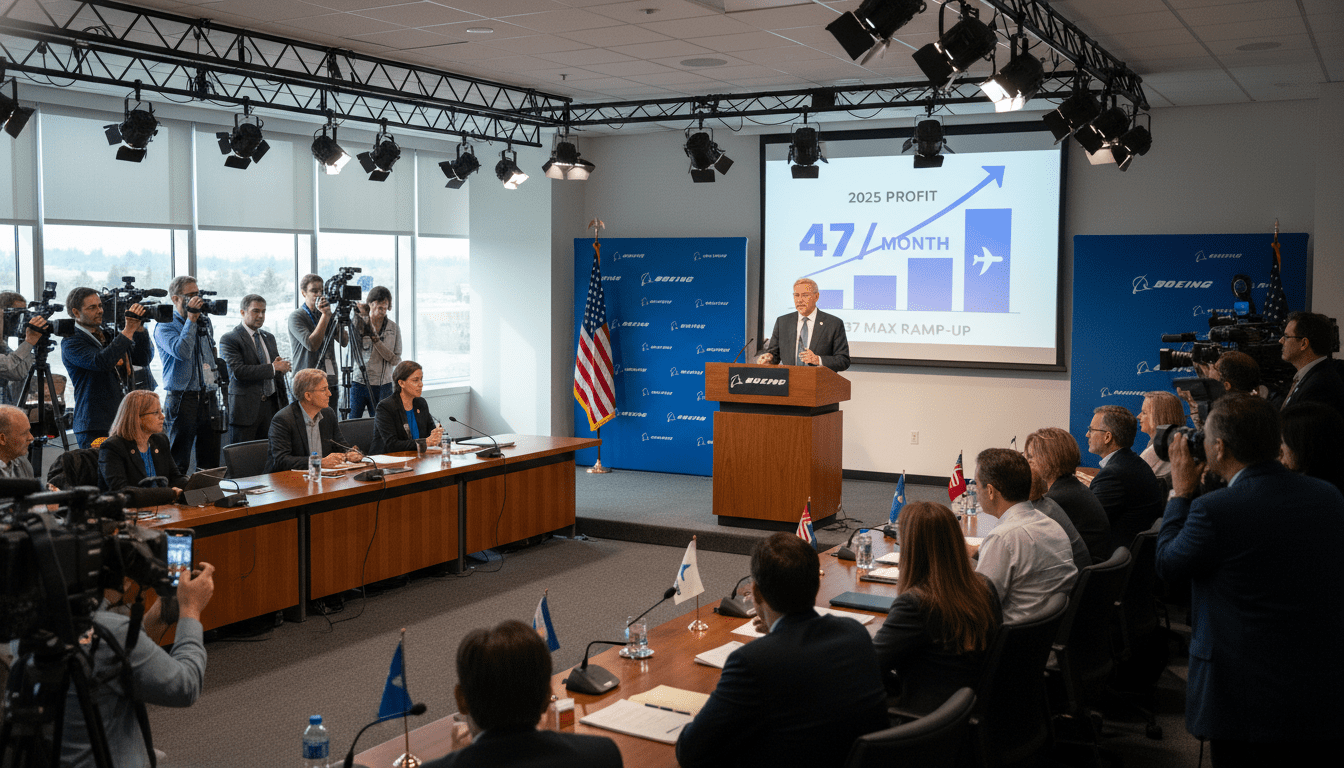
Boeing 737 MAX production to rise as Ortberg signals recovery and delivery push
Boeing 737 MAX production will increase as CEO Ortberg outlines a staged ramp-up to 47 and then 52 aircraft per month, citing certifications, quality fixes and sustained demand.
Ortberg frames 2025 as a turning point for Boeing
Boeing’s CEO Ortberg told investors and reporters that 2025 marked a recovery in orders and the first profitable year after the company’s prolonged crisis. He said the primary measure of financial health is returning to higher, stable production rates for the 737 family. Ortberg stressed that the company still faces significant work to fully restore manufacturing stability and quality after past safety and certification setbacks.
FAA clearance and phased ramp-up of 737 MAX production
Ortberg confirmed Boeing received regulatory permission to raise 737 MAX production from 42 to 47 aircraft per month, with plans for a further increase to 52 as stability is demonstrated. The company expects the upward moves to take several months each, noting the prior step from 38 to 42 succeeded. Boeing has conditioned future rate increases on consistent manufacturing performance and adherence to quality checkpoints at each station on the line.
Certification timeline for MAX variants and 777-9 shapes delivery plans
Ortberg outlined certification priorities that will shape near-term delivery flows, including approvals needed for the MAX 7 and MAX 10 variants. He said the MAX 10 certification is particularly important because it carries a larger share of new orders, enabling initial deliveries in early 2027 once approvals are complete. The executive said the 777‑9 certification is expected later this year, which would open the way for deliveries in the following year, while acknowledging the 777X program’s timelines have been extended significantly from original plans.
Quality control changes and supplier integration to cut rework
In response to the issues that followed the 737 MAX accidents and subsequent investigations, Ortberg described a series of changes to Boeing’s production culture and procedures. The company has tightened quality controls, halted the practice of advancing partially completed airframes along the moving line and now stops assembly when any safety or quality risk is detected. Boeing also completed the acquisition of Spirit AeroSystems to better manage fuselage quality and reduce the need for rework that had previously disrupted schedules.
Backlog, market demand and prospects for a clean-sheet aircraft
Ortberg said Boeing’s order backlog—he cited more than 6,200 firm orders—gives the company work for the remainder of the decade and makes a new clean-sheet commercial program premature. He identified three prerequisites for launching a wholly new airliner: strong financial health, clear market demand beyond the current family of jets, and mature propulsion or airframe technologies that would justify the investment. For now, Boeing intends to maximize output of updated variants such as the MAX series and the 777X to meet airline demand.
Defense and space ambitions continue alongside commercial focus
Beyond commercial jets, Ortberg emphasized Boeing’s strategic push into defense and space markets. He highlighted the MQ‑28 Ghost Bat uncrewed system as a market-ready capability and pointed to partnerships with European suppliers such as Rheinmetall to meet local industrial and sovereignty requirements. On crewed spaceflight, Ortberg said corrective work on the Starliner vehicle has been implemented and Boeing plans an uncrewed test flight before a subsequent crewed mission, subject to customer approval from NASA.
Boeing’s recovery narrative under Ortberg centers on production discipline, certified product launches and supply‑chain integration rather than immediate competition for market share with Airbus. The company is balancing a staged capacity increase for the 737 MAX with the need to preserve manufacturing quality and complete pending certifications, while defense and space programs provide additional revenue streams during the ramp.
