
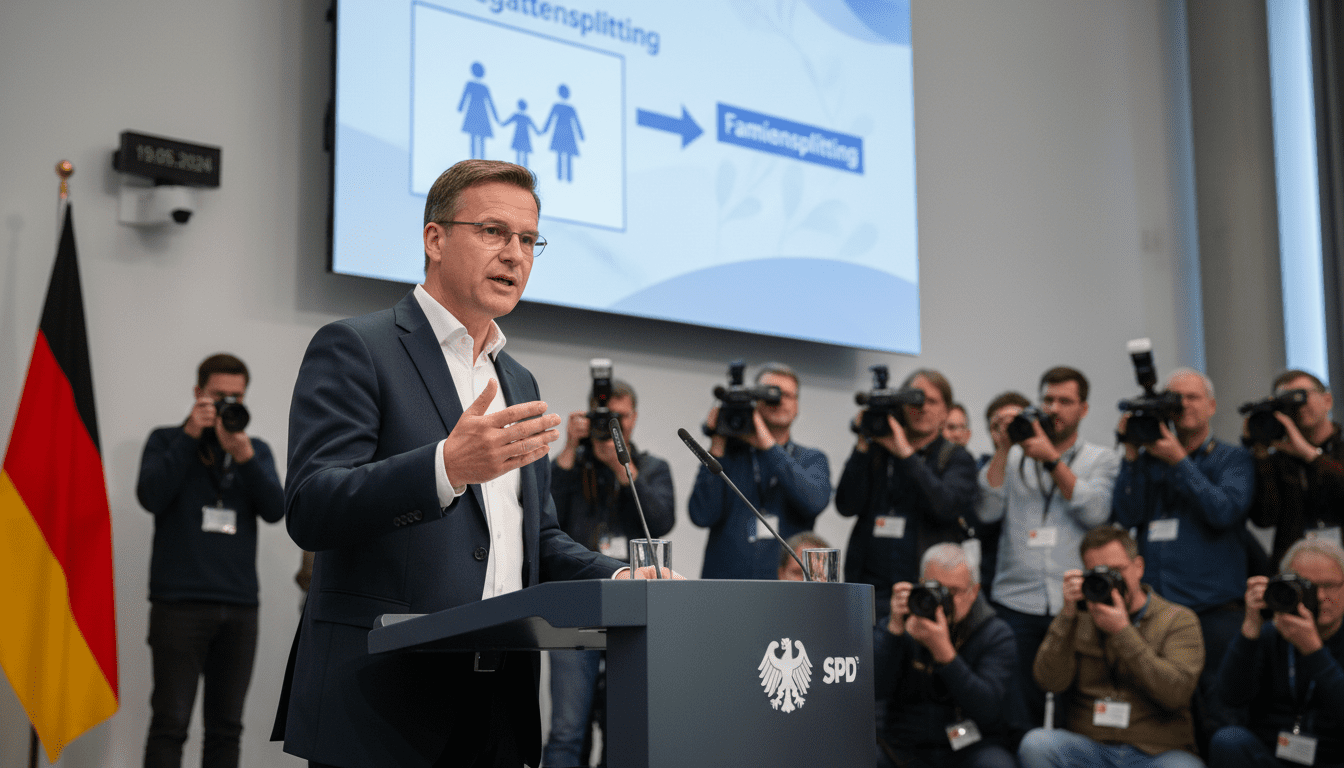
NRW SPD’s Jochen Ott Urges Reform of Ehegattensplitting, Proposes Family- and Child-Focused Model
Jochen Ott calls to transform Germany’s Ehegattensplitting into family- or child-splitting to support working parents and challenge Lars Klingbeil’s policy.
Jochen Ott, leader of the SPD parliamentary group in North Rhine-Westphalia, has publicly challenged proposals to abolish Ehegattensplitting and instead called for a targeted reform that would redirect tax benefits toward families with children. Ott said the existing marriage tax splitting should be reworked into a family- or child-splitting mechanism that applies equally to married and unmarried couples and creates incentives to return to the labor market. His intervention comes amid a wider party debate after a senior SPD figure proposed ending the current system and replacing it with an alternative designed to increase full-time employment among part-time workers.
Ott proposes conversion to family- or child-splitting
Ott argued that any change to Ehegattensplitting must prioritize households with children and workforce participation rather than simply abolishing the mechanism. He said a reformed splitting approach should offer similar tax treatment for married and unmarried couples, thereby modernizing the tax code to reflect contemporary family arrangements. The proposed model aims to reward early return to employment and to support dual-earner families, addressing concerns about low birth rates through fiscal policy.
Ott framed his proposal as a practical response to demographic challenges, saying tax relief should be targeted where it can most effectively support children and working parents. He emphasized that carving out benefits for families with children would strengthen social cohesion and signal governmental commitment to family policy. The intent is to preserve the financial security some families currently receive from Ehegattensplitting while shifting the focus toward child-centered incentives.
Klingbeil advocates abolition and a switch to “Realsplitting”
At the center of the debate is a senior SPD official who, in a recent speech, called for the abolition of the Ehegattensplitting in its present form and proposed a system known as Realsplitting as an alternative. The argument advanced by that official was that the current arrangement disincentivizes part-time workers—often women—from moving into full-time employment and that abolition would encourage workforce re-entry. The Realsplitting concept was presented as a mechanism to decouple tax benefits from marital status while still offering targeted relief to families who adjust their working hours.
Ott responded by saying outright abolition without a focused replacement would be politically and socially risky, particularly if measures do not sufficiently support families with children. He urged the party and the federal government to refine their messaging and to explain clearly how any reform would benefit working parents and address demographic concerns. Ott’s critique underscores an internal SPD clash over whether to pursue a comprehensive break with the traditional Ehegattensplitting or to pursue calibrated reform.
Fiscal and demographic rationale behind Ott’s stance
Ott linked his reform push directly to Germany’s low birth rate and the need to strengthen incentives for childbearing and sustained employment among parents. He argued that tax policy can be used more strategically to reduce the financial penalties families face and to make full-time work more attractive for part-time employees. By proposing family- or child-splitting, Ott aims to align fiscal incentives with social policy goals, such as higher labor-market participation and greater support for child-rearing costs.
Economists and policy analysts have long debated whether the marriage tax splitting distorts labor supply decisions and whether alternatives could better reconcile equity and efficiency. Ott’s proposal attempts to thread this needle by preserving targeted support while broadening eligibility beyond marriage. He framed the approach as a reallocation of benefits to where they would have the most impact on both family formation and economic productivity.
Political implications in North Rhine-Westphalia and within the SPD
Ott is the SPD parliamentary leader in North Rhine-Westphalia and is expected to be the party’s lead candidate in the 2027 state election, pending formal nomination at a party congress. His intervention therefore carries weight both as a policy position and as a signal of the regional party’s priorities ahead of the campaign. North Rhine-Westphalia is currently governed by a coalition that does not include the SPD, and Ott’s proposal positions the state SPD as advocating proactive family policy reform.
Within the national SPD, the debate may test the balance between reformist wings pushing for modernization and those seeking to protect traditional family-oriented measures. Ott’s call for clearer reform communication reflects broader frustrations about how complex fiscal reforms are presented to the public. He urged party leaders and the federal government to articulate reform goals more persuasively and to explain the distributional effects of any proposed changes.
Path forward: timeline and decision points before 2027
Ott said that the SPD and the federal government must provide concrete reform blueprints and clearer timelines if they hope to win public acceptance for changes to Ehegattensplitting. He highlighted the need for policy drafts that specify who would benefit under a family- or child-splitting regime and how transitions would be managed for households currently receiving splitting advantages. The debate is expected to intensify as the SPD prepares for regional contests and as ministers refine fiscal proposals.
A formal nomination process at the regional party congress this summer is likely to crystallize Ott’s role as a lead candidate and shape how prominently his family-splitting concept features in campaign platforms. At the federal level, any move to alter the tax regime will require detailed legislative work, cost estimates, and cross-coalition negotiation, making clear timelines essential for both political and administrative planning.
The dispute over Ehegattensplitting highlights a broader tension in German policymaking: how to modernize tax and social systems while minimizing disruption for existing beneficiaries. Ott’s proposal to redesign splitting into a family- or child-centered instrument reframes that tension as an opportunity to align fiscal policy with demographic and labor-market objectives.
Ott’s intervention adds a regional heavyweight to a national debate and signals that tax reform will remain a contested issue within the SPD and across German politics as parties weigh competing aims of equity, work incentives, and demographic policy.
