
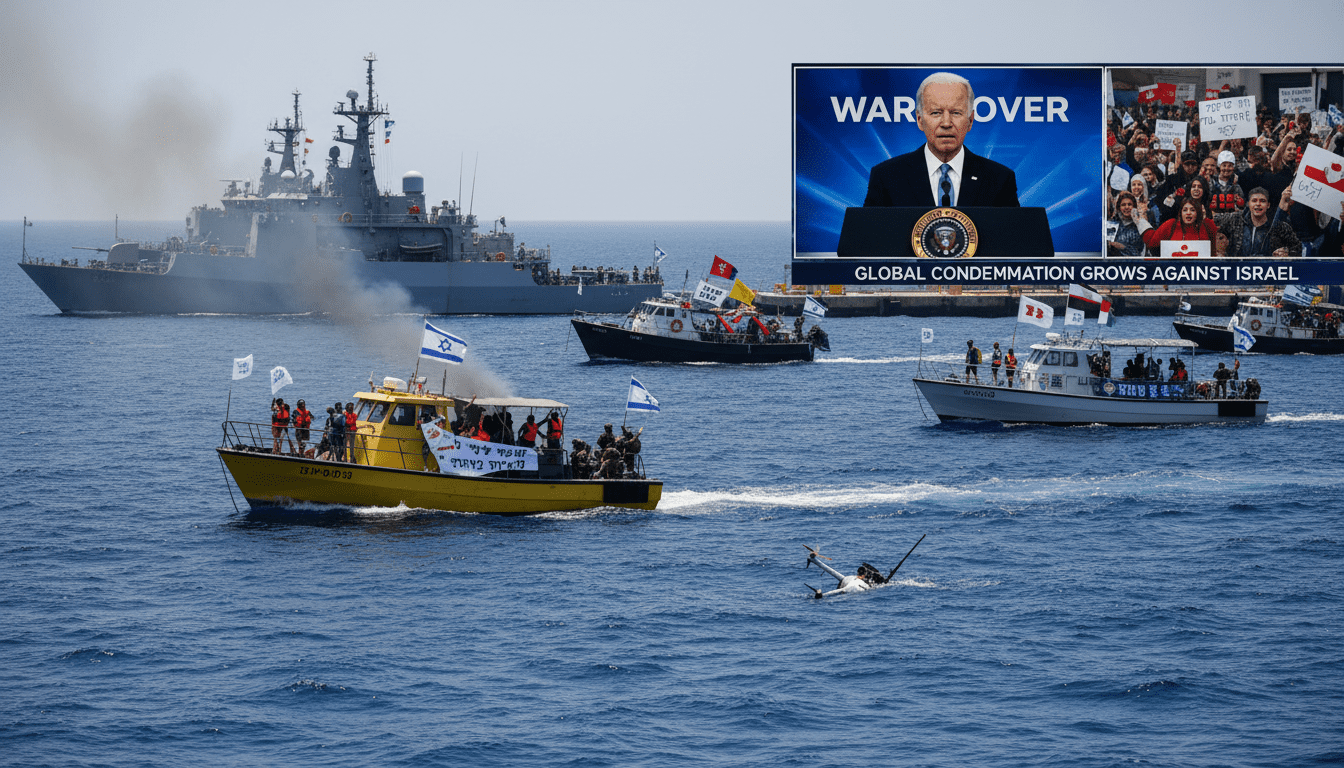
Global condemnation after Israel intercepts Gaza flotilla as US says war is ‘ended’
International criticism grows after Israel intercepted a Gaza flotilla; US says the war is “ended” under law and Japan’s PM spoke with Iran’s president.
The interception of a Gaza flotilla has prompted immediate international criticism and a flurry of diplomatic activity, with the Gaza flotilla now at the center of renewed tensions over access to Gaza and maritime security. The US government separately issued a statement declaring the war “ended” in the sense of applicable law, a characterization that has drawn scrutiny from allies and rights groups. At the same time Tokyo and Tehran exchanged high-level contacts, with Japan’s prime minister placing a call to Iran’s president as leaders sought to contain fallout from the incident.
International reaction to the flotilla interception
Governments across Europe and the Middle East issued strong statements condemning the Israeli action, describing it as disproportionate and raising concerns about the safety of civilians aboard the vessels. Humanitarian organizations and advocacy groups called for an independent investigation into the circumstances of the interception and urged immediate measures to protect aid shipments to Gaza. The speed and unanimity of responses underscored how maritime confrontations can quickly escalate into wider diplomatic disputes.
The incident revived debates over the legality of blockades and the rules that govern intervention at sea, with several legal experts pointing to the need for transparent, multilateral fact-finding. Navies and coast guards in the region were reportedly placed on alert amid fears of further maritime incidents, complicating efforts to deliver humanitarian supplies. International institutions now face pressure to propose concrete oversight mechanisms for future maritime operations affecting civilian traffic.
US government labels war ‘ended’ in legal terms
The US administration said the conflict was “ended” under the applicable legal framework, language that was interpreted differently by international observers and some allied capitals. Officials in Washington framed the declaration as a formal legal assessment rather than a political judgment, emphasizing that specific obligations and post-conflict responsibilities remain in force. Critics argued the phrasing risks minimizing ongoing humanitarian and security challenges that persist in Gaza and the surrounding area.
Legal scholars and diplomats cautioned that an administrative declaration does not erase obligations under international law, including protections for civilians and the need for reconstruction and aid access. The statement also prompted questions about future US policy, including whether the declaration will alter Washington’s role in mediating ceasefires, reconstruction funding, or accountability mechanisms. For now, US officials said they would continue to engage with international partners and regional actors on stabilization efforts.
Tokyo reaches out to Tehran amid regional tensions
Japan’s prime minister contacted Iran’s president in a call described by Tokyo as a bid to de-escalate tensions and to seek cooperation on humanitarian access and regional stability. The conversation came as several capitals urged restraint from all parties and highlighted the broader diplomatic scramble following the flotilla episode. Tokyo framed the outreach as consistent with its diplomatic priority to prevent wider conflict and to ensure the flow of humanitarian assistance.
Analysts noted that Japan’s intervention reflects a wider pattern of third-party states attempting to bridge gaps between regional rivals, particularly when civilian lives and commercial shipping are at stake. The call also underscored Japan’s interest in maintaining open sea lanes and in playing a constructive role in crisis management. Officials said further diplomatic contacts could follow as the situation evolves.
Calls for independent investigations intensify
Multiple organizations and some national governments demanded an impartial inquiry into the interception, citing the need to establish facts and assign responsibility where appropriate. Advocates stressed that only a transparent process would restore confidence and deter similar incidents in the future, recommending involvement from international observers or a joint investigative mechanism. The demand for scrutiny reflects broader concerns about accountability in maritime operations connected to prolonged conflicts.
Proponents of an inquiry pointed to precedents where third-party investigations helped to defuse tensions and produce actionable recommendations on rules of engagement. Opponents cautioned that investigative mandates must be carefully designed to ensure neutrality and access to evidence. Meanwhile, affected families and aid operators pressed for immediate humanitarian relief and assurances that future shipments would be allowed to reach Gaza without undue interference.
Humanitarian and security implications for Gaza
The interception has immediate humanitarian implications by disrupting aid deliveries and raising fears over further blockades or restrictions on maritime corridors to Gaza. Relief groups warned that any sustained interruption could worsen shortages of food, medicine, and fuel in a population already facing acute needs. Security analysts also warned that maritime incidents risk provoking retaliatory measures from armed groups and could complicate broader ceasefire or stabilization efforts.
Local populations reported anxiety over the potential impact on reconstruction and on the ability of humanitarian convoys to operate safely. Donor countries and international agencies reiterated calls for unobstructed access to civilian populations, and several pledged to explore alternative routes and modalities to ensure aid reaches those in need. The longer-term implications for reconstruction funding and political solutions remain uncertain.
The interception of the Gaza flotilla and the subsequent diplomatic responses have reopened fundamental questions about maritime law, humanitarian access, and how states balance security with civilian protection. As investigators and diplomats mobilize, the international community faces the task of both clarifying the facts of the incident and preventing a wider escalation that could deepen the humanitarian crisis in Gaza.
