
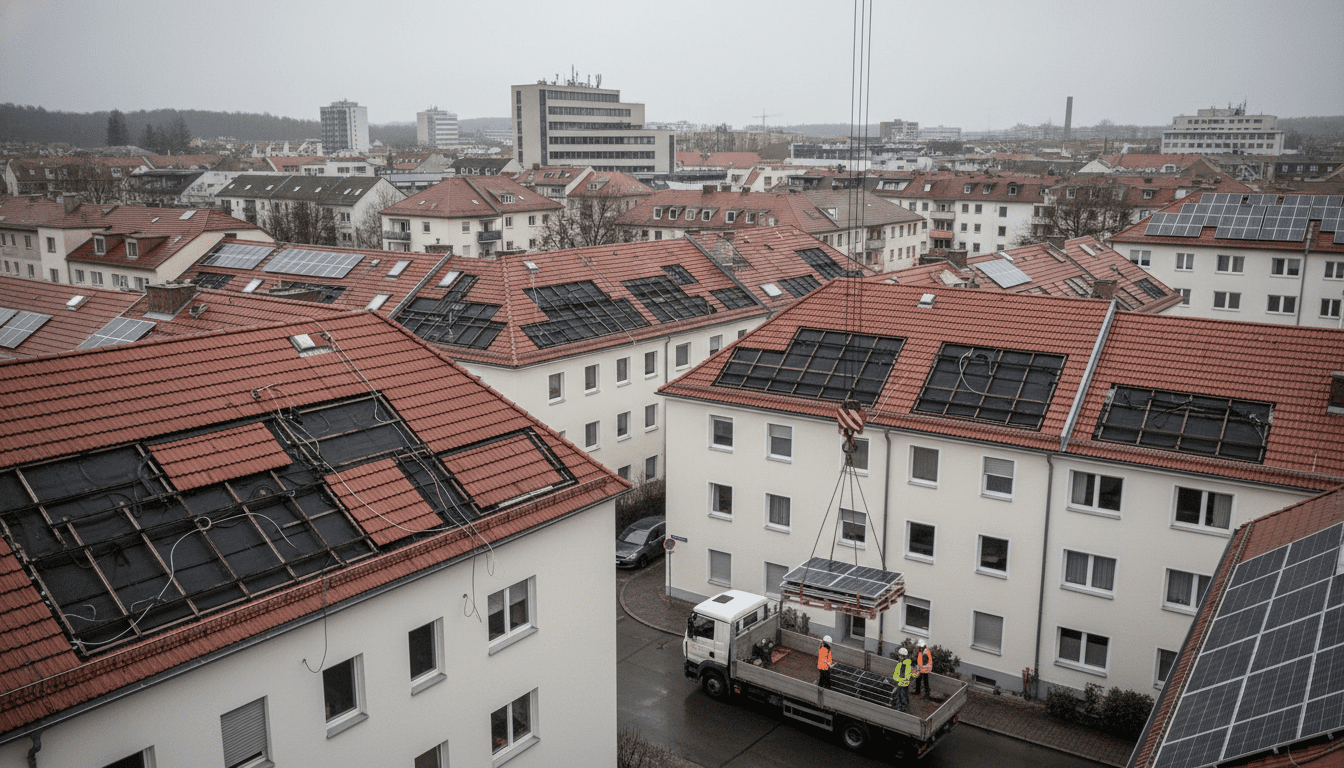
German solar installations slow in Q1 2026 as rooftops fall and utility-scale rises
Solar installations in Germany slowed to 3.5 GW in Q1 2026, down 6% year‑on‑year, as rooftop and home builds declined while ground-mounted projects expanded.
Solar installations in Germany registered a notable slowdown in the first quarter of 2026, with total new capacity of 3.5 gigawatts representing a 6 percent drop compared with the same period last year. The figures, compiled by the Bundesverband Solarwirtschaft (BSW‑Solar) on data from the Federal Network Agency, show the contraction was concentrated in rooftop and small-scale segments even as utility-scale projects grew. Industry leaders warned that policy uncertainty and changing subsidy rules are influencing investor and homeowner behaviour.
Q1 totals and data sources
BSW‑Solar reported the 3.5 GW figure based on Bundesnetzagentur datasets covering installations registered in the period. The association’s analysis highlights a year‑on‑year decline of 6 percent for newly built capacity in the first quarter of 2026. These headline numbers frame a mixed picture for the German solar sector as a whole.
The association’s release also breaks the trend down by market segment, signaling where the slowdown is most acute. Observers say the data are an early indicator of how market participants are reacting to evolving rules and broader economic pressures.
Rooftop commercial and residential segments fall sharply
The commercial rooftop segment saw the steepest reduction, with new installations down roughly one third compared with the prior year. Residential rooftop systems also slipped, with the home segment declining by about one fifth during the quarter. These drops have hit installers and local project developers who rely on smaller rooftop business.
Smaller, user‑owned systems suffered a pullback as prospective buyers weigh changing financial returns and administrative hurdles. Balcony systems—often the cheapest entry point for private solar—also fell, registering a 6 percent decrease in new capacity during the quarter.
Ground‑mounted projects buck the trend with strong growth
In contrast to rooftop declines, ground‑mounted or open‑field photovoltaic projects expanded robustly, posting around 20 percent growth in new capacity. This divergence suggests that larger project developers continued to progress planned sites while smaller-scale demand cooled. The rise in utility‑scale installations helped keep total new capacity from contracting more sharply.
Policy change narrows guaranteed feed‑in for small systems
In March, Federal Minister for Economic Affairs Katherina Reiche announced a halt to guaranteed feed‑in payments for private solar systems, signaling a policy shift for small producers. Under the revised rules, guaranteed purchase prices for excess generation will no longer apply universally; the ministry says fixed remuneration will be paid only when the electricity is needed on the grid.
The change reduces a predictable revenue stream for owners of small rooftop and balcony systems and may reshape the economics of private installations. Industry groups warn that even limited adjustments to support mechanisms can trigger immediate behavioural responses from households and small businesses.
Industry reaction and near‑term outlook
Carsten Körnig, the chief executive of BSW‑Solar, expects demand to pick up in the coming weeks and months, citing the energy crisis tied to the Iran war and anticipatory purchases ahead of possible subsidy reductions. He urged policymakers to provide stable investment conditions and to avoid further cuts to solar incentives. His comments reflect an industry seeking clarity to plan pipeline financing and installer capacity.
BSW‑Solar’s call for predictability highlights a broader tension: policymakers are managing subsidy costs while the sector needs forward‑looking frameworks to sustain deployment. Installers say that abrupt rule changes compress decision cycles, producing temporary slowdowns followed by potential short bursts of activity as consumers accelerate purchases.
Solar output rose sharply in 2025 despite build variations
Looking back over 2025, solar generation in Germany grew substantially, supplying about 87 terawatt‑hours of electricity — an increase of roughly 21 percent from the prior year. That gain included a notable expansion in small systems: the number of balcony installations surged in 2025, with capacity increases of around 26 percent reported by the industry. These production and deployment gains underline the continued role of photovoltaics in Germany’s energy mix even as quarterly build patterns fluctuate.
The contrast between rising annual generation and a weaker Q1 2026 build underscores how timing, policy signals and project portfolios interact. While larger projects pushed capacity up, the pullback in rooftop and private systems shows sensitivity to regulatory shifts.
Despite the short‑term slowdown in new small‑scale builds, the German solar sector remains a major contributor to the country’s power supply, and near‑term trends will hinge on policy clarity, subsidy design and how households and businesses interpret the value of on‑site generation in a volatile energy market.
