
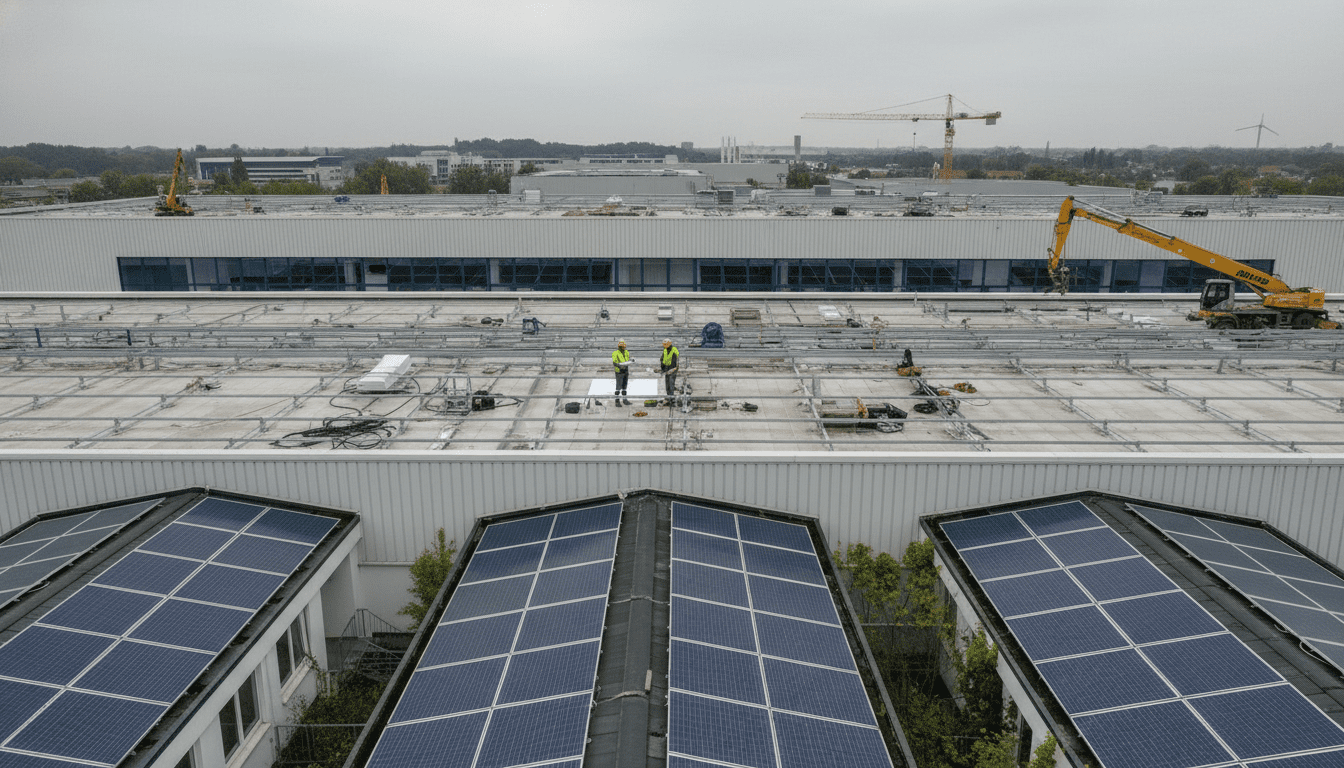
German solar installations fall 6% in Q1 to 3.5 GW as rooftop projects slow
German solar installations dropped 6% year‑on‑year in Q1 to 3.5 GW, driven by weaker rooftop and home projects amid policy changes and shifting demand.
Sharp decline in rooftop and home installations
The latest figures from the industry association BSW‑Solar, calculated from Bundesnetzagentur data, show construction of new solar capacity slowed markedly in the building sector. Commercial rooftop projects fell by roughly one third, while household installations declined by about 20 percent compared with the same period last year.
Even small-scale balcony systems, which had surged previously, saw a 6 percent reduction in new capacity in the first quarter. Industry analysts point to a mix of market uncertainty and changing incentives that have dampened investor and homeowner activity.
Ground‑mounted projects buck the trend
Contrasting with the building sector, ground‑mounted solar arrays recorded robust growth, with new capacity up about 20 percent. Large-scale free‑field projects benefitted from streamlined approvals in some regions and continued investor interest in utility‑scale renewables.
Experts say the shift toward ground installations underscores how project economics and regulatory certainty are pushing capital into larger, grid-connected builds rather than smaller distributed systems. The divergence altered the overall mix of new additions in the quarter.
Policy change: guaranteed feed‑in payments scaled back
In late March, Federal Minister for Economic Affairs Katherina Reiche announced an end to guaranteed feed‑in payments for private small‑scale systems, a policy that had guaranteed a fixed price for surplus electricity fed into the grid. Under the revised approach, payments will only be made when the injected electricity is needed on the network, signaling a significant change for household producers.
Industry groups warned that the move increases revenue uncertainty for private owners and installers, potentially reducing the appeal of rooftop and balcony systems. Government officials defended the reform as a step toward cost‑efficient integration of distributed generation into the wider power market.
Industry reaction and calls for stable investment conditions
The BSW‑Solar’s chief executive, Carsten Körnig, predicted a pickup in demand in the coming weeks, citing the broader energy supply concerns related to the conflict in Iran and a wave of installations placed ahead of anticipated subsidy reductions. Körnig urged policymakers to provide predictable investment conditions and to avoid further cuts in support for solar deployment.
Manufacturers, installers and finance providers have echoed calls for clearer long‑term rules, arguing that sudden policy shifts can raise costs and delay projects. Several market participants said they are reassessing pipelines for small‑scale systems while continuing to advance large ground‑mounted projects.
Solar’s rising contribution to Germany’s power mix
Despite the near‑term slowdown in new installations, solar generation expanded last year and increased its share in Germany’s electricity supply. Photovoltaic systems produced about 87 terawatt‑hours in the previous year, a rise of around 21 percent, reflecting strong output from existing and recently commissioned capacity.
The prior year had also seen a notable rise in balcony and other small inverter systems, which increased their added capacity by roughly 26 percent. Those gains contributed to the overall growth in solar generation even as the installation profile shifted during the most recent quarter.
Market outlook and risks ahead
Short‑term demand is expected to respond to energy security concerns and any further policy clarifications, with potential for a rebound in small‑scale installations if incentives are adjusted or new support mechanisms are introduced. However, persistent regulatory uncertainty and the possibility of tighter subsidies represent downside risks for rooftop growth.
Investors will closely watch forthcoming government guidance and regional permitting developments to gauge the trajectory of both distributed and utility‑scale projects. The balance between grid needs, market remuneration and permitting capacity will shape whether the current dip proves temporary or a longer structural shift.
Looking forward, Germany’s solar sector faces a pivotal period in which policy decisions and market responses will determine how quickly rooftop and residential markets recover and whether ground‑mounted expansion can sustain broader decarbonization goals.
