
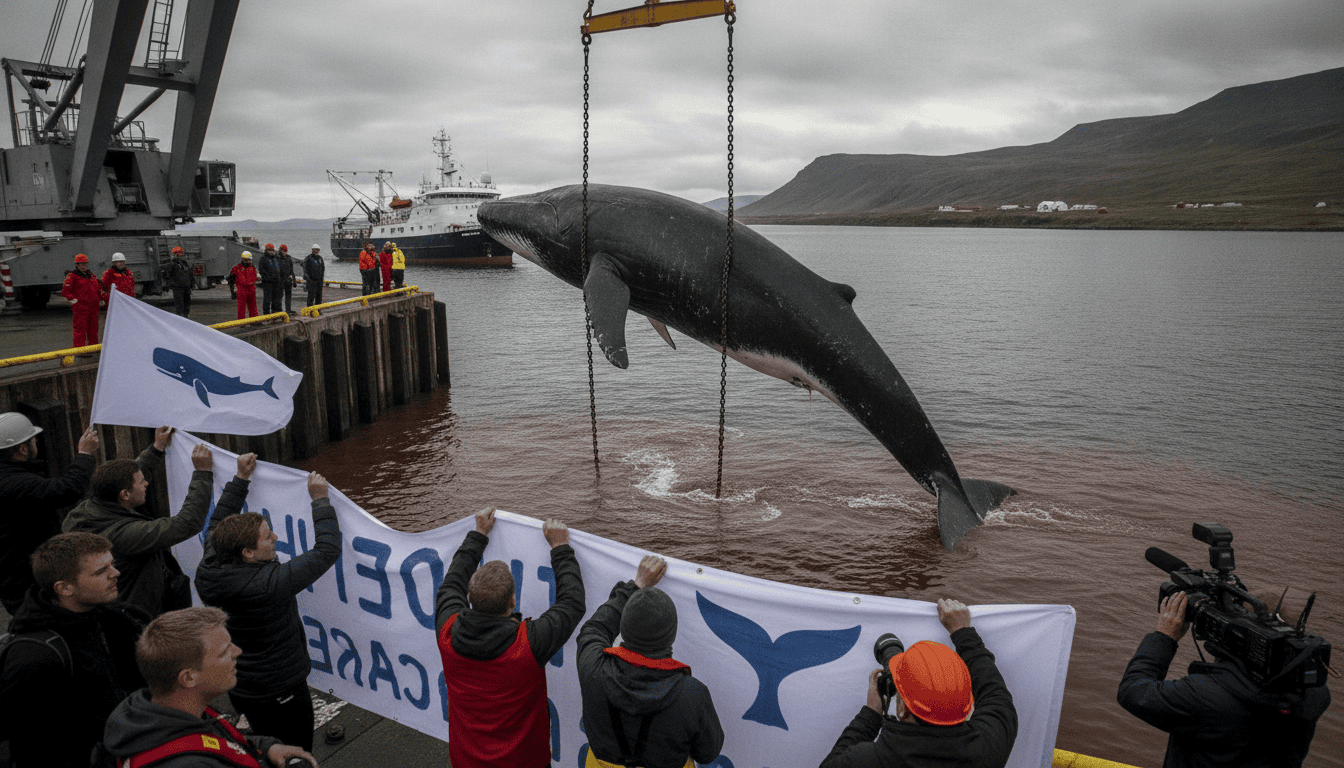
Iceland fin whale hunt restarts as Hvalur ships resume commercial catches amid protests
Iceland fin whale hunt resumes this year as Hvalur vessels take whales to shore; activists, scientists and politicians clash over quotas, animal welfare and EU prospects.
Iceland’s fin whale hunt has resumed for the summer after a pause in recent seasons, with the privately owned company Hvalur deploying its two active catcher vessels off the country’s northwestern coast. The restart, authorised under a government quota that allows the take of fin whales this year, has reignited international criticism and a domestic debate over conservation, animal welfare and the island nation’s future relationship with the EU.
Hvalur company resumes operations near Reykjavík
Hvalur, the long-established Icelandic whaling firm, has restarted hunting from its base at the head of the bay often called the “Whale Fjord,” roughly an hour and a half north of Reykjavík. The company, founded in 1948 and now controlled by Kristján Loftsson, is operating two ageing catcher ships, Hvalur 8 and Hvalur 9, which are equipped for large whale hunts.
Those vessels haul their catches to a processing station onshore where carcasses are winched up ramps and cut up by crews working on the animals’ bodies. Activists and international observers say the imagery of the process — men in rubber boots slicing into whales alongside music from the plant — has intensified outrage abroad and among local campaigners.
Hunting methods, welfare concerns and legal context
Iceland’s permitted hunts use harpoons fitted with explosive charges designed to detonate inside the whale, a method critics call inhumane. Reports from the field say individual animals are sometimes tracked for hours and may require multiple harpoon strikes before they die, a pattern that has fuelled calls for tighter welfare oversight.
The country does not recognise the 1982 International Whaling Commission moratorium on commercial whaling, a point that separates its policy from most other coastal states. Iceland and Japan are among the few nations that continue large-scale commercial takes of some whale species, a stance that regularly draws condemnation from international conservation groups.
Public opinion, tourism and local consumption
Despite the seasonal resumption of hunting, the domestic market for whale meat is limited. Surveys and museum notes indicate a large majority of Icelanders rarely eat whale, with whale-watching tourism representing a far more visible public interaction with cetaceans. Boat-based tours out of Reykjavík’s harbour commonly advertise sightings of fin whales, humpbacks and dolphins, drawing hundreds of visitors in typical summer seasons.
Street-level reactions are mixed: small public demonstrations occur in the capital, but turnout has been modest and many locals approach the issue pragmatically. For some, whaling is seen as anachronistic; for others it is defended as a traditional marine-use activity and a sovereign right against external pressure.
Scientific assessments and the basis for quotas
The government’s recent decision to authorise a finite number of fin whale takes this year was grounded in assessments by the Marine Research Institute of Iceland (Hafrannsóknastofnun), which advises on stock size and sustainable yields. Scientists working with the institute have estimated tens of thousands of fin whales in the broader Icelandic region, figures cited by officials who argue the authorised quota is within safe biological limits.
Independent experts involved in North Atlantic assessments state that population surveys and statistical reviews underpin quota setting, and that international peer review takes place. Nevertheless, some activists and observers dispute survey methods and question whether counts funded through regional bodies with member states that include whaling nations are sufficiently impartial.
Activist response and maritime confrontations
Marine conservation activists have moved to disrupt the season. Sea Shepherd and its founder, Paul Watson, have dispatched vessels to Icelandic waters in what organisers call operations to impede hunting activities, invoking direct-action tactics that date back decades. The legacy of confrontations is palpable: two older Hvalur ships, Hvalur 6 and Hvalur 7, were once sunk in port by activists in the 1980s and later salvaged but never returned to service.
Recent actions have also included activists occupying lookouts on whaling vessels and staging small protests in Reykjavík. Icelandic authorities, including the coast guard, have monitored activist ships and sought to prevent dangerous encounters at sea.
Politics, EU accession and the future of whaling
The hunt is entangled with wider political questions facing Reykjavík. The current centre-left-led government has signalled intentions to phase out commercial whaling, arguing it is not in the public interest, and has discussed legislation that could ban the practice. At the same time, a forthcoming national referendum on whether to resume EU accession talks could have indirect consequences: EU membership would require compliance with European bans on commercial whaling, a development opponents fear would reshape fishing rights and local control over marine resources.
Business and fisheries interests, some connected to influential families in the sector, are vocal opponents of measures they see as externally driven restrictions on traditional economic activities. Environmental campaigners argue those economic claims mask vested interests and that conservation and tourism offer alternative pathways for coastal communities.
Iceland’s renewed fin whale hunt has therefore become a focal point for debates about sovereignty, science and ethics, mobilising activists abroad and prompting uneasy reflection at home about how the island nation balances maritime livelihoods with international conservation expectations.
The coming months are likely to determine whether the season remains limited and contentious or whether political momentum and public sentiment tip policy decisively away from commercial whaling.
