
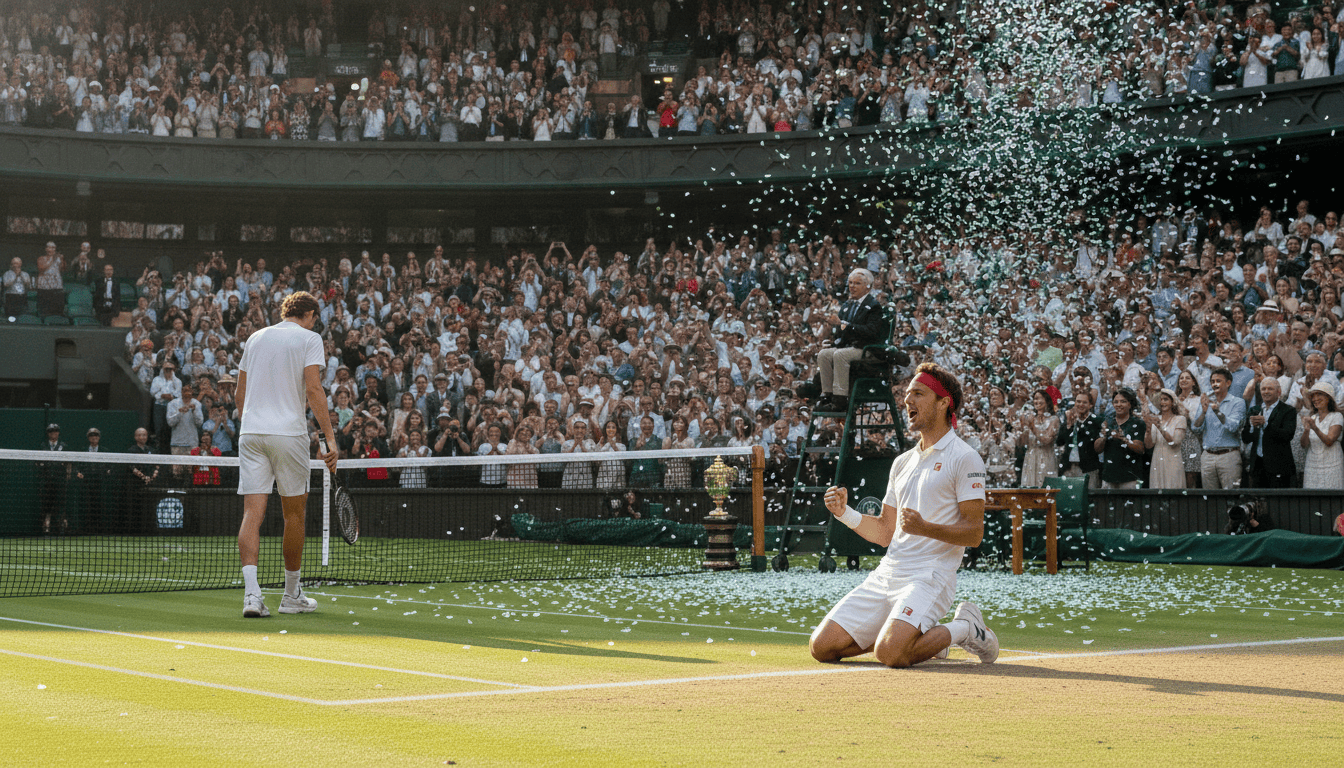
Sinner Clinches Wimbledon Final, Outclasses Zverev to Retain Title
Jannik Sinner defeated Alexander Zverev in a four-set Wimbledon final to retain the championship, underscoring his dominance on grass and his status as world No.1.
Jannik Sinner confirmed his hold on Wimbledon by beating Alexander Zverev in a high-quality, four-set final at the All England Club. The win hands Sinner consecutive Wimbledon titles and extends a season in which he has established himself as the leading player on multiple surfaces. Zverev, who carried the confidence of a recent Grand Slam victory earlier this year, pushed the match deep before Sinner found the extra gear that decided the contest.
Match summary and result
Sinner’s victory in the Wimbledon final came after a tense opening phase in which Zverev captured early momentum. Sinner responded by raising his level in the middle stages and sustained pressure with a combination of heavy serving and precise groundstrokes. The match lasted close to four hours, testing both players’ physical endurance and tactical resilience.
Officials and commentators noted Sinner’s capacity to shift tempo under pressure, a trait that proved decisive in turning a tight contest into a championship-clinching performance. Zverev left the court having produced moments of brilliance but ultimately unable to prevent Sinner from closing out the match.
Key turning points and statistics
The contest featured several pivotal sequences in which Sinner seized the initiative, particularly on return games and in extended baseline rallies. Observers highlighted a string of aggressive returns and forehand winners that broke Zverev’s rhythm at crucial junctures. Those exchanges tilted the scoreboard and opened opportunities for Sinner to serve out the match.
Statistical patterns reinforced the narrative of Sinner’s control: his first-serve percentage and break-point conversions during the middle sets proved decisive. While both players produced powerful serving performances, Sinner’s greater consistency on second-serve returns and fewer unforced errors in pressure moments separated the winner from the runner-up.
Zverev’s performance and post-match reaction
Alexander Zverev entered the final carrying the momentum of a recent major title and matched Sinner with intense shot-making and tactical variety. He won the opening set and staged sustained resistance during long rallies, demonstrating why he remains a major force in the men’s game. Zverev’s court movement and baseline aggression yielded passages of high-quality tennis that tested the world No.1 throughout the encounter.
After the match, Zverev acknowledged the narrow margins that decided the outcome and praised Sinner’s ability to lift his level when required. Team members and coaches noted positives in Zverev’s game that point to further contention at the biggest events, even as he reflected on missed chances in the final.
International reaction and media commentary
Coverage from outlets across Europe framed the result within a broader narrative of Sinner’s ascent and the evolving men’s rivalry landscape. Commentators in Italy hailed Sinner as a back-to-back Wimbledon champion and celebrated the victory as confirmation of his elite status on grass. British and French commentators emphasized the clinical nature of his late-match play and the physical and tactical demands of the final.
Comparisons to peers, including references to Carlos Alcaraz’s established major haul, surfaced in multiple reports, with analysts noting that Sinner’s blend of precision, power and creativity is rapidly reshaping expectations. Media reaction also underscored the significance of Sinner defending a title without extensive grass-court preparation, a feat that some outlets described as a hallmark of the modern elite.
Implications for the season and rankings
Sinner’s title defense at Wimbledon consolidates his position at the top of the ATP rankings and reinforces his momentum heading into the remainder of the season. The victory adds a major grass-court result to a calendar that already featured success on other surfaces, sharpening Sinner’s status as a genuine all-court contender. For Zverev, the final provides clear takeaways for adjustments and an affirmation that he remains a central challenger at Grand Slam events.
Tournament directors and ATP officials signaled that the final—both for its competitive quality and the endurance shown by the players—will be regarded as one of the more compelling championship matches in recent editions. The result also recalibrates expectations for upcoming lead-in events to the US hard-court swing and the late-season majors.
Jannik Sinner’s triumph in the Wimbledon final deepens a rivalry among the sport’s youngest elite and reinforces a narrative of transition at the top of men’s tennis. As Sinner adds another Grand Slam to his résumé and Zverev plots a response, the sport enters a period defined by tightly contested majors, tactical evolution and rising stars asserting themselves on the biggest stages.
