
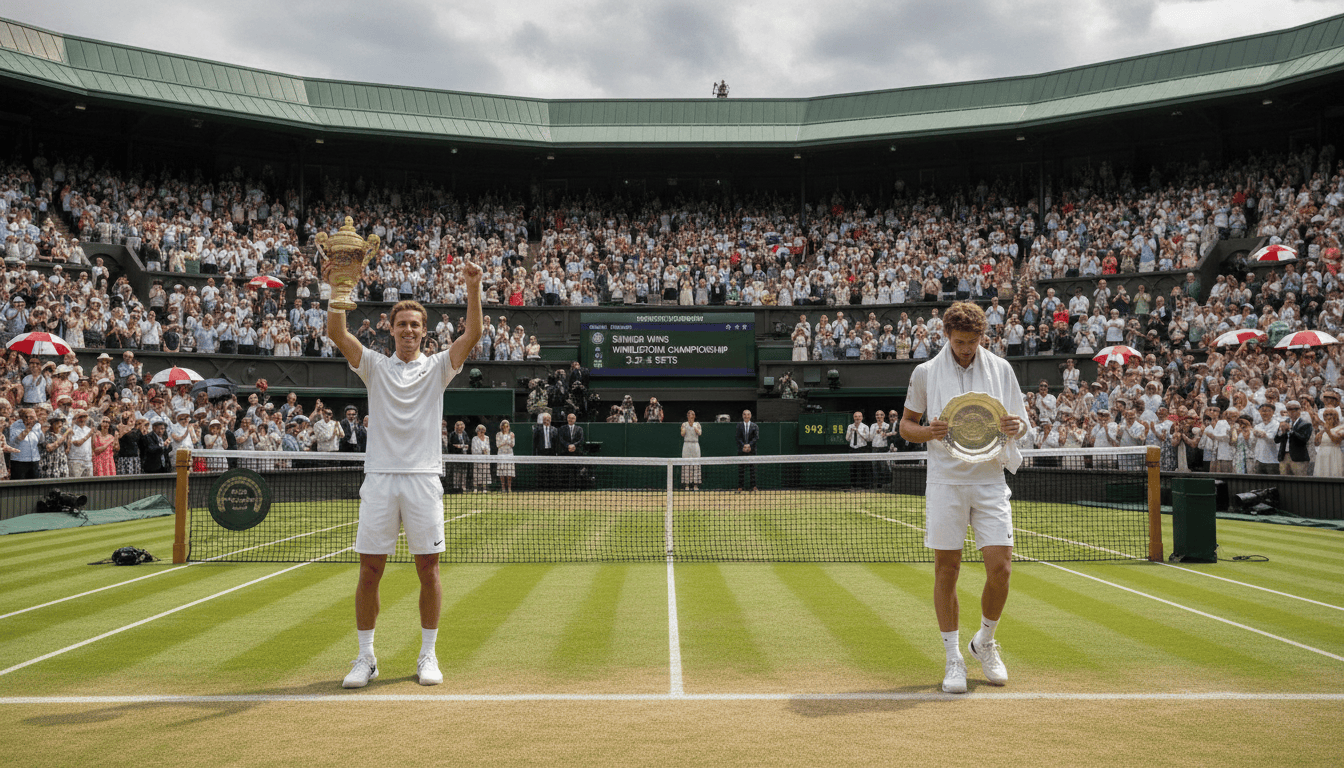
Zverev Wimbledon final: Sinner defends title in four-set Centre Court defeat
Zverev Wimbledon final — Alexander Zverev pushed Jannik Sinner to four sets but lost 7-6 (9-7), 6-7 (2-7), 3-6, 4-6 in a high-quality Centre Court final that showcased tactical shifts and a serving duel. The German, freshly crowned at Roland Garros, arrived in London with renewed confidence and an aggressive game plan that matched the world No. 1 for long stretches. Despite the loss, Zverev’s performance underlined his status as a consistent Grand Slam contender and left clear markers for his immediate future.
Zverev challenges Sinner in tightly contested final
Alexander Zverev began the match using an aggressive baseline approach that put Jannik Sinner under pressure from the first ball. The opening two sets produced two tiebreaks, reflecting how closely matched the players were on grass across service games. Zverev claimed the first set tiebreak before an error-prone second set swung back to Sinner, setting the tone for a momentum shift in the latter stages.
Aggressive tactical shift on grass pays dividends
Throughout the tournament Zverev adopted a more offensive style, taking the ball earlier and shortening points to suit the faster, lower-bouncing grass courts. That adjustment was evident in his heavier, flatter forehand and the frequent use of short balls to finish points. The strategy allowed him to neutralize some of Sinner’s baseline rhythm and to generate opportunities he had lacked in previous Grand Slam finals.
Serving duel decides many key moments
Service performance proved decisive, with Zverev landing an exceptional first-serve percentage and Sinner converting a higher share of points when his first delivery landed. Zverev produced the harder serves at times, reaching a top speed near 224 km/h, and finished with a slight edge in aces. Nevertheless, Sinner’s precision and ability to extract points on return in critical moments ultimately made the difference.
Turning points: forehand errors and an on-court slip
Several pivotal sequences shifted the match, most notably a string of forehand mistakes by Zverev in the second-set tiebreak that handed Sinner the momentum. A mid-match tumble by Zverev, when he slipped and grabbed his right knee, also punctuated the contest; the German continued after a short pause but the episode appeared to break his rhythm. Those moments compounded as Sinner secured a break in the fourth set to close out the match after three hours and forty-six minutes.
Sinner’s preparation and title defence underlined
Sinner’s decision to limit his calendar after his Paris exit paid dividends as he arrived in London fresher and ready to defend his crown. He managed crucial points with the poise of a seasoned champion, using accuracy and court positioning to blunt Zverev’s power. By winning this final, Sinner extended his major tally and confirmed his place at the top of the rankings with another Grand Slam success.
Implications for Zverev and German men’s tennis
For Zverev, the loss extends a series of near-misses at Wimbledon but reinforces his evolution into a more complete competitor on all surfaces. At 29 and already a Roland Garros champion, he insisted to his team that he believes he can capture more majors, signalling continued ambition. The defeat also prolongs Germany’s wait for a men’s singles Wimbledon champion since 1991, but Zverev’s level suggests the country remains represented by a genuine contender.
Zverev’s campaign in London offered a clear roadmap for future improvements: reduce unforced errors in key tiebreak moments and sustain the intensity after physical incidents that disrupt timing. His grass-court form and service improvements will make him a focal point heading into hard-court season and the US Open, where he can convert the lessons from this performance into another run at a major title.
